



The cost of mechanical engineering outsourcing for a US company depends on project scope, engineering complexity, and the number of hours required. There is no single fixed price that applies to every project. A simple CAD drafting task will generally require less engineering time than a complete product engineering program involving design for manufacturing, structural analysis, prototyping, and validation.
This guide breaks down the mechanical engineering outsourcing cost in the US by pricing model, project scope, and the specific factors that push a budget up or down. It also gives you a practical framework for estimating your own project before you compare vendor quotes.
Planning a Mechanical Engineering Project?
Before comparing outsourcing rates, it helps to understand exactly what your product requires—from CAD and mechanical design to DFM, prototyping, and engineering validation. Engon Technologies helps hardware startups build the right engineering scope and choose an approach that fits their product stage and budget.
Explore Mechanical Product Engineering Services for Hardware Startups →
Before comparing outsourcing models or vendor quotes, it is also useful to understand questions to ask a mechanical engineering partner about scope, revisions, ownership and engineering responsibility.
What Does Mechanical Engineering Outsourcing Cost in the US?
There is no single answer to what mechanical engineering outsourcing costs because the number depends on what is included in the scope. Most firms use one of three common models: hourly, project-based, or dedicated FTE-based support. Hourly pricing works well for smaller tasks, quick design changes, or ongoing support where the scope is not fully defined yet. Project-based pricing works better for defined deliverables, such as a complete product design or a manufacturing-ready CAD package, because it gives the client a fixed number to plan around.
FTE-based pricing is suitable for companies that need dedicated engineering capacity over a longer period. Under this model, a company can engage a mechanical engineer or engineering team on a full-time-equivalent basis to work continuously across multiple projects or ongoing engineering tasks. The cost depends on the engineer’s expertise, engagement duration, workload, and required technical skills. Compared with hiring in-house, FTE outsourcing can reduce recruitment, benefits, infrastructure, and other employment-related overheads.
The cost of mechanical engineering outsourcing also varies with the type of firm you choose. A solo freelance designer, a boutique engineering studio, and a full-service outsourced engineering team all price differently because they carry different overhead, offer different levels of expertise, and take on different amounts of project risk. In short, there is no single outsourcing price. The right way to think about cost is not “what is the rate” but “what does this specific project actually require.” A well-scoped project with a clear brief almost always costs less to execute than a vague one, because the engineering team spends less time asking questions and redoing work that was never clearly defined in the first place. The sections below walk through exactly what drives that number.
Understanding Mechanical Engineering Outsourcing Costs by Engagement Type
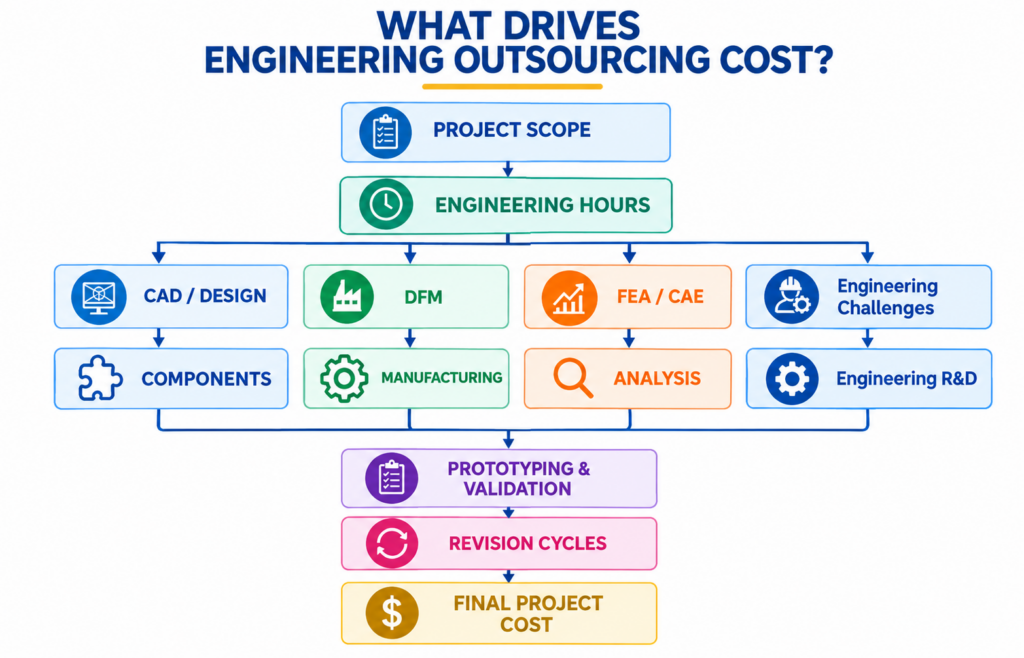
Mechanical engineering outsourcing is difficult to price with one universal rate because projects vary significantly in complexity and scope. A useful way to compare costs is to separate work into broad engagement types rather than treating every engineering task as equivalent.
Because provider rates and project requirements vary, published industry averages should be treated as starting points rather than quotes. For a realistic budget, define the scope first and then estimate the engineering hours, specialist work, prototyping, and revision allowance required for that scope.
Several variables combine to shape any mechanical engineering outsourcing pricing model. Understanding each one helps you scope a project accurately before requesting quotes.
- Engineering complexity: simple parts cost less than parts with complex surface, assemblies or systems with moving components
- Number of engineering hours: this is the single biggest driver of total project cost
- CAD and design requirements: 2D drafting is cheaper than full 3D modeling and detailed drawings
- Product development stage: early concept work carries more uncertainty than a defined final design
- Number of components: more parts mean more design time, more drawings, and more coordination
- Revision cycles: each round of feedback and rework adds hours to the project
- DFM requirements: design for manufacturing review adds engineering time but reduces production risk
- FEA and CAE requirements: structural or thermal analysis requires specialized engineering skills
- Prototyping requirements: physical prototypes need engineering support beyond the digital design
- Documentation and manufacturing support: complete manufacturing packages take longer to prepare than a basic drawing
Mechanical CAD Design vs Complete Product Engineering: What’s the Cost Difference?
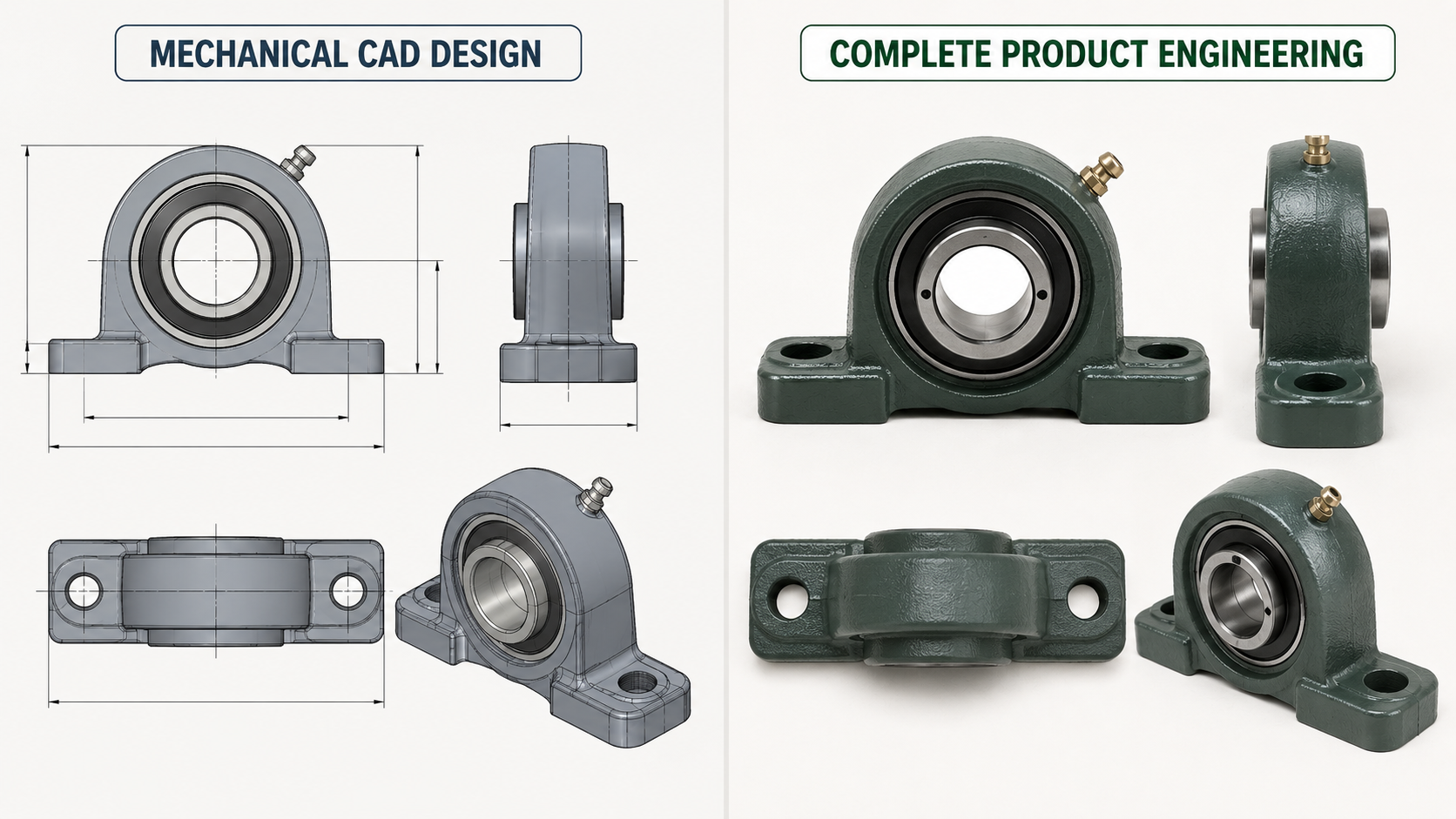
One of the most common points of confusion for US buyers is the difference between paying for CAD drafting and paying for full product engineering. These are not the same service, and the cost gap between them is significant.
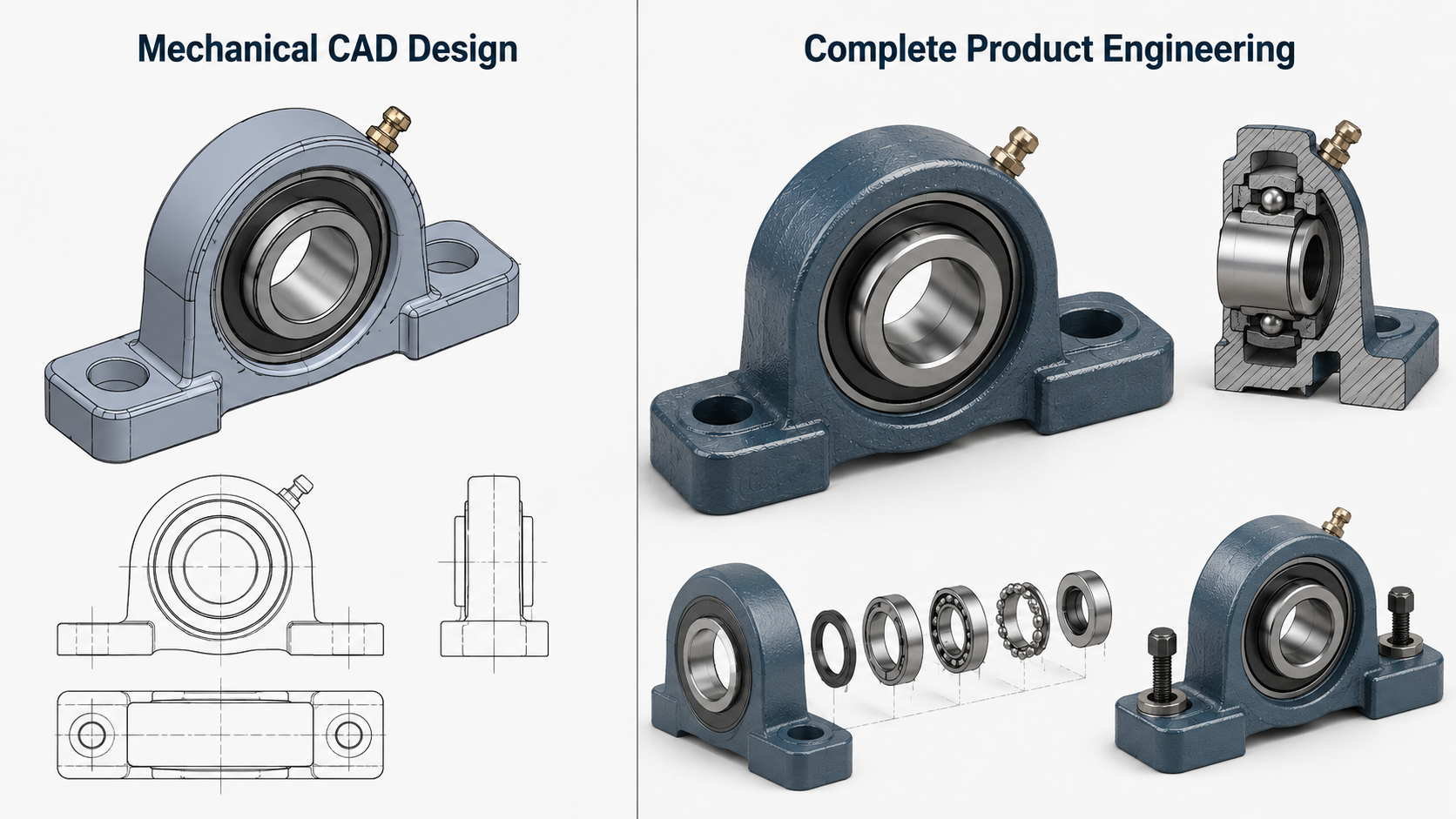
CAD outsourcing typically covers 2D and drafting, basic 3D modeling, individual parts, and engineering drawings based on defined requirements. In this model, the provider is primarily responsible for producing the specified CAD deliverables. Complete product engineering goes further. It may include product development from concept through validation, design for manufacturing and assembly, engineering analysis, prototype support, design iterations, and manufacturing engineering that prepares the design for production.
This broader approach is explained in more detail in our guide to hardware product engineering and how engineering decisions connect concept development, validation and manufacturing readiness.
If your project only needs drawings for an existing design, CAD-level pricing applies. If your project needs a product built from the ground up and validated for manufacturing and designed with all stakeholders, the scope moves into full product engineering, and the budget should reflect that broader responsibility.
Need More Than CAD Support?
If your hardware startup needs more than drawings or 3D models, the right engineering partner can support the product through design, DFM, prototyping, validation, and manufacturing readiness. Engon Technologies provides mechanical product engineering support for hardware startups in the US and Europe, helping teams move from product requirements to production-ready designs.
Explore Mechanical Product Engineering Support for Hardware Startups →
Project-Based vs Dedicated Mechanical Engineering Support
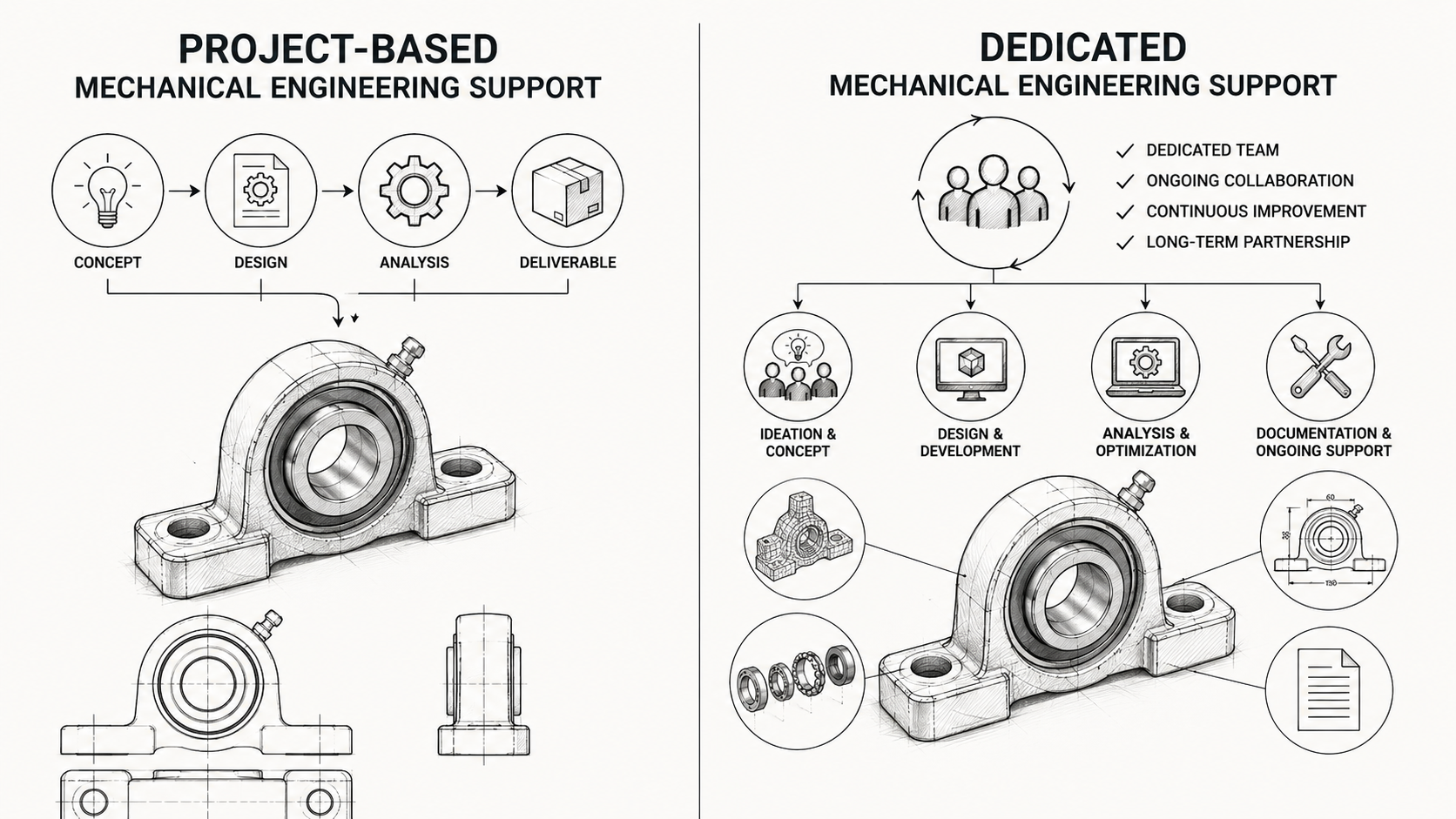
US companies generally choose between two outsourcing structures, and each affects total project cost differently.
Project-based outsourcing makes sense when you have a defined deliverable, such as a new part design or a manufacturing-ready drawing package. It gives you a fixed scope and a fixed cost, but it works best when requirements are already clear.
Dedicated engineering(Full time equivalent) support makes sense when you need ongoing capacity, such as a mechanical engineer working alongside your team across multiple projects over several months. This model costs less in total but gives you flexibility, faster turnaround on new requests, and continuity across a longer engineering roadmap.
Each model has limitations. Project-based work can become expensive if scope changes mid-project. Dedicated support works well with more work. The right choice depends on how predictable your engineering workload is.
Example: CAD Drafting vs Full Product Engineering
Imagine a US manufacturing company already has a product concept.
CAD Drafting Project
- Convert sketches into 3D CAD models.
- Create 2D manufacturing drawings.
- Update dimensions or existing assemblies.
Complete Product Engineering Project
- Develop the product from concept to production-ready design.
- Perform design reviews and engineering analysis.
- Apply Design for Manufacturing (DFM).
- Support prototyping and design validation.
- Prepare manufacturing documentation for production.
How Engineering Complexity Affects Outsourcing Cost
Complexity is one of the clearest drivers of price, and it helps to think of it as a spectrum rather than a single category.
- Basic mechanical components: simple, single part designs with few constraints
- Assemblies: multiple parts that must fit and function together
- Industrial equipment: larger systems with structural, electrical, and mechanical interfaces
- Enclosures: parts that must protect internal components while meeting size and cost targets
- Standards and regulations: Compliance with industry-specific standards and regulations can increase outsourcing costs by requiring additional expertise, testing, documentation, and certification.
- Precision components: tight tolerances that demand more design and review time
- Mechanisms: moving parts that require motion analysis and careful tolerancing
- Products requiring thermal or structural analysis: the most engineering intensive category
As a project moves down this list, expect both the engineering hours and the required expertise to increase, which raises total cost.
How Many Engineering Hours Does Your Project Actually Need?
This is often the most useful question a US buyer can ask, because engineering hours, not the hourly rate alone, drive the majority of total project cost.
A practical way to estimate hours is to walk through the project in stages: project scope, then engineering activities required for that scope, then an estimate of hours for each activity, then an allowance for revisions, then validation work, and finally the hours needed to prepare final deliverables.
Mapping the project this way, before requesting quotes, gives you a realistic budget range and makes it much easier to compare proposals from different outsourcing partners on an apples-to-apples basis.
Example: Estimating Engineering Hours for a Consumer IoT Enclosure
A US startup developing a plastic IoT enclosure may need engineering support across multiple stages instead of a single CAD task.
| Engineering activity | Typical effort |
| Industrial Design | Initial concept design and enclosure architecture. |
| System Integration | Coordination of electronics, PCB, battery, sensors, connectors, and other internal components within the enclosure to ensure proper fit, access, and overall product functionality. |
| 3D CAD modeling | Detailed enclosure design and internal component integration. |
| DFM review | Injection moulding design optimization before tooling. For injection-moulded enclosures, these DFM decisions can have a significant effect on tooling and manufacturing costs. See our guide to DFM techniques for reducing IoT enclosure manufacturing costs. |
| Engineering revisions | Changes based on client feedback and manufacturing review. |
| Manufacturing documentation | Production-ready drawings and documentation package. |
Instead of estimating cost from an hourly rate alone, companies should estimate the engineering effort required for each phase of development.
Required Competency and Experience
The competency and experience of the engineering team can have a significant impact on mechanical engineering outsourcing costs. A project that requires basic CAD modeling can often be handled by a designer with general drafting experience, while complex product development may require senior mechanical engineers with specialized knowledge in areas such as manufacturing, materials, simulation, tolerancing, or regulatory requirements.
When evaluating an outsourcing partner, consider the level of expertise the project actually requires:
- CAD proficiency: Experience with tools such as SolidWorks, AutoCAD, CATIA, Creo, or similar platforms may be essential depending on the project.
- Mechanical design experience: Engineers should understand component design, assemblies, mechanisms, materials, tolerances, and design constraints.
- Manufacturing knowledge: Experience with CNC machining, sheet metal, injection molding, casting, or other relevant processes helps ensure that designs are practical to manufacture.
- Engineering analysis: Projects involving structural, thermal, vibration, or other simulations may require engineers with FEA or CAE experience.
- Industry experience: Products used in automotive, industrial equipment, medical devices, consumer electronics, or other regulated industries may require specialized knowledge.
- Design standards and documentation: Experienced engineers can work with applicable standards, GD&T, engineering drawings, BOMs, and manufacturing documentation.
- Project experience: A team that has handled similar products or engineering challenges may identify potential problems earlier and reduce costly redesigns.
Higher-level expertise can increase the hourly or project rate, but it may also reduce the total number of engineering hours required. An experienced engineer can often make better design decisions earlier, identify manufacturing constraints before prototyping, and minimize unnecessary revisions. A structured design review can help identify these issues before they become expensive downstream changes.
For this reason, US companies should evaluate total project value and expected engineering effort, rather than selecting an outsourcing partner based solely on the lowest hourly rate.
How DFM, FEA, and Prototyping Affect Engineering Costs
Three specialized services tend to add the most cost on top of baseline design work, and each one exists to reduce risk later in the project.
Design for manufacturing review varies by process. Injection molding DFM looks at wall thickness, draft angles, and tooling constraints, all of which can affect injection mold tooling costs.. Sheet metal DFM looks at bend radii and material thickness. CNC manufacturing considerations focus on tool access and achievable tolerances. Each process requires a different type of manufacturing knowledge.
FEA and CAE analyses add engineering time because it requires simulation setup, load case definition, and interpretation of results, usually by a more specialized engineer.
Prototype development and design validation can add further cost because they introduce iteration between the digital design and a physical build. The exact requirement depends on the product, risk level, manufacturing process, and validation objectives.
Why the Lowest Engineering Hourly Rate May Not Be the Lowest Project Cost
A low hourly rate can be misleading. The real driver of budget overruns is not the rate itself but everything that adds hours after the project starts.
- Rework caused by an unclear initial design
- Poor documentation that has to be corrected later
- Communication gaps that slow decisions and create misunderstandings
- Excessive revisions beyond what was scoped
- Manufacturing errors discovered after tooling has already started
- Missed requirements that surface late in the project
- Additional engineering supervision needed to catch mistakes
- Delayed prototypes that push back the entire product timeline
Many of these downstream costs can be influenced by decisions made during product development, including how components are designed for assembly and manufacturing. See our guide to reducing assembly time and manufacturing costs.
A partner with a higher rate but a disciplined process often costs less overall than a cheaper partner whose mistakes add hours you did not budget for. When you compare quotes, weigh the process and track record behind the rate, not just the number on the page.
Example: Comparing Two Outsourcing Quotes
A US hardware company receives two outsourcing proposals for the same enclosure design project.
| Vendor A | Vendor B | |
| Engineering scope | Basic CAD design only. | CAD design + DFM review + manufacturing documentation. |
| Revision process | Additional revisions billed separately. | Defined revision cycle included in scope. |
| Manufacturing readiness | Limited production support. | Production-ready documentation included. |
Even if Vendor A has a lower hourly rate, Vendor B may reduce overall project cost by minimizing rework and improving manufacturing readiness.
How US Companies Can Estimate Their Mechanical Engineering Outsourcing Budget
A simple framework can help you build a realistic starting budget before you request formal quotes.
Estimated Cost = Engineering Hours × Rate + Specialized Engineering + Prototyping + Revisions + Additional Project Costs
This formula will not give you an exact figure without a defined scope, but it forces you to account for every category that typically gets left out of a rough budget, where most cost surprises come from.
Questions to Ask a Mechanical Engineering Outsourcing Partner Before Comparing Quotes
Vendor quotes are only comparable if the scope behind each one is comparable. Ask these questions before you evaluate the price.
- What is included in the quoted engineering hours?
- How many revisions are included?
- Is DFM included in the quote?
- Is engineering validation included?
- Who owns the CAD files and the intellectual property?
- How are engineering changes handled once work has started?
- What happens when project scope changes midway through?
- Who communicates directly with manufacturing vendors?
How to Get an Accurate Mechanical Engineering Outsourcing Cost Estimate
The most reliable way to price a project is to have an experienced outsourced mechanical engineering team review your actual requirements, not a generic rate card. Scope, complexity, and manufacturing goals all shape the real number, and a short scoping conversation usually gets you a far more accurate estimate than any published hourly rate. Before comparing estimates, it is also useful to understand how global mechanical design partnerships can affect engineering capacity, project economics and overall ROI.
That conversation should walk through your product stage, your target manufacturing process, and how many revisions you expect to need, so the estimate reflects your project rather than an industry average that may not apply to you.
Pricing Comparison by Service
| Service | Typical Scope | Main Cost Drivers |
| CAD drafting | 2D and 3D documentation | Drawing complexity, revisions |
| Mechanical design | Components and assemblies | Complexity, engineering hours |
| Product engineering | Full product development | Scope, validation, iterations |
| DFM | Manufacturing optimization | Manufacturing process, design complexity |
| FEA / CAE | Engineering analysis | Model complexity, load cases |
| Tool Engineering | Design and Engineering | Complexity of the part |
| Prototype support | Prototype-ready engineering | Materials, process, iterations |
| Dedicated Engineering (FTE) | Ongoing engineering support from a dedicated resource | Engineer expertise, engagement duration, workload, and required capacity |