
Why This Decision Is Difficult for Hardware Startups

Software startups can scale engineering headcount up and down with relative ease. Hardware startups cannot. A hardware product has to move through physical design, prototyping, testing, and manufacturing, and the skills required at each stage are not identical. The mechanical design work needed to build a first prototype looks very different from the design-for-manufacturing work needed to build the thousandth unit.
This creates a few structural problems that software companies rarely face:
- Engineering requirements shift significantly as a product moves from concept to prototype to production.
- Different stages need different specialists, not just more of the same specialist.
- Workload is rarely constant. A mechanical engineer might be essential for four months and underused for the next four.
- Manufacturing introduces requirements, tolerances, materials, and supplier constraints that a generalist engineer may not have deep experience with.
- Runway is limited, and hiring takes time you may not have.
- One engineer, however capable, cannot cover mechanical design, industrial design, electronics, and manufacturing engineering simultaneously.
The key message is simple: a startup does not need to build every engineering capability internally from day one. The decision is not “hire or don’t hire.” It is “What is the right way to access the capability we need, right now, at this stage of the product?”
What Does a Mechanical Engineer Actually Do for a Hardware Startup?
Before deciding how to access mechanical engineering capacity, it helps to be precise about what the role actually covers. A mechanical engineer working on a hardware product is typically responsible for:
- Mechanical architecture and system-level layout
- Mechanical design and 3D CAD
- Component and assembly design
- Enclosure design
- FEA Simulation and Design Validation
- Material selection
- Tolerance analysis
- Tool Design and Engineering Support
- Engineering drawings and documentation
- Prototyping and design validation
- Design for manufacturing (DFM)
- Communication with manufacturing partners
- Managing design revisions as feedback comes in from testing or suppliers
Here is the distinction that matters most for this decision: hiring one mechanical engineer does not automatically give you a complete product engineering capability. A physical product often needs industrial design, electronics, embedded systems, simulation or CAE, testing, and manufacturing engineering alongside the core mechanical work. A single hire covers one piece of that puzzle. That gap is exactly why outsourcing or a hybrid model becomes relevant for many startups, even ones that eventually plan to hire internally.
When Should a Hardware Startup Hire an In-House Mechanical Engineer?
Hiring makes the most sense when mechanical engineering is going to be a permanent, ongoing part of how your company operates, not just a one-time push to get a product built.
Mechanical Engineering Is a Core Long-Term Capability
If mechanical design and iteration will remain a continuous part of your business for years, not months, an internal hire starts to make financial and strategic sense. You are not paying for a project. You are building a competency the company will rely on indefinitely.
You Have a Consistent Engineering Workload
A consistent engineering workload can make either a full-time hire or an ongoing outsourcing partnership a practical option. A steady backlog of design changes, new SKUs, or product variants may justify an in-house engineer, particularly when deep product knowledge and daily internal collaboration are important.
However, outsourcing can also be economically attractive when a company needs ongoing engineering capacity without building or expanding its permanent team. An engineering partner can provide continued support, access to specialized expertise, and flexibility as requirements evolve.
The right choice depends on the total cost of each model, the capabilities required, the level of internal collaboration needed, and the long-term engineering workload.
You Need Deep Internal Product Knowledge
An internal engineer accumulates institutional knowledge that is hard to replicate externally: why a decision was made eighteen months ago, how a specific customer complaint shaped a tolerance, what failed in testing and why. That accumulated context has real value for products with long lifecycles and frequent iteration.
You Plan to Build a Larger Engineering Organization
If your roadmap includes building an internal engineering team of five, ten, or twenty people, an early mechanical engineering hire can become the foundation of that team, not just a solo contributor.
Product Development Requires Daily Internal Collaboration
Some products need engineering decisions made in real time, side by side with electronics, firmware, manufacturing, and operations teams. If your development cadence genuinely requires that level of daily, in-person coordination, an internal hire removes friction that a remote or external arrangement would introduce.
Engineering Scenario: Multiple Products, Continuous Engineering Work
A hardware company has several products in development and production, with regular design changes and supplier coordination.
Engineering Insight: Continuous mechanical work allows an in-house engineer to build valuable product and manufacturing knowledge.
Validation: A steady workload across multiple products supports the case for hiring, while external specialists can provide niche expertise when needed.
Key Takeaway: For continuous mechanical engineering needs, an in-house engineer can provide stronger long-term value, with external support added when required.
When Does Outsourcing Product Engineering Make More Sense?
Outsourced product engineering tends to make sense when a startup needs real engineering capability without committing to permanent headcount before it is justified.
You Need Expertise Before You Need a Full-Time Hire
A common scenario: a startup needs six months of intensive mechanical engineering work to get a product to a manufacturable state, but does not have enough ongoing mechanical work afterward to justify a permanent position. Outsourcing lets you access that expertise for exactly as long as you need it.
You Need Multiple Engineering Capabilities
A product development partner for startups can often provide access to several disciplines, mechanical design, DFM, sometimes industrial design or manufacturing engineering, depending on the partner’s own team. That range is difficult to replicate with a single internal hire.
Cost leverage Without Permanent Headcount
Outsourcing product engineering gives hardware startups access to mechanical design, CAD, design validation, and manufacturing-readiness expertise without the commitment of permanent hires.
It offers flexibility to scale support as workloads change, while ongoing partnerships can also suit companies with sustained engineering needs.
Compare total costs, including salaries, benefits, software, management, partner fees, and potential rework, to determine which model offers better value.
You Need to Accelerate Development
If you are facing a fundraising milestone, a customer pilot deadline, or a trade show, and internal hiring would take three to six months you do not have, an established engineering partner can typically start sooner because the team already exists.
Your Engineering Workload Is Project-Based
This is especially common at the earliest stages, when a startup is still validating the product and does not yet know what its long-term engineering needs will look like.
You Need Prototype-to-Production Support
Many startups arrive with a working prototype but need help closing the gap to a manufacturable product: design refinement, DFM, tolerance work, documentation, and manufacturing readiness. This is a well-defined, project-shaped need that outsourcing is particularly well suited to.
Engineering Scenario: Prototype Ready, Manufacturing Is Next
A startup has a functional prototype but needs enclosure refinement, tolerance work, DFM, and manufacturing documentation before production.
Engineering Insight: These tasks require focused engineering support but may not justify a permanent hire.
Validation: If the work is concentrated in a six-month production phase, outsourcing can provide the needed expertise while the startup retains product strategy and final decisions.
Key Takeaway: For a defined production phase, a product engineering partner can provide focused support without adding permanent headcount.
You Want to Preserve Internal Focus
Outsourcing lets a founder or CTO retain ownership of product strategy and decision-making while handing off clearly scoped engineering execution to specialists, rather than spending months managing a hiring process.
Hiring One Mechanical Engineer vs. Working With a Product Engineering Team
Requirement | In-House Mechanical Engineer | Product Engineering Partner |
Mechanical CAD | Yes | Yes |
Mechanical design | Yes | Yes |
Broader product engineering | Depends on experience | Access to additional engineering disciplines, depending on the partner’s capabilities |
DFM | Depends on experience | Available when included in the partner’s services |
Multiple specialists | Limited | Potentially available |
Hiring time | Required | Usually avoided |
Long-term internal knowledge | Strong | Must be documented and shared |
Project-based capacity | Less flexible | More flexible |
Scaling engineering capacity | Hiring required | Potentially faster |
Internal product ownership | Strong | Requires clear collaboration |
Cost benefits | Predictable salary costs, but includes employment and infrastructure overhead | Flexible project or retainer costs, but includes partner fees and coordination costs |
Not every external partner offers every capability listed above. The table is a starting point for the questions you should be asking a candidate partner, not a guarantee of what any given firm provides.
The Real Cost of Hiring Goes Beyond Salary
Salary is only one line item in the true cost of an internal engineering hire. A fuller accounting includes benefits, recruiting fees, onboarding time, engineering software licenses, workstation hardware, management overhead, training, and office infrastructure. It also includes the quieter cost of downtime between projects, the weeks when a highly paid specialist has no mechanical work that actually needs their skill set.
Outsourced engineering has its own cost structure: project or retainer fees, the time your team spends managing and communicating with the partner, the cost of scope changes, the effort of selecting the right partner, and the risk of rework if requirements were not well defined upfront.
Beyond these expenses, startups should compare the cost of outsourced mechanical design with the total cost of hiring an in-house mechanical engineer to understand the financial trade-offs between the two models.
Neither model is automatically cheaper. The real question is which model provides the right amount of engineering capacity for your current stage and workload, not which one has a lower headline number.
The Hidden Cost of Hiring Too Early
Consider a startup that hires a full-time mechanical engineer before its product requirements have stabilized. Then the product direction changes. The engineering workload changes with it. New disciplines turn out to be needed that the engineer does not have. The engineer becomes underutilized on the work they were hired for, while the startup still has to bring in external specialists for everything else. Runway shrinks in the meantime.
Before committing to a permanent engineering team, startups can explore how to build a cost-effective hardware MVP without over-engineering and align engineering investment with the product’s current stage.
The lesson is not that hiring is a mistake. It is that hiring should match actual, demonstrated long-term engineering demand, not anticipated demand that has not yet materialized.
The Hidden Risks of Outsourcing Too Much
Outsourcing carries its own failure modes, and a fair guide has to name them. Common risks include loss of internal product knowledge, communication gaps, intellectual property concerns, poor or incomplete documentation, dependency on a single vendor, a diminished sense of product ownership inside the company, a partner that requires constant supervision to stay aligned, misalignment with product goals, weak manufacturing understanding, and difficulty managing design revisions cleanly.
Before transferring critical engineering tasks to an external partner, startups should understand the common risks of engineering outsourcing and establish clear processes to manage them.
Outsourcing tends to work well when a startup brings clear requirements, defined deliverables, strong and regular communication, clear internal ownership of decisions, solid IP and confidentiality agreements, and a designated project manager or product owner on the startup’s side. Skip any of those and even a capable partner will struggle to deliver good results.
When a Hybrid Engineering Model Makes the Most Sense
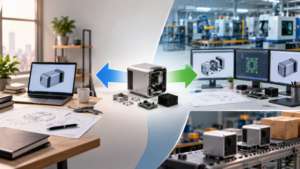
A hybrid model keeps product strategy, requirements, and final decisions internal, while routing defined engineering execution, mechanical design, CAD, DFM, prototyping support, to an external partner. The structure typically looks like this:
Founder or CTO owns product strategy, requirements, and final decisions, and works with an external engineering partner who handles mechanical design, CAD, DFM, prototyping, and engineering support within that strategy.
This model tends to be a good fit when a startup has a CTO but limited mechanical expertise, has electronics or firmware capability but no mechanical engineering, is still working through evolving product requirements, has an engineering workload that fluctuates significantly month to month, needs specialist support specifically for manufacturing, or expects to build an internal team eventually but is not there yet.
A hybrid approach can also help teams assess whether their product is ready for mass production before scaling production
Engineering Scenario: CTO-Led Startup With Limited Mechanical Expertise
A startup has an experienced CTO and strong electronics capability but no dedicated mechanical engineer. An external engineering team handles mechanical design, CAD, DFM, prototyping, and manufacturing support while the CTO retains product and technical decisions.
Engineering Insight: Outsourcing fills a specific capability gap without requiring an immediate full-time hire.
Validation:If mechanical engineering requirements become sustained and justify permanent internal capacity, the startup can build an in-house team while continuing to use external specialists for additional capabilities or workload peaks.
Key Takeaway: Outsourcing works well when a startup needs mechanical expertise but does not yet have enough ongoing work to justify a a dedicated in-house hire.
Which Engineering Model Is Right for Your Startup?
Startup Situation | Potentially Best Model |
No engineering team yet | Outsourced product engineering |
Founder has strong engineering expertise | Hybrid |
One short-term mechanical project | Outsource |
Continuous mechanical workload | Hire |
Multiple engineering disciplines required | Outsource or hybrid |
Prototype needs productionization | Product engineering partner |
Rapid development deadline | Outsource or hybrid |
Multiple products being developed | Internal plus external |
Established engineering organization | Internal plus specialist partners |
Treat this as a starting point rather than a rule. The right model for your startup may combine elements of more than one row, depending on how your product and team evolve.
Questions Founders Should Ask Before Hiring or Outsourcing
- How much engineering work will we actually need over the next 12 to 24 months?
- Is that workload continuous or project-based?
- What engineering capabilities are we missing internally right now?
- Do we need one specialist, or several disciplines at once?
- What stage is our product currently in?
- Are we still validating the product, or preparing for manufacturing?
- How quickly do we need engineering support in place?
- Who inside the company will manage the engineering work day to day?
- How important is deep internal product knowledge for this particular product?
- What are our next major product milestones, and what do they require?
- What should stay in-house no matter what?
- What is genuinely better suited to an external partner?
- What deliverables do we actually need at the end of this, CAD, drawings, a BOM, a manufacturable design?
How to Evaluate a Product Engineering Partner
If outsourcing or a hybrid model looks like the right direction, the partner you choose matters as much as the decision itself. Evaluate candidates against these criteria:
- Relevant hardware experience. Look for a track record with products of similar complexity to yours, not just adjacent industries.
- Mechanical engineering capability. Confirm the partner can actually perform engineering work, not only produce CAD drawings from a spec you hand them.
- Manufacturing knowledge. A good partner understands how a design actually moves toward production, not just how it looks in a 3D model.
- DFM capability. The partner should be able to catch manufacturing-related design issues before they become expensive problems on the factory floor.
- Prototyping experience. Ask specifically how they support iteration during prototyping, not just the final handoff.
- Documentation. Confirm they will provide CAD files, drawings, a BOM, specifications, engineering documentation, and clear revision history, not just a finished-looking model.
- Communication. This matters even more when you are working across time zones or with a distributed team.
- IP and confidentiality. Get clarity upfront on ownership of CAD files and deliverables, confidentiality terms, and how your data is handled.
- Project management. Understand who owns requirements, milestones, revisions, and day-to-day communication on the partner’s side.
- Evidence. Ask for relevant case studies, examples of past engineering work, and client references where the partner can share them.
Example: When Outsourcing May Be Better Than Hiring
Consider a hypothetical US hardware startup building an early IoT device. The founder is a technical CTO with strong electronics and firmware capability, an early working prototype, and real customer interest. What the team lacks is mechanical engineering: enclosure development, DFM, and manufacturing preparation.
Rather than hiring several specialists at once, this company could engage a product engineering partner to handle the mechanical and productization work while the internal team stays focused on electronics, firmware, and customers. Once mechanical engineering becomes a continuous, ongoing workload, the company would be in a better position to justify building that capability internally.
Example: When Hiring an In-House Mechanical Engineer May Be Better
Now consider a hypothetical hardware company with multiple products, continuous mechanical design work, regular engineering changes, ongoing internal manufacturing coordination, and a long-term product roadmap. Here, a full-time mechanical engineer is likely to provide stronger long-term value, since the workload is steady and the internal knowledge that builds up over time becomes genuinely valuable. This company could still use external partners for specialized work or short-term capacity spikes, without that changing the case for a core internal hire.