

June 2026

Overengineering Structural Features

10 Design Mistakes That Increase Injection Mold Tooling Costs and How to Avoid Them

Tooling is one of the largest upfront investments in any injection-molded product. For most projects, the mould itself represents 30 to 60 percent of total product development cost, and those numbers can climb fast when the design is not built with manufacturability in mind. The frustrating reality is that most tooling cost overruns are not caused by poor supplier selection or unexpected material prices. They are locked in during the design phase, often weeks or months before a purchase order is issued. This guide walks through ten design decisions that consistently drive up injection mold tooling costs, along with practical strategies engineers and product teams can use to avoid them. Each section includes a real-world case study to show how the principles apply in practice. 1. Designing Features That Require Side Actions, Sliders, and Lifters What Are Side Actions, Sliders, and Lifters? Side actions in injection molding are mechanical mechanisms built into a mold to form features that cannot be released by opening the mold along its primary axis. Sliders move horizontally to create external undercuts such as lateral holes or recesses, while lifters in injection molds move at an angle to release internal undercut features during part ejection. Both add significant mechanical complexity to the tool. How Undercuts Drive Up Mold Complexity and Cost Every undercut design feature in a design requires a corresponding mechanism in the mold. Each mechanism adds machined components, wear surfaces, cooling considerations, and assembly points. A simple two-plate mold with no side actions can be designed, machined, and assembled in a fraction of the time a mold with four or five mechanisms requires. Beyond initial build cost, mechanisms increase long-term maintenance frequency and the likelihood of production downtime. The cost impact of mold complexity caused by side actions is significant. Industry estimates suggest each additional side action can add 8 to 15 percent to total tooling cost depending on the mechanism size and accessibility within the tool. For a baseline mold in the $40,000 to $80,000 range, three or four side actions can translate to an additional $15,000 to $30,000 in tooling investment before production begins. Design Alternatives and DFM Strategies The most effective way to control mold construction cost is to eliminate undercuts during the design phase through geometry modification. Repositioning holes to align with the draw direction, splitting features across two mold halves, or adding draft to recessed areas can often remove the need for mechanisms entirely. When side actions are unavoidable because functional requirements demand the feature, toolmakers should be consulted early to select the lowest-complexity mechanism that satisfies the design intent. DFM reviews that focus specifically on injection mold tooling costs will flag every potential side action before mold design begins, giving engineering teams the option to simplify while design changes are still inexpensive.   Case Study: Smart Home Controller EnclosureA smart home device manufacturer designed a plastic enclosure with multiple side openings for cable routing and mounting features. The initial design required four side actions and two lifters, significantly increasing mold complexity and tooling costs. During a DFM review, the enclosure geometry was modified to avoid many undercuts and reposition critical features. The revised design reduced the number of side actions required, simplified mold construction, and shortened tooling lead times. The company moved into production faster while avoiding unnecessary tooling investment.   2. Creating Intricate Geometries That Increase Mold Complexity What Makes a Geometry Difficult to Mold? Not all complex shapes present the same challenges. The geometries that consistently drive up machining time and tooling cost share a few common characteristics: deep, narrow ribs that are difficult to reach with standard cutters, sharp inside corners that require EDM rather than CNC machining, organic contours that require extensive hand polishing, and sections where wall thickness varies dramatically across a single surface. Deep ribs below a width-to-depth ratio of 1:3 create significant access limitations for milling tools. Cutting these features typically requires small-diameter end mills running at slow feed rates with multiple passes, or EDM operations that add days to the machining schedule. Either way, the cost per feature rises sharply compared to a part with open, accessible geometry. Impact on Cycle Time and Production Cost Intricate geometries do not just increase tooling cost during fabrication. They affect cycle time in production as well. Thin walls in isolated areas of an otherwise thick part create uneven cooling, forcing longer cycle times or introducing warping and sink marks that require secondary processing. Every second added to the production cycle multiplies across hundreds of thousands of parts over a tool’s lifetime. Simplification Strategies During Product Development The best time to challenge geometric complexity is during early concept review, before industrial design decisions are locked. Replacing organic transitions with compound radii, reducing rib depth, and standardising fillet sizes across a part are changes that take minutes to implement in CAD but can remove hours of machining time from the tooling schedule. Balancing aesthetics with manufacturability is not a compromise; it is a design discipline that produces better products at lower cost.   Case Study: Wearable Electronics HousingA wearable electronics company requested a premium cosmetic finish across all exterior and interior molded surfaces. Toolmakers identified that the specification would require extensive polishing and significantly increase mold fabrication time. After reviewing the product’s user interaction points, the design team limited premium finishes to visible exterior surfaces only. Interior and mating surfaces were assigned practical functional grades. This reduced mold finishing requirements while maintaining product aesthetics where it mattered most.   3. Over-Specifying Cosmetic Surface Finish Requirements Understanding SPI Surface Finish Standards The Society of the Plastics Industry defines a graded scale of mold surface finish cost standards, from the rough A-6 through the mirror-polished A-1. Each step up the scale requires progressively more hand polishing time, higher-grade polishing media, and greater skill from the toolmaker. The difference in labour between an SPI B-2 finish and an SPI A-1 finish on a large mold face can represent 40 to 80 hours of additional skilled polishing work.

10 Design Mistakes That Increase Injection Mold Tooling Costs and How to Avoid Them Read More »
Modular Product Architecture for Faster Manufacturing

10 Product Design Decisions That Reduce Assembly Time and Manufacturing Costs

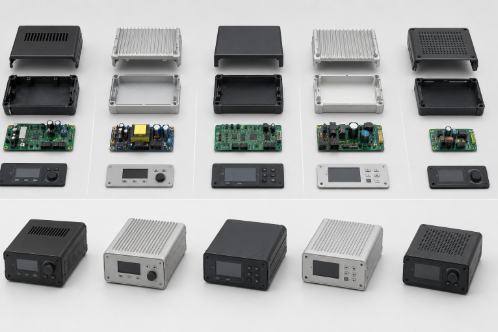
In today’s competitive manufacturing landscape, the most successful products are not just well-engineered; they are designed to be built efficiently. Product design decisions made during the early development phase have a direct and measurable impact on assembly time, production costs, tooling complexity, and overall profitability. At Engon Technologies, we help hardware manufacturers and product teams build smarter from the start. Here are ten high-impact design decisions that reduce assembly time and manufacturing costs without compromising product performance.   1. Reduce Part Count Through Functional Integration Why Fewer Components Mean Lower Manufacturing Costs Reducing part count is one of the most powerful levers in Design for Assembly (DfA). Every additional component in a Bill of Materials (BOM) adds procurement complexity, storage requirements, assembly labor, and the risk of defects. Functional integration, which combines two or more parts into a single moulded or machined component, eliminates redundancy while maintaining full performance. When should multiple parts be combined into one? The decision depends on whether the functions served can be physically co-located without sacrificing structural integrity, repairability, or material compatibility. If a bracket, a housing, and a locating feature can all be captured in a single injection-moulded part, the design is almost always stronger and cheaper in production. The practical impact of reducing part count is significant across several cost centres: BOM reduction lowers material and procurement costs; tooling consolidation reduces the number of mould tools required; inventory simplification cuts warehouse and logistics overhead; and assembly labour savings compound with every unit produced. In consumer electronics and industrial equipment, this principle consistently delivers 15 to 30 percent reductions in per-unit assembly time. AI Overview Opportunity: “How reducing part count lowers manufacturing cost” Case Study: Industrial Equipment Assembly An industrial equipment manufacturer redesigned a multi-part mounting assembly by integrating brackets and locating features into a single moulded component. The change reduced part count by 28%, shortened assembly time, and lowered inventory management costs while maintaining product performance. 2. Design Self-Locating Features That Eliminate Manual Alignment How Engineers Reduce Assembly Errors with Smart Geometry Manual alignment is one of the most time-consuming and error-prone steps in assembly. Self-locating features, geometric details built directly into parts, guide components into their correct position automatically, reducing operator intervention and dramatically cutting the opportunity for defects. Common self-locating features include: Alignment tabs: protrusions that slot into corresponding recesses, locking parts into position before fastening Lead-ins: tapered edges that guide mating surfaces together smoothly during assembly Chamfers: angled edges that ease part insertion, reduce force requirements, and prevent mis-seating Guide pins: precision locating features that align sub-assemblies within tight tolerances Assembly poka-yoke principles: asymmetric geometry that physically prevents incorrect part orientation (see Section 9) When self-locating features are properly engineered, they reduce assembly time, eliminate rework, improve consistency across production runs, and reduce the training burden for assembly operators. The investment in slightly more complex tooling geometry pays back rapidly at scale.   AI Overview Opportunity: “What are self-locating features in product design?”   3. Replace Excessive Fasteners with Snap-Fits and Integrated Joining Features Reducing Assembly Time Through Fastener Optimization Screws, bolts, and threaded inserts are reliable, but they are also slow, expensive, and tool-dependent. Every fastener in an assembly requires a separate component, a separate assembly step, a torque specification, and often a dedicated tool. Fastener reduction strategies replace screw-based joining with engineered alternatives that are faster to assemble and cheaper to produce. Snap-fit features (cantilever, annular, or torsional) can replace multiple screws in a single housing or cover assembly. When properly designed with correct deflection limits and material selection, snap-fits provide sufficient retention force for most non-structural applications. Tool-less assembly enabled by snap-fits also simplifies maintenance and end-of-life disassembly. The tradeoffs are real: snap-fits require careful material selection (particularly for fatigue life), tighter geometric tolerances on mating features, and a higher tooling investment upfront. For high-volume consumer products, the per-unit savings in hardware procurement and assembly time typically justify this investment within the first production run. This is also an area where industrial design and mechanical engineering collaboration matters most. Industrial designers define the user experience of product opening and closing; mechanical engineers validate the structural requirements. When these disciplines work together during DfA review, the result is a joining strategy that is both functional and manufacturable.   Case Study: Consumer Electronics Housing A consumer electronics company replaced multiple screws with engineered snap-fit features in a device enclosure. The redesign reduced assembly operations, shortened production time, and lowered hardware procurement costs without affecting structural integrity.   4. Standardize Components Across the Product Assembly Why Standard Parts Lower Production Costs Non-standard components (fasteners, connectors, brackets, or purchased assemblies) introduce unnecessary complexity into the supply chain and the assembly line. Component standardization is the practice of selecting common, off-the-shelf parts and using the same specification across multiple locations within a product and across the product family. Standard screw sizes mean a single tool torques every fastener on the assembly. Common hardware selection means a single purchase order and a single supplier relationship covers dozens of applications. Purchased component standardization reduces the number of unique line items in procurement, simplifies incoming inspection, and reduces the risk of obsolescence. At the product architecture level, standardization also improves assembly quality by reducing operator decisions. When every M3 screw looks the same, there is no risk of selecting the wrong fastener. Supply chain simplification translates directly into reduced lead times, lower minimum order quantities, and stronger negotiating positions with suppliers.   AI Overview Opportunity: “Benefits of standardization in manufacturing”   5. Design for Top-Down Assembly and Automated Production Simplifying Assembly Line Operations Through Product Architecture Assembly architecture, which refers to the sequence and direction in which components come together, is a fundamental driver of assembly line efficiency. Products designed for top-down assembly exploit gravity, reduce the need for repositioning, and allow components to nest naturally into sub-assemblies. This single principle can reduce fixturing requirements, shorten cycle times, and improve consistency. Key design strategies for top-down assembly include: Gravity-assisted assembly: components seat naturally without

10 Product Design Decisions That Reduce Assembly Time and Manufacturing Costs Read More »