
Most product failures do not happen on the factory floor. They happen months earlier, when industrial design and mechanical engineering work in separate lanes instead of one shared process. A product can look stunning on screen and still fail in production if structural feasibility, tooling limitations, assembly logic, and manufacturing constraints are not considered from day one.
When industrial designers and mechanical engineers collaborate early, businesses reduce costly redesigns, shorten development timelines, improve Design for Manufacturability (DFM), and launch products that are both visually appealing and mechanically sound.
This is especially important for startups and growing manufacturers, where every prototype cycle and tooling decision carries real financial weight. A single overlooked clearance issue, tolerance stack-up, or unrealistic mold geometry can add weeks to a launch schedule and significantly increase development costs. Building a shared workflow between industrial design and mechanical engineering from the earliest sketches helps protect product quality, manufacturing efficiency, and the bottom line.
The following ten reasons explain why this collaboration is essential for successful product development.
Key Benefits of Integrating Industrial Design and Mechanical Engineering
Before diving into the details, here is a quick snapshot of what cross-functional collaboration delivers. It reduces costly design revisions during development, improves Design for Manufacturability (DFM), and Design for Assembly (DfA), and lowers injection mold tooling costs. It also simplifies product assembly, accelerates prototype validation, and improves component packaging, and enhances product reliability and durability. Beyond the production line, it reduces manufacturing risks, speeds up product launches, improves product quality and user experience, and supports scalable production as a business grows.
| Industrial Design | Mechanical Engineering | Combined Business Benefit |
|---|---|---|
| Product aesthetics | Structural integrity | Better product quality |
| User experience | Manufacturability (DFM) | Lower production costs |
| Ergonomics | Material selection | Improved reliability |
| Product form | Assembly optimization (DfA) | Faster product launches |
| Brand identity | Thermal & structural performance | Production-ready products |
1. Prevent Costly Product Redesigns Later in Development
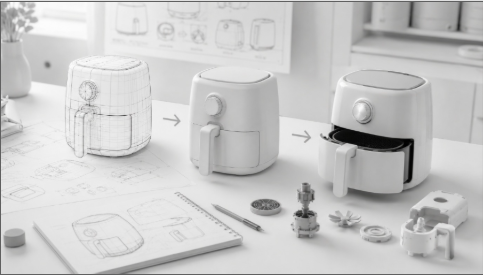
When industrial designers and mechanical engineers review a product concept together during the early stages of development, they can identify packaging constraints, structural feasibility, manufacturability, and assembly issues before a single prototype is built. This proactive approach helps reduce engineering change orders (ECOs), avoid costly redesigns after prototyping, and keep project timelines and development budgets on track.
According to engineering cost studies, the cost of implementing design changes increases significantly as projects progress from concept design to tooling and production. Identifying design issues early helps minimize engineering changes, reduce development costs, and prevent schedule delays later in the product development process.
Redesigns rarely stay contained to a single part. A change to a wall thickness can ripple into the mold, the assembly fixture, and the supplier quote, multiplying both cost and delay. Catching these conflicts at the concept stage, while changes are still just sketches and CAD files, is dramatically cheaper than catching them after a tool has already been cut.
Many costly redesigns can be prevented through a structured design review process that identifies manufacturability, assembly, and production risks before development progresses. Learn more about the design review mistakes that lead to costly production delays.
Engineering Scenario: Consumer Kitchen Appliance During the development of a consumer kitchen appliance, the industrial design team proposed a sleek, compact enclosure to enhance the product’s visual appeal. During the concept phase, mechanical engineers identified potential packaging constraints between the heating assembly, airflow components, and electronic controls that could have led to multiple redesigns during prototyping. By working together early, both teams optimized the internal layout, refined the enclosure design, and ensured sufficient space for critical components without compromising the product’s aesthetics. Addressing these challenges before prototype development reduced engineering changes later in the project and helped prepare the design for efficient manufacturing. |
2. Balance Product Aesthetics with Engineering Performance
A great-looking product still has to function reliably. Collaboration ensures attractive designs meet structural requirements and that ergonomics are optimized without compromising functionality. Teams can address thermal, mechanical, and environmental constraints early, which improves user experience while maintaining reliability and prevents conflicts between styling goals and engineering requirements.
Tension between aesthetics and engineering is one of the most common sources of friction in product development. A designer may want thin, seamless surfaces, while an engineer needs enough wall thickness to survive a drop test. Resolving that tension together, rather than passing a finished concept down the chain, usually produces a design that satisfies both goals instead of forcing one team to compromise late in the process.
Engineering Scenario: Premium Coffee Machine While designing a premium coffee machine, the industrial design team proposed a seamless front panel with hidden fasteners to achieve a clean, modern appearance. During engineering development, the mechanical team identified that the original design restricted airflow around the heating system and made routine servicing difficult. Working together, both teams refined the internal structure by redesigning mounting features, improving ventilation paths, and integrating hidden fastening solutions that maintained the product’s premium appearance. The final design achieved the desired visual appeal while meeting structural, thermal, and serviceability requirements without compromising manufacturing feasibility. |
3. Optimize Internal Component Packaging
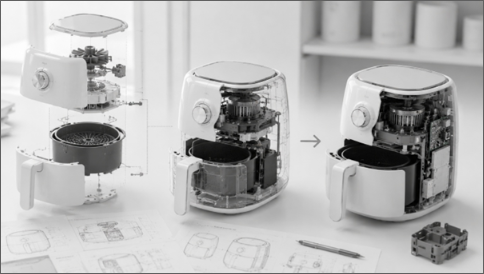
Maximizing available internal space allows for efficient placement of batteries, PCBs, connectors, and mechanical components, reducing interference between parts. This simplifies assembly and servicing while supporting compact, user-friendly product designs without compromising functionality.
Internal packaging decisions made early often determine how much flexibility a product has for future revisions. A layout designed with adequate clearances and modular component placement makes it easier to upgrade batteries, integrate additional electronics, improve airflow, or accommodate regulatory changes without redesigning the entire enclosure.
Engineering Scenario: Consumer Kitchen Appliance s a consumer kitchen appliance evolved to include additional electronic features, the available space inside the enclosure became increasingly limited. The challenge was to accommodate the heating assembly, control PCB, airflow system, wiring, and removable basket within a compact product without increasing its external dimensions. By carefully reorganizing the internal component layout, optimizing mounting features, and improving cable routing, the engineering team created a more efficient package that simplified assembly and improved serviceability. The optimized layout also provided flexibility for future product enhancements while maintaining the product’s compact design and user-friendly experience. As shown in the illustration above, optimizing internal component packaging enables industrial designers and mechanical engineers to efficiently integrate functional components within a compact enclosure while maintaining manufacturability, serviceability, and a seamless user experience. |
5. Improve Design for Manufacturability (DFM)
As illustrated below, Design for Manufacturability (DFM) combines design reviews, engineering analysis, simulation, tooling evaluation, and production planning to ensure products are optimized for efficient, scalable manufacturing.
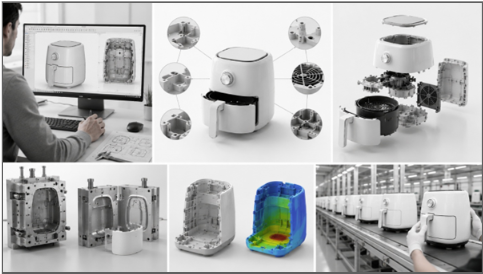
DFM reviews help simplify product geometry for easier production, reducing manufacturing complexity and overall production costs. This leads to better product consistency and quality while minimizing secondary operations and manual adjustments, supporting efficient scaling from prototype to full production.
DFM is most effective when it is integrated throughout the product development process rather than treated as a one-time checkpoint before tooling. Reviewing part geometry, draft angles, wall thickness, ribs, bosses, and feature placement at every major design milestone helps identify manufacturability issues while they are still easy and cost-effective to resolve, reducing production risks before manufacturing begins.
Poor DFM decisions can create unnecessary tooling complexity and higher production costs. Learn how early design improvements can help reduce injection mold tooling costs.
According to Protolabs, applying Design for Manufacturability (DFM) principles early in product development helps identify tooling, molding, and production issues before manufacturing begins. Early DFM reviews reduce costly design revisions, improve production readiness, and support a smoother transition from prototype to manufacturing.
Engineering Scenario: Consumer Electronic Device During the development of a consumer electronic device, the initial enclosure design included complex cosmetic features and undercuts that increased tooling complexity and manufacturing costs. Through Design for Manufacturability (DFM) reviews, the engineering team simplified non-critical features, optimized draft angles, and refined wall thickness while preserving the product’s intended appearance. These improvements reduced tooling complexity, improved molding consistency, and streamlined production without compromising product quality or aesthetics, resulting in a more efficient transition from prototype to manufacturing. Engineering ObservationMany manufacturability issues are not caused by complex engineering but by small design decisions, such as insufficient draft angles, inconsistent wall thickness, unnecessary undercuts, or overly complex cosmetic features. Identifying these issues early through continuous DFM reviews helps reduce tooling modifications, minimize production risks, and improve manufacturing efficiency without affecting the product’s design intent.
|
7. Simplify Product Assembly
As illustrated below, Design for Assembly (DfA) focuses on simplifying the assembly process by reducing part complexity, minimizing manual operations, and ensuring components fit together efficiently and consistently.
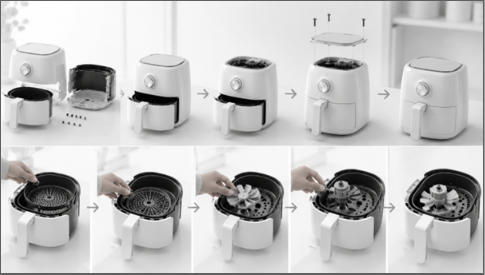
Smart design choices can significantly reduce assembly steps. Incorporating self-locating features, error-proof (Poka-Yoke) design elements, and minimizing fasteners and secondary hardware improves assembly speed, consistency, and overall manufacturing efficiency while lowering labor and production costs.
Assembly time adds up quickly at scale. A feature that saves even a few seconds per unit can translate into substantial labor savings across thousands of products. Designing components that fit together in only one correct orientation also reduces operator training time, minimizes assembly errors, and improves overall production quality.
Effective assembly optimization requires a combination of mechanical design expertise and manufacturing understanding. Our mechanical product engineering services help create production-ready designs that improve assembly efficiency and scalability.
Engineering Scenario: Consumer Kitchen Appliance During the assembly of a consumer kitchen appliance, operators experienced delays because several internal components required manual alignment before installation. The engineering team redesigned the product by introducing self-locating tabs, integrated guide features, and simplified fastening methods that allowed components to align naturally during assembly. These improvements reduced assembly time, improved production consistency, and minimized the risk of assembly errors without affecting the product’s appearance or functionality. Applying Design for Assembly (DfA) principles helped create a more efficient manufacturing process while supporting higher production volumes. Engineering ObservationMany assembly challenges are caused by unnecessary complexity rather than the product itself. Features such as self-locating tabs, snap-fits, integrated guides, and standardized fasteners can significantly reduce assembly time, improve repeatability, and lower production costs without increasing design complexity. |
8. Improve Product Reliability and Durability
A product’s reliability depends on more than its appearance—it must consistently perform under real-world operating conditions. Close collaboration between industrial designers and mechanical engineers ensures that structural performance, material selection, and product durability are considered throughout development. This integrated approach helps products withstand repeated use, accidental drops, vibration, thermal exposure, and everyday wear while reducing field failures and warranty risks.
Reliability issues discovered after product launch are significantly more expensive to resolve than those identified during development. Warranty claims, product recalls, and customer dissatisfaction can quickly outweigh the cost of conducting drop testing, vibration analysis, thermal validation, and material performance assessments before production begins. Evaluating these factors early enables teams to strengthen weak areas, improve product longevity, and deliver a more dependable user experience.
Engineering Scenario: Portable Consumer Device During validation of a portable consumer device, engineers observed that repeated drop testing created stress concentrations around the charging port, increasing the risk of cracking during normal use. Rather than redesigning the entire enclosure, the industrial design and mechanical engineering teams evaluated the affected area and introduced an internal reinforcing rib while selecting a more suitable material grade. These targeted improvements enhanced structural strength and durability without affecting the product’s appearance, ergonomics, or manufacturing process. By addressing the issue during development, the product achieved improved reliability while maintaining its intended design and user experience. Engineering ObservationProduct reliability is often influenced by small engineering decisions rather than major design changes. Reinforcing high-stress areas, selecting appropriate materials, and validating products under realistic operating conditions help improve durability, reduce field failures, and deliver consistent product performance throughout the product’s lifecycle. |