

engontech

9 Reasons Product Designs That Look Perfect Still Fail in Manufacturing

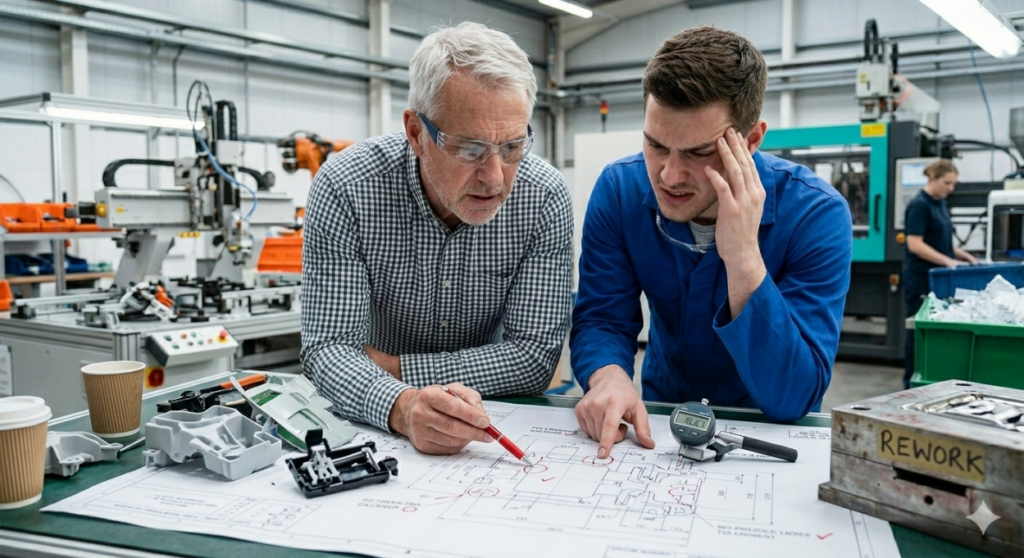
Something can seem perfect while being drawn up. Even if digital plans are sharp, things operate as expected at first, yet real trouble often begins later. However, when the product enters large-scale production, many companies experience unexpected product design failures in manufacturing. It shows up since making prototypes isn’t anything like full-scale fabrication. One moment you’re shaping parts with adaptable methods – CNC mills, say – or layering them in a 3D printer. The next shift arrives: factories need uniform routines that run without surprise. That transition often challenges many teams when moving from test models to large production batches. Problems arise when designs assume perfect consistency, but real manufacturing introduces natural variations A lot of smaller factories face setbacks when problems pile up – costs rise, timelines stretch, sometimes everything halts before launch. Spotting frequent roadblocks early lets teams shape designs with real-world building in mind right away. This is why many companies turn to specialized engineering partners like Engon Technologies to review designs early and ensure they are ready for scalable production. Working with experts who understand design for manufacturing (DFM) and production realities can help prevent these costly problems. For US manufacturing SMEs looking to scale production efficiently, engineering support services such as engineering outsourcing for US manufacturing SMEs can help validate designs, optimize manufacturability, and reduce the risk of product design failures before production begins. The Prototype vs Production Reality Prototypes are typically produced in low quantities using flexible processes like 3D printing, CNC machining, or manual assembly. Mass manufacturing, however, relies on repeatable processes such as injection molding, stamping, casting, and automated assembly. This difference is why many design to manufacturing problems appear only after scaling production. Manufacturing Readiness Importance for Small Businesses Ready to make means the plan works every time, without hiccups. Skip that step; firms run into trouble like delays or wasted parts Production delays Increased scrap rates Tooling redesign costs Supplier conflicts This is why many SMEs seek engineering outsourcing for manufacturing to validate designs before moving into large-scale production. The Hidden Price of Mistakes in Making Things Mistakes spotted while designing might set you back a few hundred bucks to correct. When found later – once things are rolling – it could mean losing way more than that. Understanding the root causes of product design failures in manufacturing can help companies avoid these costly setbacks. Ignoring DFM Principles: A Common Cause of Product Design Failures in Manufacturing A frequent error in design for manufacturing shows up when performance grabs all the attention, leaving production limits out of sight. Though sleek function might look ideal, real-world building often hits roadblocks if practical assembly isn’t weighed early. Details like material choice or part complexity slip through when speed and output take center stage. Without balancing both sides, even brilliant concepts stall before reaching customers. Built right, a product moves smoothly through production when tools and methods match its design. Yet if shapes get too tricky – like sharp angles, narrow sections, or sunken areas – machining slows down or breaks down. Smooth paths depend on early checks, not late fixes. Odd forms often demand special tooling, more time, and higher cost. When geometry ignores reality, output stumbles before it starts. Planning ahead avoids traps hidden in corners and curves. These design for manufacturability issues significantly increase production costs and manufacturing time. A manufacturing-friendly design simplifies geometry, reduces machining operations, and minimizes unnecessary complexity. Mini Case Study A Texas industrial equipment startup developed a precision aluminum housing that performed perfectly during prototype machining. When production started, manufacturers discovered impossible tolerances and extremely complex tool paths. After redesigning the component using DFM analysis, machining time dropped by 38% and production became scalable. Unrealistic Tolerances That Lead to Product Design Failures in Manufacturing Many engineering teams design products with extremely tight tolerances to achieve precision. However, unrealistic tolerances often lead to serious manufacturing tolerance issues during production. One part might fit just fine on its own. Yet when several come together, tiny differences add up – shifting things out of place. Sometimes those shifts go beyond what machines at a factory can handle. That mismatch leads to more pieces getting tossed aside, never making it into the final build. Quality wobbles as a consequence. Effective tolerance engineering balances precision with manufacturability. Instead of forcing unnecessary accuracy, engineers should design tolerances that reflect realistic production capabilities. Mini Case Study A German automation company designed a robotic assembly component with extremely tight tolerances. Suppliers struggled to maintain consistency during volume production. After performing tolerance stack-up analysis and adjusting specifications, manufacturing yield improved by 22%. Prototype Materials Don’t Match Production Materials Material differences are a major reason for prototype-to-production failure. When building early models, teams might pick quick-to-shape stuff like printed resin or bendy plastic. Still, what gets used in the real product can handle stress, heat, or movement in another way entirely. For example, a part designed for 3D-printed resin may behave differently when produced using injection-molded ABS. Without proper material engineering analysis, these differences can lead to structural failures or performance issues. Mini Case Study A California consumer hardware startup prototyped parts using 3D-printed resin but later switched to injection-molded ABS for production. The design lacked reinforcement for the new material, causing failures during stress testing. Engineers redesigned the structure to support the production material. Designs That Ignore Assembly Complexity Cause Product Design Failures in Manufacturing Another major contributor to design to manufacturing problems is ignoring how a product will actually be assembled. One way to cut down on work during building is to make things easier to put together. Fewer pieces mean less trouble fitting them later. When a product uses too many fasteners or tiny bits, it takes longer to build. Time spent putting parts together adds up quickly. More hands-on effort means higher expenses in the long run. Fewer pieces mean less clutter during build. With room to move, tools reach spots faster. Order matters – step-by-step setup cuts delays. Efficiency climbs

9 Reasons Product Designs That Look Perfect Still Fail in Manufacturing Read More »
Why Engineering Outsourcing Fails SMEs: 10 Hidden Risks That Multiply Costs Later

Out there among smaller factories, sending design work overseas often looks like a win on price. Cheaper pay by the hour might catch your eye first – then quicker drawings start piling up in your inbox. Specialized know-how shows up where you didn’t expect it, making everything seem leaner than before. But behind those numbers sits something less clear: whether savings last when things get complicated. But engineering outsourcing failures for SMEs often surface later — during tooling, pilot production, or market launch — when corrections are exponentially more expensive. Unlike large corporations, SMEs operate under tight margins, compressed timelines, and high product dependency. A single round of engineering cost overruns can destabilize the entire business. Many manufacturers today explore engineering outsourcing to access global expertise and control development costs. Companies like Engon technologies work with manufacturing SMEs to provide engineering support that aligns design decisions with production realities. However, outsourcing without the right structure can introduce hidden risks. Businesses looking to understand how to implement engineering outsourcing for US manufacturing SMEs often focus on balancing cost efficiency with manufacturing readiness to avoid expensive redesigns later in the product development cycle. Here come the top ten dangers small firms run into when they outsource engineering work, minus a plan focused on actual output. Limited Financial Buffer A Major Cause Engineering Outsourcing Failures for SMEs Why SMEs Cannot Absorb Engineering Cost Overruns Big manufacturers set aside extra funds just in case. Meanwhile, smaller ones skip that step entirely. When engineering cost overruns occur due to outsourced design errors, small businesses struggle to absorb: Rework costs Additional validation cycles Tooling modifications Extra charges for longer company help These SME engineering budget constraints mean even minor outsourcing engineering risks can cascade into severe financial stress. Cash Flow Disruption Caused by Rework Cycles Rework creates invisible financial strain: Payment to offshore teams continues. Toolmakers charge revision fees. When things kick off, it takes longer than planned. Revenue inflow stalls The resulting cash flow impact is often more damaging than the actual redesign cost. This explains how engineering outsourcing failures affect SME finances far beyond initial projections. Hidden Engineering Outsourcing Costs Beyond Quoted Pricing Many SMEs underestimate hidden engineering outsourcing costs for small businesses, including: Extra iterations beyond scope Engineering revision loops Communication overhead Vendor realignment meetings Documentation corrections These compound into substantial development budget loss. Organizations that successfully outsource engineering usually combine cost efficiency with strong production validation processes. Many manufacturers follow structured engineering frameworks developed by experienced partners such as Engon Technologies, who work closely with Engineering outsourcing for US manufacturing SMEs to align product design with real production requirements. Financial Risk Modeling Before Outsourcing Engineering Outsourcing considerations for small businesses Model worst-case rework costs Estimate tooling delay scenarios Calculate cash reserve thresholds. Build contingency buffers Risk modeling reduces outsourcing engineering risks dramatically. Single Product Dependency in Engineering Outsourcing Failures for SMEs Revenue Concentration in Single-Product SMEs People running small businesses often pin their hopes on a single standout item. Waiting stops money from coming in. This increases exposure to product engineering outsourcing problems. How Outsourcing Delays Destroy Launch Momentum Engineering slippage causes: Product launch delay Lost distributor confidence Marketing campaign waste Channel fatigue This is precisely how outsourcing delays kill SME product launches. Market Window Loss in Competitive Manufacturing Sectors In fast-moving sectors: Certification windows close Competitors capture early adopters. Pricing advantage disappears This market window loss creates a permanent disadvantage. Late-Mover Disadvantage Due to Engineering Slippage Being second to market often means: Lower margins Price wars Weak brand perception This is the true first-mover disadvantage resulting from outsourcing delays impact SMEs. Risk Mitigation Through Production-First Planning SMEs must adopt: Production readiness checkpoints Parallel supplier alignment Design freeze governance Milestone-based release structure This reduces engineering outsourcing risk for single-product companies. Lack of Manufacturing-First Engineering CAD Design vs Production Engineering Reality People selling tools often care more about drawings than building stuff easily. This is where manufacturing engineering outsourcing breaks down. Design that works in software may fail in: Mold flow Assembly ergonomics Fixture accessibility Tolerance stack-ups DFM/DFA Gaps in Outsourced Product Design Outsourcing DFM Engineering Without Oversight Wall thickness variations create mold defects. More intricate assembly means higher wages paid for work time. Tool wear accelerates These design for manufacturability issues drive long-term inefficiencies. Prototype Success Masking Production Failure A 3D-printed prototype rarely reveals: Shrinkage issues Cycle time problems Long-term durability risks This is a classic case of outsourced product design failures. Ignored Manufacturing Constraints Common overlooked constraints: Machine capacity limits Injection pressure thresholds Tool steel wear rates Surface finish feasibility Such blind spots define engineering outsourcing without manufacturing knowledge. Production Readiness Review Framework SMEs must implement: Tolerance stack-up validation Tool feasibility assessment Assembly simulation Supplier feasibility sign-off On boarding tooling team in all stages This ensures production readiness before tooling release. Tooling Rework Costs in Engineering Outsourcing Failures for SMEs Post-Tooling Design Changes and Their Root Causes When tools are made, adjustments cost more. Common causes: Poor tolerance analysis Incomplete DFM review Late-stage requirement change Communication errors These lead directly to tooling rework costs. In many cases, they become major contributors to engineering outsourcing failures for SMEs, particularly when outsourced design teams lack close alignment with real manufacturing conditions and production constraints. Mold Rework Cost Breakdown Typical mould rework includes: Few repairs tackle holes by reshaping metal after heat joins parts together. Core insert modification Cooling channel redesign Surface texture correction The mold rework expense often exceeds original savings. How Poor Tolerance Analysis Triggers Tooling Modification Tolerance stack-up failures cause: Assembly interference Warping Component misalignment Leading to high tooling modification cost. Tooling Validation Checkpoints Before Release Before cutting steel: Conduct a tolerance simulation Validate DFM review Freeze specifications Secure toolmaker approval This reduces tooling rework caused by poor engineering outsourcing. Communication Gaps Causing Engineering Outsourcing Failures for SMEs Offshore Time-Zone Decision Lag With offshore teams: Questions get answered within a day or two. Escalations get delayed Issues compound silently These time zone delays amplify offshore engineering outsourcing problems. Specification Ambiguity

Why Engineering Outsourcing Fails SMEs: 10 Hidden Risks That Multiply Costs Later Read More »

7 Hidden Ways Cheap Engineering Causes Manufacturing Rework Cost in US and Europe

When making things, tight budgets often lead teams to choose less expensive engineering help. At first glance, that choice seems like it cuts expenses. Yet down the line, problems start piling up during actual building work. The so-called budget option tends to trigger repeated design changes, fixes to molds and tools, parts that do not align properly, and shrinking profits-especially across manufacturing programs in the US and Europe, where labour, tooling, and compliance costs are significantly higher. What initially appears as savings often results in rising manufacturing rework cost, especially when pilot runs expose flaws, scaling gets shaky, suppliers clash, changes pile up. Many companies exploring engineering outsourcing for US manufacturing SMEs underestimate how early design shortcuts translate into downstream production instability. At first glance, cheap outsourced engineering seems fine, just numbers on a page. Only after things move forward do the real expenses emerge. When trouble hits, money can’t be pulled back, timelines hold firm, and fixes demand more time and cash. This piece reveals seven unseen ways low-cost engineering hikes up rework expenses in production – while showing fixes via smart design-to-manufacturing alignment. What looks like savings at first often backfires later downstream. What Drives Manufacturing Rework Cost in Production in US and Europe? Something going wrong on the factory floor does not come from a single disaster. Small oversights pile up, especially when planning how parts go together. Decisions made too quickly in design often ignore how things actually get built. Tolerances that seem fine on paper cause trouble once assembly begins. Methods intended to simplify manufacturing sometimes have the opposite effect when applied without care. Many structured engineering firms such as Engon Technologies emphasize early production validation precisely to prevent these downstream disruptions. Over time, these misalignments directly increase manufacturing rework cost, especially when assembly variation, scrap, and inspection sorting become routine rather than exceptions. The Real Cost of Engineering Change Orders (ECOs) A single change in engineering might keep things moving forward. Yet when those changes multiply fast – midway through testing or full-scale builds – it often points back to early oversights. Mistakes made while shaping the design tend to surface later as a flood of adjustments. What looks like progress can actually be catching flaws too late. Late ECOs create: Tooling modification cost Production line stoppage due to design errors Supplier renegotiation Revalidation and FAI repetition Inventory scrap and rework Few realize how fast expenses climb when engineers alter designs late in the process – tooling shifts right after documents get updated, while suppliers scramble to adapt. Assembly methods reshape just as inspections tighten. One tweak sparks chain reactions across every corner of production, rapidly increasing manufacturing rework cost across tooling, validation, and supply chain operations. How Poor DFMA Increases Scrap and Revalidation One thing about checklist-driven DFM reviews – they miss the point of real DFMA work. Surface-level inspections tend to overlook what matters. Validation of process capability using Cp and Cpk Statistical tolerance stack-up Ramp-up yield modelling Supplier process variability When DFMA lacks quality, output takes a hit right away. Parts get tossed more often than before. Testing starts again, without warning. The path to steady manufacturing wobbles. Tools that model production flow are available, yet still ignored. Low-cost design teams skip them, even when managing high-volume programs, leading to a sharp rise in manufacturing rework cost during validation and ramp-up. Tolerance Errors and Their Impact on Assembly Yield Fine margins shape spending more than most expect. Cost bends where precision begins. Too much tightness in specs makes machining pricier. When tolerances are too loose, parts won’t fit right, causing fixes later. Getting it just right means using GD&T smarter, backed by number patterns that predict variation. A few microns might seem tiny when you’re holding a prototype. Yet multiply that across ten thousand units, and suddenly gaps appear where nothing fits right. One overlooked curve, one unchecked edge – soon the line slows down. Mistakes don’t grow loud. They spread quietly, like cracks in plastic under heat, gradually driving up manufacturing rework cost across assembly, inspection, and scrap management. How Cheap Engineering Triggers Engineering Change Orders Out on its own, budget-focused design rarely talks to the machines it needs. Without that link, fixes pile up later because nobody asked the people who built things. Mistakes repeat when plans ignore what happens after decisions are made. This disconnect is common in poorly structured engineering outsourcing for US manufacturing SMEs, where design teams operate far from real production constraints. Late Design Changes After Tooling Investment Heavy expenses hit hard when tools change post-mold cut. After money gets locked in, small tweaks demand fresh spending. Tool-safe design compromise Mold welding or re-machining New inserts Additional sampling A surprise risk showing up post-funding burns through budgets faster than almost any other mistake in design work. ECO Impact on Production Schedules When suppliers deliver late, production timelines shift without warning. Inspection sign-offs drag; everything waits behind them. Machines run only after the investments pay back their base cost. Timing bends around each of these anchors. An eco launched amid a ramp-up Delays product launch Increases validation cost Triggers supplier-driven redesign Reduces forecast confidence When a product launches late, the money lost usually surpasses what was saved during development. Cost of Revalidation and Tool Modifications Each change to the tools kicks off a fresh start First Article Inspection (FAI) PPAP documentation Capability studies Functional testing Costs from revalidating manufacturing grow fast. Early savings in design vanish when tests are redone again and again. Why Superficial DFMA Increases Manufacturing Rework Cost in US and Europe Checklist-Based DFM vs Engineered DFMA There is a fundamental difference between a DFM checklist and real DFMA engineering. A checklist might confirm: Minimum draft angles Basic machining feasibility Standard material selection Engineered DFMA analyzes: Process drift and variation Cp, Cpk alignment with functional tolerances Digital manufacturing simulation Supplier capability mapping The difference between DFM checklist and real DFMA engineering determines whether a design survives mass production. Process Capability (Cp, Cpk) Misalignment

7 Hidden Ways Cheap Engineering Causes Manufacturing Rework Cost in US and Europe Read More »

Is Your Product Really Ready for Mass Production?

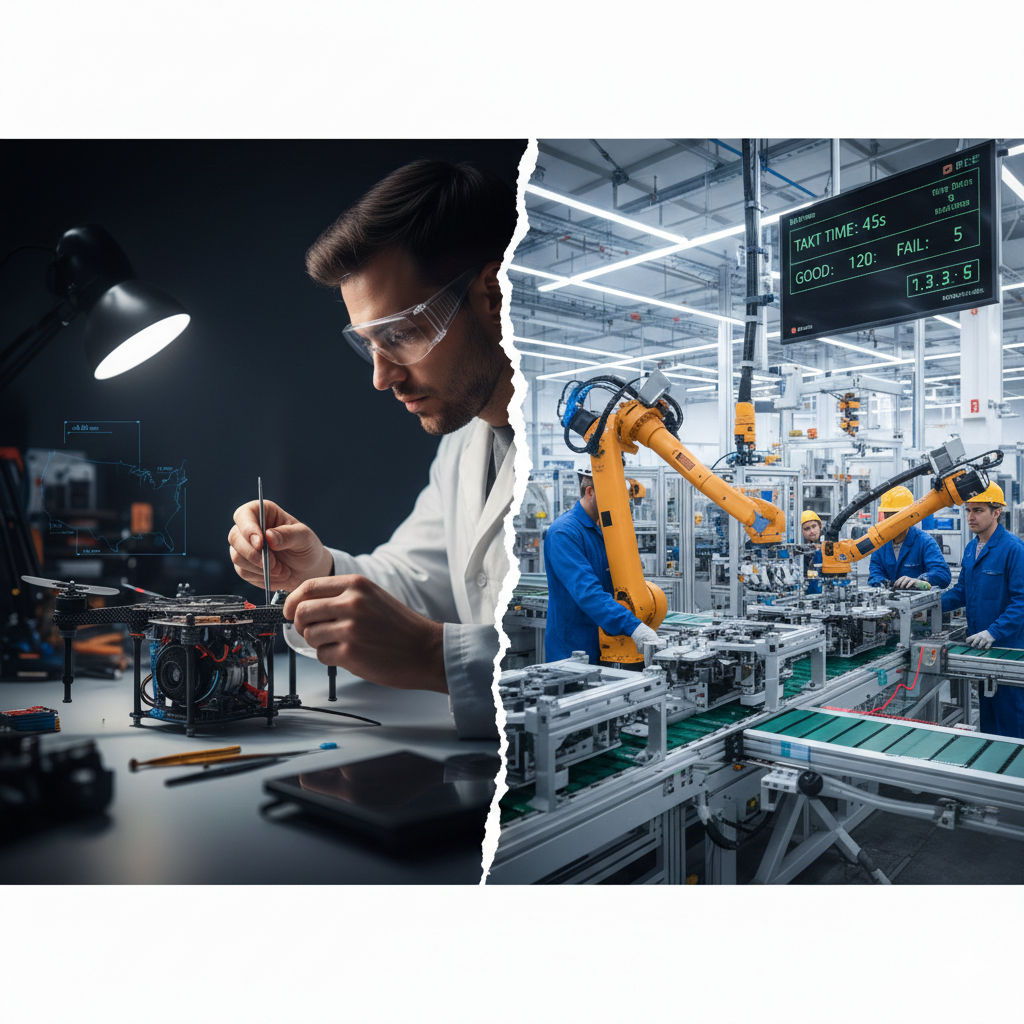
9 Common SME Pitfalls Derailing US & European SMEs Many SMEs across the United States (US) and Europe (EU) believe they are ready for mass production because the prototype works, customers are interested, and initial builds look promising. Yet scale-up failure is rarely caused by a single catastrophic mistake. It is usually the cumulative result of weak manufacturing readiness discipline across design, suppliers, tooling, cost, and validation. Without a structured Production Readiness Audit for SMEs, these hidden scale risks often remain invisible until ramp-up. This audit is a core part of our broader framework at Engon Technologies for engineering outsourcing for US manufacturing SMEs, helping manufacturers de-risk scale early. Below are nine systemic pitfalls that repeatedly derail otherwise promising products during industrialization. 1. Prototype ≠ Production-Ready in US and European Manufacturing One of the most common SME mistakes is confusing functional validation with manufacturing validation. A prototype proving that the product works does not mean the design is production ready. Functional Validation vs Manufacturing Validation Engineering Validation Test (EVT) builds confirm functional performance. Design Validation Test (DVT) verifies compliance and robustness. Production Validation Test (PVT), however, validates manufacturability, repeatability, and yield under line conditions. Recognizing this gap early is exactly why a Production Readiness Audit for SMEs should feed into your engineering outsourcing strategy — for example, our structured services for engineering outsourcing for US manufacturing SMEs build readiness into every phase. The difference between prototype and production design lies in process robustness, tolerance capability, assembly efficiency, and material stability—not just performance. Prototype Materials vs Production Materials SMEs often use substitute materials in prototypes: CNC aluminum instead of die-cast, 3D prints instead of injection-molded parts. These materials behave differently under stress, heat, and assembly load. When production materials are introduced, dimensional shifts and failure modes appear. Hand-Built vs Line-Built Differences Hand-built assemblies tolerate rework, fitting, and technician intuition. Line-built units depend on standardized work, fixtures, takt time, and operator skill consistency. Many pilot build failures in SMEs stem from ignoring this transition. Design Hardening for Volume Design for mass production requires tolerance optimization, fastening simplification, poka-yoke features, and Cp/Cpk-driven tolerancing. Without this hardening, why prototypes fail in mass production becomes painfully obvious during ramp-up. 2. DFMA Is Treated as a One-Time Check + Tolerance Stack-Ups Ignored DFMA (Design for Manufacturing and Assembly) is frequently misunderstood as a checklist exercise rather than a cross-phase discipline. DFMA vs DFM vs DFA DFM focuses on manufacturability of individual parts. DFA addresses ease of assembly. DFMA integrates both. Treating DFM and DFA separately causes interface failures and assembly tolerance issues. DFMA as an Iterative Process DFMA analysis must occur during concept, detailed design, and pre-tooling phases. It must also be updated after supplier feedback and pilot builds. Static DFMA documentation leads to DFMA failures in mass production. Assembly Sequence-Driven Design Parts must be designed around real assembly flow. Excess fasteners, orientation ambiguity, and inaccessible joints create design for assembly errors. Line balancing constraints must inform geometry and fastening strategy. Part Count Reduction & Functional Integration Reducing components improves cost and reliability—but excessive consolidation may complicate tooling or increase scrap sensitivity. DFMA best practices for scale-up require balancing integration with process capability. Tolerance Stack-Up Analysis Tolerance stack up analysis is critical. Worst-case stacking leads to over-constrained fits. Statistical stack-ups require Cp/Cpk alignment. Poor datum strategy creates cosmetic and functional misalignment. Tolerance stack up problems in assemblies often appear only during ramp. Ignoring tolerance discipline results in yield loss, shimming, forced fits, and post-tooling ECOs. 3. Tooling Reality Is Ignored CAD intent rarely reflects tooling design constraints. Tool Design Constraints vs CAD Draft angles, undercuts, parting lines, gate location, and ejection strategy define manufacturability. Mold design limitations frequently contradict aesthetic or structural assumptions made in early design. Mold Flow & Steel Selection Mold flow analysis identifies weld lines, sink risk, and fill imbalance. Tool steel selection determines life expectancy and wear resistance. Poor choices lead to tooling cost overruns and premature degradation. Cycle Time Assumptions Cycle time drives cost. SMEs often assume theoretical cooling times that prove unrealistic. Real-world thermal gradients, part geometry, and machine capability extend cycle time, eroding margin. Early tooling feasibility analysis prevents why tooling fails after design freeze scenarios. 4. Supplier Capability Is Assumed, Not Verified Supplier capability assessment must be evidence-based. Cp, Cpk and Drawing Alignment Machine capability must align with drawing requirements. If a drawing specifies ±0.05 mm but supplier Cp/Cpk supports ±0.12 mm, yield loss is inevitable. Supplier Audits Technical audits verify process controls, maintenance systems, calibration, and training. The supplier qualification process should include statistical validation, not just commercial evaluation. A structured Production Readiness Audit for SMEs formalizes this validation by reviewing Cp/Cpk evidence, SPC discipline, maintenance systems, and process controls before volume ramp. It ensures supplier capability is statistically verified rather than commercially assumed. Silent Substitutions Manufacturing supplier risk increases when suppliers substitute materials or processes without formal approval. Regional supplier maturity differences can compound risk. To avoid supplier failures during scale up, SMEs must verify—never assume—capability. 5. No Process FMEA Before Scale Process FMEA (PFMEA) is often neglected until defects appear. DFMEA vs PFMEA DFMEA identifies design risks. PFMEA manufacturing identifies process-level manufacturing failure modes. Identifying Failure Modes Process risks include misalignment, torque variation, contamination, incorrect assembly order, and operator error. Each must be ranked by severity, occurrence, and detection. Linking PFMEA to Control Plans PFMEA manufacturing outputs must drive control plan manufacturing documentation: inspection frequency, error-proofing, and reaction plans. Using PFMEA during pilot builds allows validation of risk assumptions. Updating PFMEA during ramp-up supports structured production risk management. Missing PFMEA is a common cause of manufacturing defects due to missing PFMEA discipline. 6. Cost Is Estimated, Not Engineered Quoting suppliers is not manufacturing cost engineering. Should-Cost Modeling Should cost analysis decomposes BOM cost breakdown, cycle time, scrap rate, labor, overhead, and tooling amortization. It validates whether quoted cost aligns with process physics. Production Cost Drivers Cycle time, yield loss, scrap sensitivity, and labor content are primary production cost drivers. Small tolerance changes may double

Is Your Product Really Ready for Mass Production? Read More »

Benefits of digital engineering outsourcing USA

Why U.S. Manufacturers Prefer a Digital Engineering Outsourcing Company for Faster Product Development

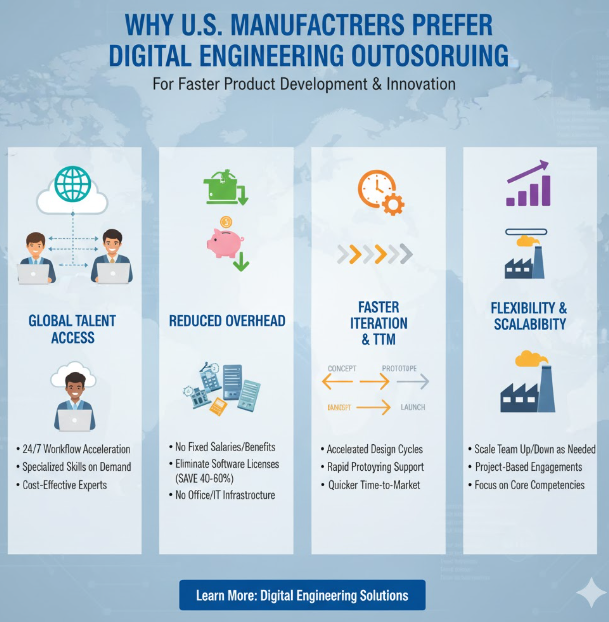
In the competitive U.S. manufacturing landscape, companies face constant pressure to launch innovative products quickly. Whether in consumer electronics, industrial systems, smart devices, automotive components, or industrial machinery, every segment demands speed, precision, and flexibility. Traditional engineering systems cannot keep up with market expectations. As product lifecycles shorten and customer demands increase, manufacturers increasingly turn to digital engineering outsourcing USA firms to speed up development, lower engineering costs, and stay ahead of the competition.  Digital engineering has evolved beyond simple CAD modelling. It now includes simulation, automation, digital twins, generative design, virtual prototyping, and collaborative cloud platforms. By outsourcing these functions, manufacturers access skilled engineers, cutting-edge tools, and efficient processes without the burden of building expensive internal teams. Many companies also rely on specialized mechanical engineering design services for handling complex CAD and simulation workloads. Engon Technologies has become a preferred partner for U.S. companies looking for quicker, more flexible, and reliable product development support. This article discusses why U.S. manufacturers choose digital engineering outsourcing companies and how this strategy helps shorten time-to-market while maintaining high engineering quality.  The Growing Shift Toward Digital Engineering USA Trends in U.S. Manufacturing How U.S. Manufacturers Improve Speed and Accuracy with Digital Engineering USA U.S. manufacturers are undergoing a digital transformation in designing, developing, and launching products. Digital engineering has replaced traditional methods. Virtual Prototyping and Digital Twins in Digital Engineering USA This shift allows companies to create virtual prototypes, simulate real-world behaviour, and validate designs long before physical testing begins. With advanced tools and digital product development services, companies can reduce manual tasks, spot errors early, and iterate quickly.  Rather than relying solely on internal teams, manufacturers now prefer to work with outsourcing partners specializing in engineering design, simulation, CAD development, prototyping, and automation. These partners bring global expertise and deep engineering knowledge that enable faster execution. This trend reflects a broader industry movement where data-driven engineering and outsourced collaboration become vital for achieving innovation in a competitive market.  Why U.S. Manufacturers Choose Digital Engineering Outsourcing USA Companies Faster Time-to-Market with Digital Engineering Outsourcing USA The primary reason U.S. manufacturers opt for outsourcing is speed. Collaborating with experienced digital engineering outsourcing firms significantly shortens product development timelines. Internal engineering teams often face heavy workloads, limited skill sets, and time-consuming processes. Outsourced teams offer immediate access to resources, allowing companies to move from concept to prototype faster than ever.  Outsourcing speeds up new product launches by enabling multiple design and simulation tasks to run simultaneously. Digital engineering allows teams to validate concepts through virtual simulations, quickly refine CAD models, and identify issues early. Reducing delays is crucial for manufacturers in fast-moving markets, where saving even a week can create a significant competitive edge.  Access to Specialized CAD & Simulation Talent Through Engineering Outsourcing USA Another reason U.S. companies prefer engineering outsourcing is access to specialized talent. Modern product development requires experts in advanced CAD modelling, CAE simulation, industrial design, materials engineering, digital twin creation, FEA analysis, and design automation. Building such a diverse internal team is costly, slow, and hard to maintain. A digital engineering outsourcing firm provides a global engineering team with all the necessary skills, ensuring manufacturers have specialists available at every step of the product lifecycle. Familiarity with tools like Creo, SolidWorks, CATIA, Ansys, and NX further enhances engineering accuracy and efficiency.  Industry research from the American Society of Mechanical Engineers shows that digital engineering workflows and simulation-driven design significantly improve engineering efficiency and reduce development time. Reducing Engineering Costs with Digital Engineering Outsourcing USA Cost optimization is another major factor driving this outsourcing trend. Hiring full-time engineers, purchasing costly software licenses, investing in digital infrastructure, and maintaining internal R&D departments place a heavy financial burden on manufacturers. Outsourcing offers cost-effective engineering resources, allowing companies to pay only for the services they need. This approach cuts overhead while ensuring quality engineering output. For startups and medium-sized manufacturers, this is particularly beneficial as it helps them compete with larger companies without excessive spending.  Communication efficiency has also improved significantly thanks to modern digital tools. U.S. manufacturers now collaborate smoothly with offshore teams through shared platforms, cloud-based design systems, daily virtual meetings, and real-time file access. Engineering design outsourcing partners integrate well with internal teams and act as an extension of the manufacturer’s R&D department. The result is a unified engineering process where decisions are made faster, documentation improves, and design iterations flow smoothly.  How Digital Engineering Outsourcing from USA Enhances Mechanical Design and CAD Workflows Mechanical design outsourcing has become essential for U.S. manufacturers because it supports everything from concept sketches to production-ready designs. By relying on skilled CAD engineers, manufacturers avoid bottlenecks and ensure that modelling, assemblies, tolerance studies, and detailed drawings are completed accurately. Outsourced CAD design teams manage large assemblies, complex mechanisms, enclosures, sheet metal parts, and plastic components, delivering production-ready models that meet engineering standards.    Mechanical Design Outsourcing Benefits for U.S. Manufacturers Working across diverse industries and various products cultivates powerful cross-functional expertise. his broad exposure allows teams to meet unique industry needs, including smart devices requiring IoT enclosure design services that combine durability with manufacturability., or applying financial rigor to operational logistics. This proficiency is invaluable as it breaks down organizational silos, enabling a holistic view of challenges and opportunities. A cross-functionally proficient team member can effectively translate needs between departments, anticipate downstream impacts, and drive innovation by adopting best practices regardless of their origin. Ultimately, this expertise leads to more efficient processes, better problem-solving, and more successful product outcomes. Small organizations get diverse expertise (tooling engineers, Production engineers, Reverse engineers, Analysis engineers, etc) and best systems & methods under single roof to solve their problems. Strategic Advantages of Offshore Engineering Partnerships for U.S. Companies Using India Engineering Outsourcing Partnering in India opens the door to a vast and diverse talent pool, offering an unparalleled scale of skilled professionals. This strategic access assures a continuous, reliable supply of high-caliber manpower essential for sustained growth and operational scaling. 24/7 Engineering Cycles with India Engineering Outsourcing An

Why U.S. Manufacturers Prefer a Digital Engineering Outsourcing Company for Faster Product Development Read More »

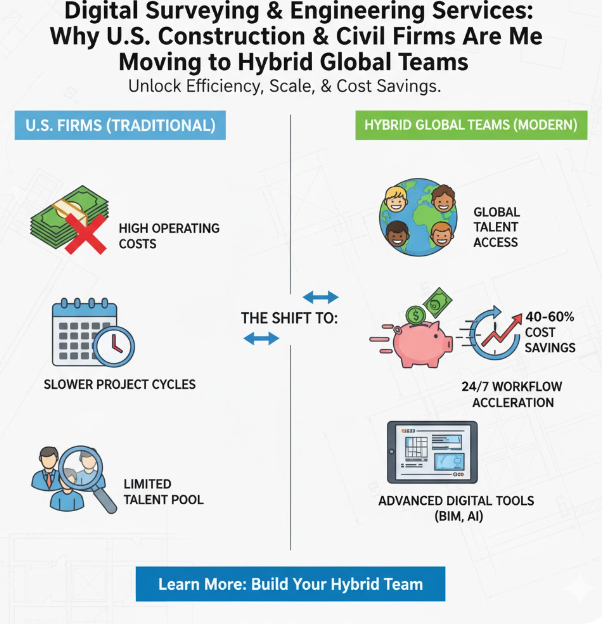
Digital Surveying Services USA infographic comparing traditional U.S. firms with hybrid global engineering teams.

Digital Surveying and Engineering Services: Why U.S. Construction and Civil Firms Are Turning to Hybrid Global Teams

Q: Why are U.S. construction firms shifting to hybrid global engineering teams? A: Because hybrid teams help firms process survey data faster, reduce BIM/CAD bottlenecks, and maintain 24/7 engineering workflows. They also cut engineering costs by 30–50% while improving accuracy and project delivery speed. The construction and civil engineering landscape in the United States is changing rapidly. Urbanization, increased spending on infrastructure, labour shortages, strict regulations, and growing project complexities have pushed the industry to adopt a more digital, data-driven, and collaborative approach. In this shifting environment, Digital Surveying Services USA are key to executing projects faster, more efficiently, and more accurately.  At the core of this change is a new operating model: hybrid global engineering teams. These teams blend U.S.-based project leaders with offshore engineering and digital surveying expertise. This structure enables construction and civil firms to work around the clock, cut overhead costs, speed up design approvals, and enhance overall project outcomes. Firms are increasingly viewing civil engineering outsourcing not just as a cost-saving measure, but as a way to drive innovation, scalability, and timely project delivery.  24/7 Engineering Cycles That Speed Up Project Delivery As U.S. firms adopt more digital tools, the demand for digital surveying services USA, civil engineering outsourcing, and hybrid global engineering teams continues to rise. Learn more about our full-range engineering services Top Benefits of Hybrid Global Teams Faster survey data processing Lower engineering costs 24/7 design cycle Reduced BIM rework Faster approvals     Engon Technologies is leading the way in supporting U.S. construction, infrastructure, and EPC companies with digital surveying solutions, BIM and CAD outsourcing, and comprehensive construction engineering support. This article explores why hybrid global teams have become essential for U.S. firms, how outsourcing speeds up civil project delivery, and how digital surveying improves precision in land development, transportation, energy, and large-scale construction projects.  Rise of Digital Surveying Services USA in Construction and Civil Engineering Why Hybrid Global Engineering Teams Are Increasing in the U.S. Traditionally, the construction industry has been slow to embrace new technologies, but the last decade has seen significant change. This shift is driven by the need for faster execution, better accuracy, and more efficient use of resources. Today, U.S. firms rely on digital tools like LiDAR scanning, GIS platforms, advanced drones, 3D mapping, and geospatial services to enhance the quality of land surveys and site data. These advancements also increase demand for 3D laser scanning services USA, especially for high-accuracy infrastructure projects.” Digital Tools Powering Modern Digital Surveying Services USA  (LiDAR, Drones, GIS, 3D Mapping) Old surveying methods can no longer meet the demands of modern infrastructure. Digital surveying solutions, paired with cloud-based engineering tools, enable contractors and engineering teams to create detailed, high-accuracy digital representations of job sites. These datasets are crucial for planning, design, permitting, and clash detection. As reliance on digital tools increases, so does the need for skilled engineering teams to process large amounts of data, pushing companies to embrace hybrid outsourcing models.  U.S. construction project engineering workflows have become complex. They now involve topographical surveys, structural design, utility coordination, environmental analysis, BIM modelling, CAD drafting, and digital validation techniques. This complexity demands diverse talent, advanced software skills, and the ability to manage multiple tasks at once. Hybrid global teams offer the ideal solution by merging local decision-making with global technical execution. Independent infrastructure-efficiency research by McKinsey shows how hybrid global engineering teams shorten project cycles and reduce project-development costs.  Why U.S. Firms Choose Civil Engineering Outsourcing & Digital Surveying Services USA for Faster, More Accurate Project Delivery Addressing the U.S. Shortage of BIM, CAD & Surveying Talent The rise in outsourcing is driven by several challenges affecting the construction and civil sectors. One major issue is the nationwide shortage of qualified engineers, surveyors, and drafting professionals. Construction firms have difficulty hiring and keeping full-time specialists in surveying, 3D mapping, BIM, and CAD modelling. This shortage leads to delays, inefficiencies, and higher project risks.  The ongoing labor shortage among U.S. civil engineers reported by ASCE highlights why firms struggle to hire surveying, drafting, and BIM specialists in-house. According to BLS civil-engineer projections (2024–34), demand for engineering talent will continue outpacing supply, making outsourcing essential for maintaining productivity. By adopting civil engineering outsourcing models, companies can quickly access a skilled global workforce. These teams can handle surveying data processing, CAD development, structural drafting, planning documentation, and digital engineering analytics. Outsourcing allows U.S. teams to focus on site management, contract administration, inspections, client coordination, and regulatory approvals, while offshore teams take care of the technical work needed for project progression.  Growing Demand for CAD Drafting Outsourcing USA Cost optimization also drives outsourcing. Keeping a full-time, in-house engineering team is costly, especially for firms managing multiple projects with varying engineering needs. A hybrid team offers a flexible engineering workforce, letting companies adjust staffing based on project phases. This flexibility helps maintain budgets, improve profitability, and minimize the risks linked to overstaffing or understaffing.  Another reason firms outsource digital surveying and engineering services is the demand for faster land survey data processing. Digital surveying tools produce vast amounts of raw geospatial data, including point clouds, terrain maps, elevation models, and 3D site scans. Many contractors now rely on LiDAR surveying USA to capture detailed terrain and elevation data. Processing this data manually is time-consuming and labour-intensive. Offshore engineering teams, skilled in advanced software and large-scale data processing, can convert raw data into usable deliverables quickly, ensuring that planning and construction schedules stay on track.  How Hybrid Global Teams Accelerate Construction and Civil Project Delivery  Faster Survey-to-CAD and Survey-to-BIM Processing Pipelines Hybrid global engineering teams work around the clock, keeping work moving even after U.S. teams finish their day. This 24-hour engineering cycle significantly reduces delivery timelines. When surveyors or field teams upload datasets, offshore engineers begin processing them right away. By the next morning in the U.S., refined drawings, terrain models, and design updates are ready for review. This level of efficiency is hard to achieve with only local teams.  The combination of digital surveying solutions

Digital Surveying and Engineering Services: Why U.S. Construction and Civil Firms Are Turning to Hybrid Global Teams Read More »

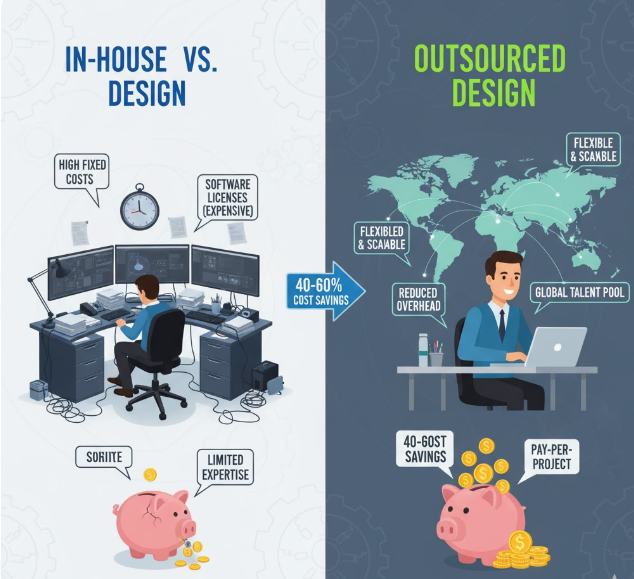
In-house vs outsourced mechanical engineering design cost comparison highlighting 40–60% savings for manufacturers in the USA and Western Europe.

Engineering Cost Breakdown: In-house vs Outsourced Mechanical Design for Small Manufacturers

For small-to-medium enterprises (SMEs) focused on product innovation, understanding outsourced mechanical design cost is essential when deciding whether to outsource mechanical design or hire internally plays a vital role in profitability and speed to market. The common belief that “in-house control” is cheaper often hides the true costs of having internal engineering teams. This analysis offers a detailed comparison of engineering costs, providing a framework to evaluate the real costs of outsourcing mechanical engineering against the fixed and hidden expenses of internal staffing. This comparison is important because specialized engineering services can lead to substantial cost savings, often allowing small manufacturers to reduce their overall product development expenses by 40 to 60% while accessing top-notch expertise. Understanding this engineering cost breakdown for product design is the first step in optimizing your SME engineering budget. In-House Engineering Costs vs. Outsourced Mechanical Design Cost When manufacturers compare in-house and outsourced engineering team cost, they often only consider employee salaries. However, the costs of hiring a mechanical engineer go beyond their pay check, creating a significant and often underappreciated financial obligation. The total expenses—fixed no matter the workload—can drain small business resources. Decoding the Hiring Cost of a Mechanical Engineer To fully understand the commitment involved in hiring internally, one must consider the entire compensation package. Let’s break down the costs of hiring a mechanical engineer in the U.S. as a typical example:- Base Salary: A mid-level mechanical design engineer in the U.S. usually earns between $75,000 and $100,000 annually. This is the minimum fixed expense. (Source: BLS Mechanical Engineer Salary Data, SBA Payroll Tax Guide) Payroll Taxes and Benefits: Employers must cover FICA, state, and federal taxes, unemployment insurance, and worker’s compensation. Additionally, offering competitive benefits (like health, dental, 401k match, paid time off, and sick leave) typically adds another 30% to 45% on top of the base salary. Example: For a $90,000 base salary, the real cost of an in-house engineering team, including benefits, jumps to about $117,000 to $130,500, even before considering overhead. This sharply contrasts with a project-based engineering salary versus outsourcing, where you pay only for completed work. The True Cost: Overhead and Hidden Expenses in Outsourced Mechanical Design Cost Analysis One of the most overlooked parts of the engineering cost comparison is the overhead related to the engineering team. These costs exist whether your engineer is actively working on a product or waiting for the next project phase. When companies evaluate outsourced mechanical design cost, this hidden overhead becomes a critical factor—often revealing how outsourcing can eliminate non-productive expenses and improve overall engineering efficiency. Software and Tooling: Accessing professional-grade tools is essential. Annual license fees for advanced CAD/CAE software (like SolidWorks, Fusion 360, or specialized analysis tools) can range from $5,000 to $20,000 per seat per year. Physical Infrastructure: Costs for office space, dedicated desks, high-performance workstations, utilities, and IT support add significantly to fixed expenses. Training and Development: To maintain skills, mandatory training, conferences, and certifications can add several thousand dollars each year. (Guidelines: WIPO IP Guide, USPTO IP Policy) Recruitment and Turnover: The cost of recruiting a specialized engineer—including agency fees, interview time, and onboarding—represents a major, non-recoverable expense. Capacity Constraints and Inflexibility The in-house model is often rigid. When demand spikes, the team can become overloaded, leading to delays. When demand drops, which is common in cyclical product development phases, manufacturers still pay 100% of the engineer’s salary and overhead costs. This fixed-cost model lacks the flexibility small manufacturers need to stay competitive. By comparing these fixed expenses with outsourced mechanical design costs, it becomes clear that outsourcing offers a more scalable, cost-efficient alternative that aligns engineering resources with actual project demand. Analysing the Mechanical Engineering Outsourcing Cost The main benefit of outsourcing mechanical design is turning a large fixed cost into a precise, variable project expense. Small manufacturers pay only for the specific expertise and hours they require, making the engineering cost comparison tilt heavily in favour of outsourcing for non-continuous or specialized work. When evaluating outsourced mechanical design cost, it becomes clear that this model helps businesses control spending while accessing exactly the level of engineering support they need. Flexible Models for Outsourced Mechanical Design Outsourcing provides various engagement models, offering significant flexibility for the SME engineering budget:- Project-Based (Fixed Price): This model works best for well-defined deliverables (like designing a specific enclosure or optimizing a single part). The manufacturer gets a fixed engineering cost breakdown upfront, preventing budget overruns. Time & Materials (Hourly): This model suits ongoing development, troubleshooting, or tasks with an undefined scope. It directly connects to mechanical design hourly rates. Retainer Model: This option offers dedicated capacity at a better rate. The retainer model is ideal for manufacturers with predictable yet intermittent monthly engineering needs. Calculating the Outsourced CAD Design Cost and CAD/CAE Cost Per Hour External firms typically use a transparent pricing structure based on specific deliverables or hourly rates:- Hourly Rates: While a U.S.-based consulting firm may charge $120 to $200 per hour, this rate includes software licenses, overhead, and benefits. Clients do not pay for employee downtime or training. Global Sourcing (Offshore): Hiring an offshore engineering team can significantly lower rates, sometimes down to $40 to $80 per hour, depending on the specialization and location. This reduction can greatly decrease the outsourced CAD design cost for high-volume modelling work. (Industry data: Statista Outsourcing Data) Focus on Output: Unlike internal engineers, whose costs accrue regardless of output, external teams charge based on completing milestones. The effective CAD/CAE cost per hour becomes a performance metric rather than a fixed expense. When SMEs analyze outsourced mechanical design cost, they often find that this milestone-based model brings far greater efficiency and accountability.  This analysis shows that the outsourcing cost model protects the SME engineering budget from the steep fixed commitment of $148,000 for a single internal engineer. Scenario Analysis: Project-Based Needs Consider a small manufacturer needing 500 hours of product development work over the year for two new products. In-House Cost: $148,000 (The manufacturer still pays 100% of

Engineering Cost Breakdown: In-house vs Outsourced Mechanical Design for Small Manufacturers Read More »

IP67IOT enclosure design services for waterproof, drop-proof, heat-managed IoT enclosures.

IP67, Drop-Proof, and Heat-Managed IoT Enclosures: Engineering Best Practices US & European Brands Must Know

IP67 IoT Enclosure Design Services are essential for building reliable products. Modern IoT hardware operates in tough environments. Whether a smart meter in a snow-covered utility area, an outdoor sensor on a pole in Arizona, a gateway on a construction site, or a device attached to heavy equipment, the enclosure plays a crucial role in the system’s survival against real-world stress. For U.S. and Western European buyers who prioritize long-term reliability, regulatory compliance, and predictable field performance, enclosure engineering directly affects product success, warranty cost, and customer trust. For U.S. brands in industrial, consumer, or commercial sectors, enclosure engineering is now essential for product reliability, rather than just an afterthought during mechanical design. Companies in the U.S., Germany, France, the Netherlands, and the Nordics increasingly demand IP67 sealing, thermal stability, and impact performance as mandatory—not optional—criteria before approving a design partner or outsourcing engineering. An enclosure that has IP67 protection, withstands drops, and manages heat effectively is the new standard for rugged IoT products. Engon Technologies has extensive experience in these areas. This guide reveals the engineering basics U.S. teams must embrace to create reliable, field-ready IoT hardware. For buyers seeking faster time-to-market, extended device lifetime, and reduced maintenance cost, these best practices directly map to measurable ROI. Why High-Performance Enclosures Matter in the U.S. Market – IP67 IoT Enclosure Design Services The United States faces a mix of environmental and operational challenges. From humid conditions on the East Coast to the extreme heat of the Southwest, and from the cold Midwest winters to stormy Gulf areas, IoT devices must function reliably year-round. These climate differences are just part of the picture. Many IoT systems are used in industries like construction, public utilities, logistics, manufacturing, and agriculture. These settings expose devices to dust, vibrations, handling, temperature changes, and unpredictable weather. Key Reliability Expectations from U.S. & EU Engineering Buyers U.S. and European buyers look for partners who can guarantee: Proven IP67/IP68 sealing performance Ability to pass UL, CE, NEMA, IK, ASTM, and MIL-STD tests Low failure rates during deployment (critical for enterprise and government buyers) Designs optimized for scalable manufacturing and reduced warranty claims Engineering teams with simulation, DFM, and ruggedization expertise That’s why creating rugged IoT enclosure systems with IP67 sealing, drop resistance, heat stability, and UV protection is essential. U.S. customers expect products to endure real-life handling, and regulatory agencies often require specific durability tests. A smartly designed waterproof IoT enclosure keeps services running, reduces failures in the field, and shields sensitive electronics from moisture, dust, and accidental submersion. A well-constructed drop-proof enclosure ensures the product can handle unintentional drops or rough treatment by technicians during installation and maintenance. Finally, a heat-managed IoT enclosure prevents overheating and extends the lifespan of internal components. These points directly influence purchasing approval cycles and are often key decision criteria in U.S. and EU RFPs. Understanding IP67 Requirements for IoT Devices – IP67 IoT Enclosure Design Services IP67 certification is a common goal for outdoor and industrial IoT products. The “6” ensures full protection against dust, while the “7” indicates water resistance for up to one meter deep for 30 minutes. Getting this rating involves more than just adding a gasket. It requires precise engineering of every mechanical interface, including mating surfaces, screw bosses, ventilation designs, PCB positioning, and manufacturing tolerances. Why IP67 Matters When Outsourcing Mechanical Design This level of engineering rigor is exactly what U.S. & EU buyers expect when outsourcing mechanical design for enclosure development—especially in industrial, energy, EV charging, metering, environmental monitoring, and smart-city applications. In the U.S., IP67 is largely viewed as equal to or a functional alternative to specific NEMA enclosure ratings depending on the application. Many brands aim for a single enclosure design that meets both global and local standards. This makes robust IP67 plastic enclosure design critical for compliance and market acceptance. Engineering an IP67 Enclosure: Principles That Cannot Be Ignored – IP67 IoT Enclosure Design Services An effective IP67 IoT enclosure design revolves around controlled sealing and predictable mechanical behaviour. Key elements include the geometry of mating surfaces, gasket reliability, material stability, tolerances, screw load distribution, and surface smoothness. A good housing typically uses a tongue-and-groove or stepped design to ensure a controlled sealing path. This setup stops water from bypassing the joint and creates a uniform compression area for the gasket. Buyers in the U.S./EU often evaluate suppliers based on repeatable gasket compression quality, automated QC processes, and sealing consistency at scale—core requirements for reducing failure rates during mass deployment. Sealing & Gasket Engineering Best Practices Gasket design matters just as much. The gasket must maintain long-term compression without losing its elasticity, even when exposed to sunlight or going through repeated temperature shifts. Silicone is often preferred due to its durability, resilience, and consistent performance. For products meant for long outdoor use, UV-resistant silicone or EPDM materials often perform better. The gasket track design must support the right compression. Too much compression harms the seal, while too little fails to provide waterproofing. Consistent gasket placement and not relying on adhesive for sealing are vital best practices. Manufacturing Tolerances & QC Also, IP67 sealing design relies heavily on managing manufacturing tolerances. Variations in enclosure walls, mating surfaces, or screw bosses can lead to small gaps that break waterproofing. Draft angles, Mold shrinkage, and part warpage must be accounted for at the design stage. This is why successful IP67 mechanical design guidelines stress close cooperation among design engineers, material specialists, and melding teams. These factors also drive cost savings for buyers by reducing retooling iterations and accelerating NPI timelines. SEALING METHODS COMPARISON Sealing Method Strength Weakness Best For Silicone Gasket Long life, flexible Needs precise compression IP67 industrial devices EPDM Gasket UV resistant Less flexible Outdoor sunlight-heavy use Liquid Gasket Automated application Hard to rework Mass-production Overmolded Seal Best sealing High tooling cost Rugged devices, zero leakage Material Selection: The Foundation of a Rugged Outdoor IoT Device – IP67 IoT Enclosure Design Services Choosing the material for an outdoor IoT device enclosure is

IP67, Drop-Proof, and Heat-Managed IoT Enclosures: Engineering Best Practices US & European Brands Must Know Read More »

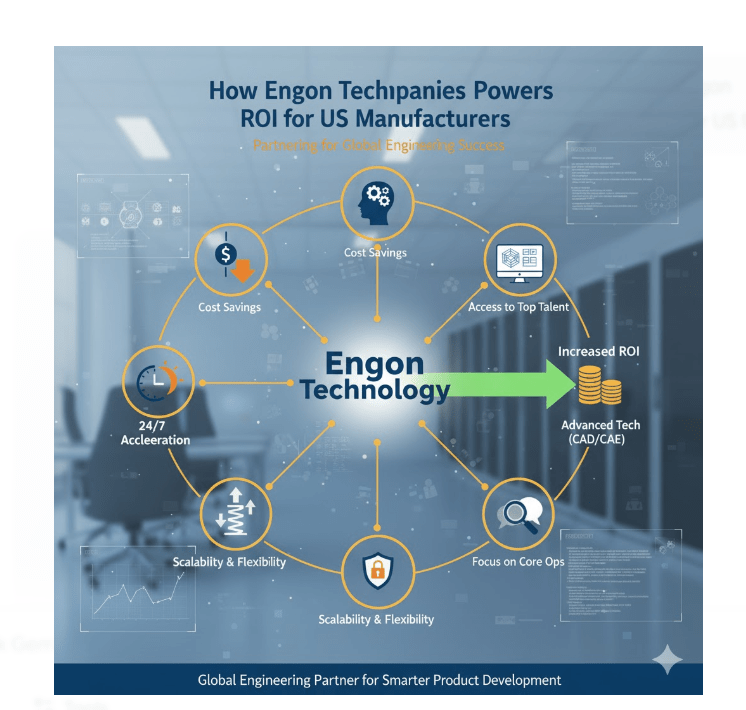
Engon Technologies powers ROI for US manufacturers through global mechanical design outsourcing, highlighting cost savings, 24/7 acceleration, scalability, access to top talent, and advanced CAD/CAE technology

How US Manufacturers Boost ROI Through Global Mechanical Design Partnerships

Why Global Mechanical Design Outsourcing Boosts ROI In today’s highly competitive manufacturing landscape, US manufacturers are under constant pressure to innovate faster, reduce production costs, and improve product quality — all while maintaining profitability and ROI. Traditional in-house design teams, though capable, often face limitations in scalability, specialized expertise, and cost efficiency. This is where global mechanical design outsourcing partnerships come in, offering a smarter, leaner, and more collaborative approach to engineering excellence. By leveraging specialized outsourced mechanical design outsourcing services, manufacturers are no longer confined to local talent pools or costly R&D setups. Instead, they gain access to a worldwide network of mechanical engineers, product designers, and simulation experts who work around the clock to bring ideas to life. For US firms, this isn’t just about cutting costs — it’s about unlocking innovation, agility, and faster time-to-market. Companies like Engon Technologies are at the forefront of enabling this transformation. With a global delivery model and a proven record in mechanical product development, Engon helps manufacturers turn complex design challenges into commercially viable solutions that directly improve ROI. Quick Stats — ROI from Global Mechanical Design Outsourcing Key Metric Impact for US Manufacturers 30% Faster Design Cycle Achieved through 24/7 design collaboration and global engineering handoff. 25% Cost Reduction Lower labor and infrastructure costs via offshore design partnerships. 20–35% Higher ROI Driven by faster time-to-market and improved design optimization. 100% Quality Assurance ISO & ASME-compliant engineering processes validated with FEA and CAD simulations. Understanding the ROI Equation in Manufacturing Design Return on Investment (ROI) in manufacturing has traditionally been measured by tangible outcomes like reduced production costs, shorter design cycles, and lower failure rates. However, the modern ROI equation includes strategic intangibles — agility, innovation capability, and global competitiveness. When manufacturers invest in mechanical design outsourcing services, they’re not merely buying engineering hours; they’re investing in efficiency and innovation multipliers. Global partnerships enable them to spread R&D costs, tap into niche domain expertise, and accelerate product iterations through parallel engineering teams. This combination directly translates to higher ROI through: Faster Time-to-Market: With global design teams working across time zones, development cycles shrink dramatically. Lower Overheads: Outsourcing eliminates fixed costs of hiring, training, and maintaining large in-house teams. Higher Quality Output: Access to multidisciplinary experts ensures better validation, fewer redesigns, and improved product performance. Engon Technologies, for example, has worked with several US-based OEMs to achieve up to 30% reduction in design cycle time and 25% cost savings per project. Their approach combines precision-driven modeling tools like SolidWorks and Creo with simulation-driven validation to ensure every product is optimized before it reaches production. Ultimately, ROI in manufacturing today isn’t just a financial metric — it’s a reflection of how efficiently and intelligently a company designs its future products. The Strategic Edge of Global Mechanical Design Partnerships Global design partnerships have evolved beyond transactional outsourcing. Today, they represent a long-term strategic collaboration that fuels innovation, scalability, and operational excellence. By forming alliances with specialized engineering partners like Engon Technologies, US manufacturers can amplify their design capabilities without inflating costs. Such partnerships are built on co-engineering models, where the external design team functions as an integrated extension of the client’s in-house R&D. This allows for flexible resource scaling during high-demand phases like product launches or redesign cycles. Additionally, global partners bring exposure to diverse manufacturing standards, materials, and simulation methodologies — offering design diversity and risk mitigation that internal teams often lack. Engon Technologies stands out in this space by aligning global resources with local client priorities. Their project management framework ensures seamless collaboration, real-time updates, and quality assurance at every stage of mechanical product development. For US manufacturers aiming to enter new markets, this global-local synergy ensures that designs are compliant with international safety norms and production constraints. In essence, global partnerships transform design from a cost center into a competitive differentiator. When managed strategically, they not only reduce expenditure but also elevate the manufacturer’s ability to innovate — driving sustainable ROI growth. Cost Efficiency Without Compromising Innovation One of the biggest myths about outsourcing design is that cost savings come at the expense of innovation or quality. In reality, outsourced mechanical design services can deliver both — when executed with the right partner. Engon Technologies has perfected this balance through its “Value Engineering First” philosophy. Instead of simply executing client blueprints, the company collaborates deeply to identify optimization opportunities — whether it’s reducing material usage, simplifying assembly, or improving manufacturability. Every design phase, from CAD modeling to prototype validation, is guided by the dual goals of cost-effectiveness and innovation excellence. Through advanced simulation software’s, Engon’s engineers validate mechanical integrity and optimize performance before production begins. This proactive design validation prevents costly post-production errors and rework — one of the most overlooked ROI killers in manufacturing. By tapping into global mechanical design engineering partnerships, US manufacturers can access top-tier design expertise at a fraction of the local cost. The savings generated can then be reinvested into innovation — funding new product lines, automation upgrades, or sustainable material exploration. In today’s competitive landscape, the smartest manufacturers are not those who spend more but those who design smarter. Engon enables precisely that — helping clients achieve cost efficiency without diluting creativity or engineering rigor. Accelerating Product Development and Time-to-Market In fast-moving industries like consumer electronics, automotive, or industrial equipment, speed defines survival. The faster a company can move from concept to prototype to production, the stronger its market advantage. This is where global mechanical design engineering partnerships deliver a massive ROI impact. Engon’s distributed engineering model enables round-the-clock development. With design teams in multiple time zones, progress continues even after US business hours — effectively cutting project turnaround times by 30–40%. This time-zone advantage allows manufacturers to iterate designs, run simulations, and receive deliverables overnight. Furthermore, Engon’s agile project management ensures that feedback loops are short and transparent. Using digital collaboration platforms, clients can review 3D models, simulation reports, and design revisions in real time. This agility not only accelerates product development but

How US Manufacturers Boost ROI Through Global Mechanical Design Partnerships Read More »

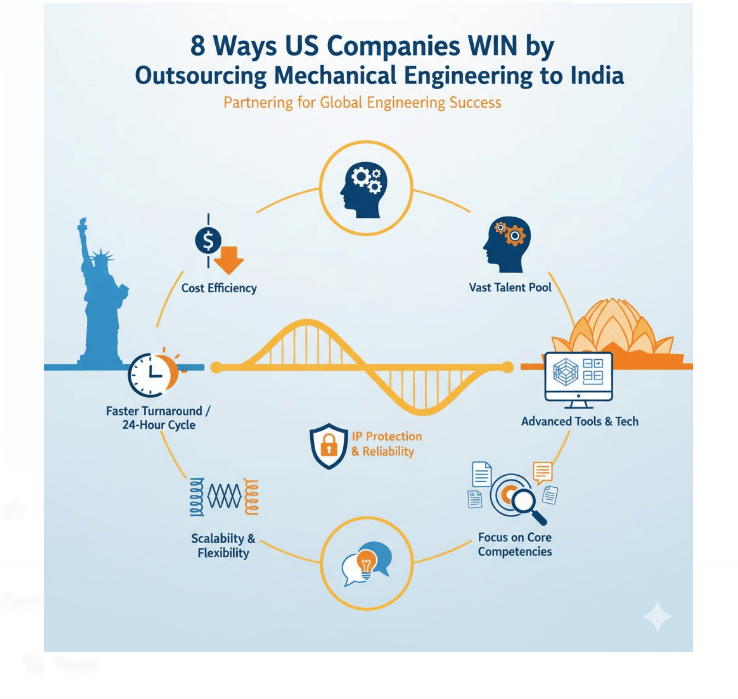
US company collaborating with Indian mechanical engineers for CAD design

8 Ways US Companies Gain by Outsourcing Mechanical Engineering to India

In today’s fast-paced product development ecosystem, agility, precision, and cost-effectiveness determine who leads and who lags. For many US-based manufacturing and product design companies, balancing innovation with operational efficiency has become increasingly complex. This is where outsourcing mechanical engineering to India is transforming the competitive landscape. India has evolved into a powerhouse for mechanical design, prototyping, and simulation services, offering not only cost advantages but also world-class engineering expertise. With a strong pool of mechanical engineers, advanced CAD/CAE proficiency, and a growing culture of innovation, India provides more than just a workforce — it offers partnership in problem-solving. For US companies, collaboration with Indian firms like Engon Technologies enables faster project turnaround, higher design precision, and scalability without inflating operational costs. Engon’s engineering teams combine technical excellence with a deep understanding of international manufacturing standards, helping startups and OEMs alike bring complex ideas to market efficiently. Here are eight powerful ways in which US companies gain a tangible edge by outsourcing mechanical engineering design and development to India — and how Engon Technologies is helping bridge that global innovation gap. Cost Efficiency Without Compromising Quality One of the primary reasons US companies turn to India for mechanical engineering support is the significant cost advantage. Outsourcing can reduce project expenses by up to 50–60%, freeing up budgets for research, innovation, and marketing. However, cost savings are only part of the story — quality engineering delivery remains the key differentiator. Indian mechanical engineers are highly skilled in CAD platforms like SolidWorks, Creo, and AutoCAD, ensuring designs meet both aesthetic and functional goals. Firms like Engon Technologies go beyond standard outsourcing by implementing multi-level design quality checks and simulation-based validation before project delivery. This balance of affordability and precision allows US manufacturers to scale operations, experiment with multiple prototypes, and refine product features without the typical cost constraints. Moreover, Engon’s engineering processes adhere to ISO and ASME standards, ensuring every component and assembly aligns with global benchmarks. For startups and mid-sized US businesses, this means having access to premium engineering support that rivals in-house teams — but at a fraction of the cost. Outsourcing to India, when done through a specialized partner like Engon, transforms cost efficiency into strategic value. Access to a Vast Pool of Skilled Engineers India’s mechanical engineering talent pool is among the largest and most diverse in the world. Every year, thousands of engineers graduate with specialized expertise in design, thermodynamics, materials science, and production engineering. This creates a ready ecosystem of technical talent that US firms can tap into for a wide variety of design and development needs. Engon Technologies, for example, leverages this talent advantage by building dedicated engineering teams for US clients across domains like product design, simulation, reverse engineering, and prototyping. Their engineers are trained in global best practices and equipped to collaborate seamlessly across time zones using modern communication tools and project management systems. This scalability helps US businesses overcome a key challenge — shortage of skilled engineers locally. Whether it’s a startup developing a custom enclosure for IoT devices or an established OEM needing component redesigns, Engon can instantly onboard experts tailored to the project’s needs. By outsourcing to India, US companies gain not just manpower, but specialized minds who understand complex geometries, design optimization, and real-world manufacturing constraints — ensuring innovation is both practical and production-ready. Faster Turnaround and Time-Zone Advantage In product development, speed to market is everything. Outsourcing to India offers a distinct time-zone advantage that accelerates project timelines. When the US workday ends, Indian teams begin theirs — effectively creating a 24-hour engineering cycle. This means design iterations, simulations, and revisions can continue overnight, leading to faster project delivery and reduced time-to-market. Engon Technologies maximizes this benefit by operating on a “follow-the-sun” model, ensuring continuous progress. For example, a US client can share project inputs at the end of their day, and Engon’s engineers can have updates ready by the next morning. This seamless workflow drastically reduces delays in design validation, prototyping, and documentation. Moreover, Engon combines agile methodologies with engineering design principles, allowing clients to receive frequent updates, feedback loops, and quick design refinements. For industries where deadlines dictate competitiveness — such as automotive, consumer electronics, and industrial equipment — this model ensures US companies stay ahead of the curve. By outsourcing to India through Engon Technologies, US businesses not only gain speed but also ensure engineering precision under tight deadlines, a critical advantage in today’s innovation-driven economy. Access to Advanced Engineering Tools and Technologies Modern mechanical design demands cutting-edge software and tools for CAD modelling, CAE simulation, FEA analysis, and product lifecycle management. Outsourcing to India provides US companies access to the latest engineering technologies without heavy capital investment. Engon Technologies, for instance, employs a full suite of tools such as SolidWorks, Creo, CATIA, Ansys, and Autodesk Inventor, ensuring compatibility with global design ecosystems. This allows clients to receive deliverables in formats that integrate seamlessly into their internal processes. Beyond software, Engon uses virtual prototyping, 3D simulation, and digital twin approaches to validate designs before production. This reduces errors, improves design reliability, and enhances manufacturability — saving both time and money in the long run. For smaller US companies, this is a game-changer. Instead of spending thousands on licenses and high-end hardware, they can access world-class design environments through Engon’s infrastructure. Engon’s engineering ecosystem enables clients to innovate freely without infrastructure constraints, turning ideas into production-ready designs faster and more accurately. By outsourcing mechanical engineering to India, US firms gain the technological leverage they need to compete globally — powered by partners like Engon who invest heavily in tools, training, and process automation. Scalability and Flexibility for Every Project Size One of the most overlooked advantages of outsourcing mechanical engineering to India is scalability. Whether a US company needs support for a single prototype or an entire product line redesign, Indian engineering firms can quickly adapt to changing project scopes. Engon Technologies offers flexible engagement models — from project-based assignments to dedicated design teams — allowing

8 Ways US Companies Gain by Outsourcing Mechanical Engineering to India Read More »