
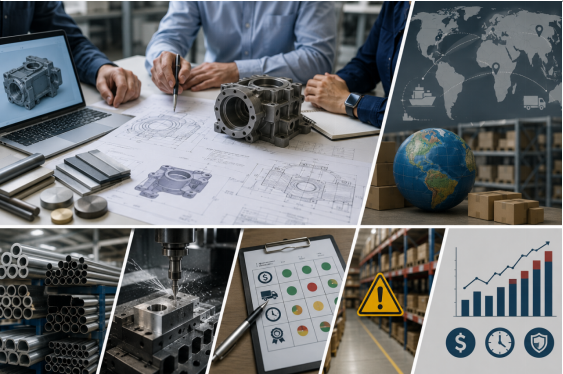
 A hardware product rarely moves directly from a concept sketch to a production line.
Between those two points are a series of engineering decisions that determine whether the product will perform as intended, whether its components can be assembled efficiently, whether the selected manufacturing process is appropriate, and whether the design can be produced consistently at the required volume.
A CAD model is an important part of that process, but it is only one part.
A product can have a complete 3D model and still have problems with material selection, tolerances, assembly access, manufacturability, structural performance, or production economics. Those problems become progressively more expensive to address as development moves from concept to prototype, tooling and production.
In practice, many manufacturing problems are not caused by a single major design error. They often come from small decisions made early in development—an inaccessible fastener, an unnecessarily tight tolerance, an unsuitable datum, a difficult-to-machine feature, or geometry that complicates tooling.
This is where hardware product engineering becomes important.
Rather than treating CAD, prototyping, DFM, validation and manufacturing support as disconnected activities, product engineering brings them together around the requirements of the finished product.
The objective is not simply to create geometry that works in CAD. It is to develop a product whose design, materials, tolerances, assembly method and manufacturing process work together under real production conditions.
Almost 70% of manufacturing costs are determined during the design phase and yet, most product teams only begin thinking about manufacturing after the design is finalized. This is a profound problem in product development.
A hardware product rarely moves directly from a concept sketch to a production line.
Between those two points are a series of engineering decisions that determine whether the product will perform as intended, whether its components can be assembled efficiently, whether the selected manufacturing process is appropriate, and whether the design can be produced consistently at the required volume.
A CAD model is an important part of that process, but it is only one part.
A product can have a complete 3D model and still have problems with material selection, tolerances, assembly access, manufacturability, structural performance, or production economics. Those problems become progressively more expensive to address as development moves from concept to prototype, tooling and production.
In practice, many manufacturing problems are not caused by a single major design error. They often come from small decisions made early in development—an inaccessible fastener, an unnecessarily tight tolerance, an unsuitable datum, a difficult-to-machine feature, or geometry that complicates tooling.
This is where hardware product engineering becomes important.
Rather than treating CAD, prototyping, DFM, validation and manufacturing support as disconnected activities, product engineering brings them together around the requirements of the finished product.
The objective is not simply to create geometry that works in CAD. It is to develop a product whose design, materials, tolerances, assembly method and manufacturing process work together under real production conditions.
Almost 70% of manufacturing costs are determined during the design phase and yet, most product teams only begin thinking about manufacturing after the design is finalized. This is a profound problem in product development.
Manufacturing Cost Is Often Shaped Early
This is why manufacturing considerations need to be introduced early in the product development process. Decisions about materials, tolerances, part geometry, manufacturing processes, assembly methods and tooling can significantly influence the final cost and production feasibility of a product.Addressing these factors during design can help identify potential manufacturing and cost issues before they become expensive changes later in development.
Need Engineering Support for Your Hardware Startup?
Whether you are refining a concept, developing your first prototype, or preparing an existing design for manufacturing, the right engineering support can help you make better decisions earlier.
Explore Engon’s Mechanical Product Engineering Support →1. Why Product Engineering Decisions Matter Before Manufacturing
Product Engineering at a Glance
The objective is not simply to create geometry that works in CAD. It is to develop a product whose design, materials, tolerances, assembly method and manufacturing process work together under real production conditions.| Requirements |
| Architecture |
| Mechanical Design |
| Prototype |
| Validation |
| DFM |
| Production |
Product engineering connects early design decisions with the realities of manufacturing, assembly, validation and production.
Many of the decisions that influence downstream manufacturing problems are made before a product reaches production. Understanding those relationships early can help prevent expensive changes later.2. Define the Product Architecture Before Detailed CAD
What Needs to Be Defined Early
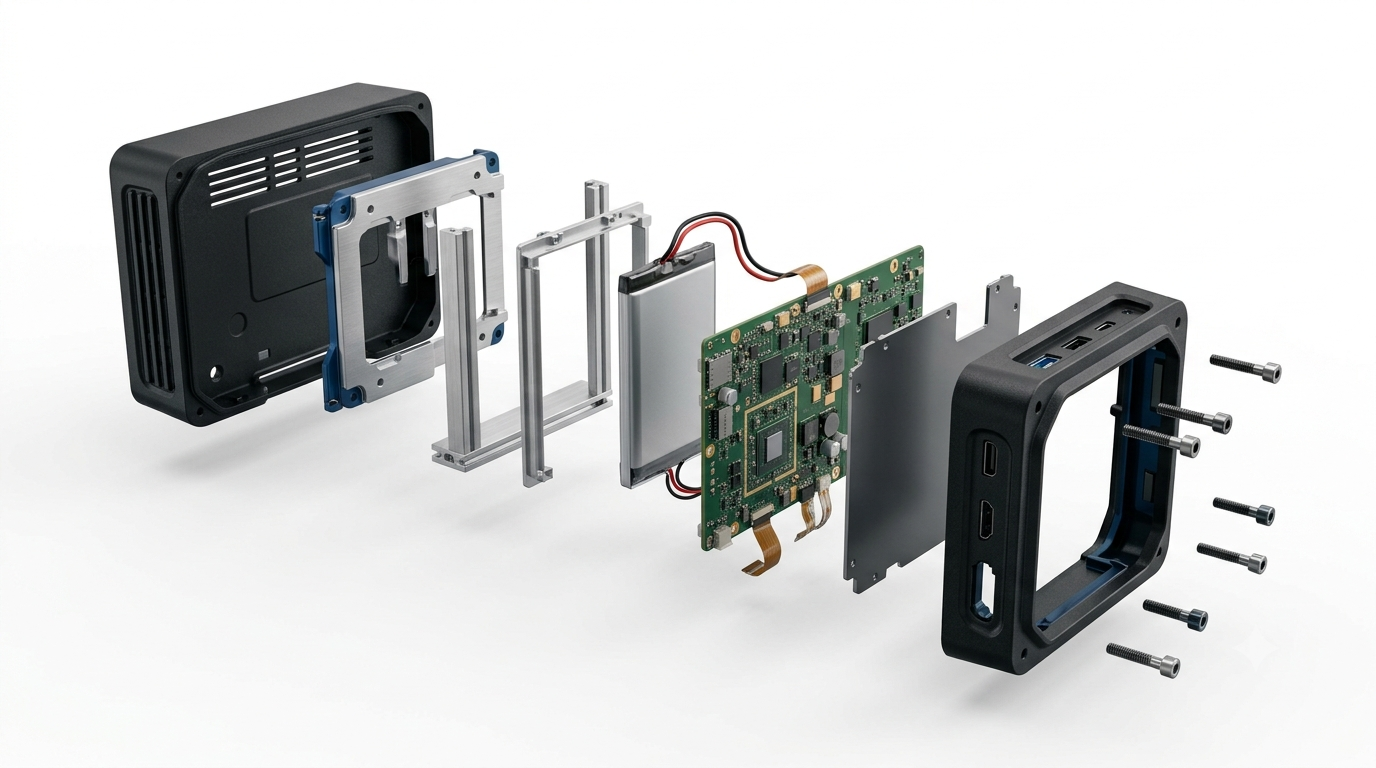
· Product dimensions and packaging constraints · Electronics and component interfaces · Material requirements · Environmental conditions · Expected production volume · Market-specific compliance requirements · Manufacturing processes · Assembly requirements · Serviceability · Performance and testing requirementsEngineering Scenario: Compact Industrial Monitoring Device
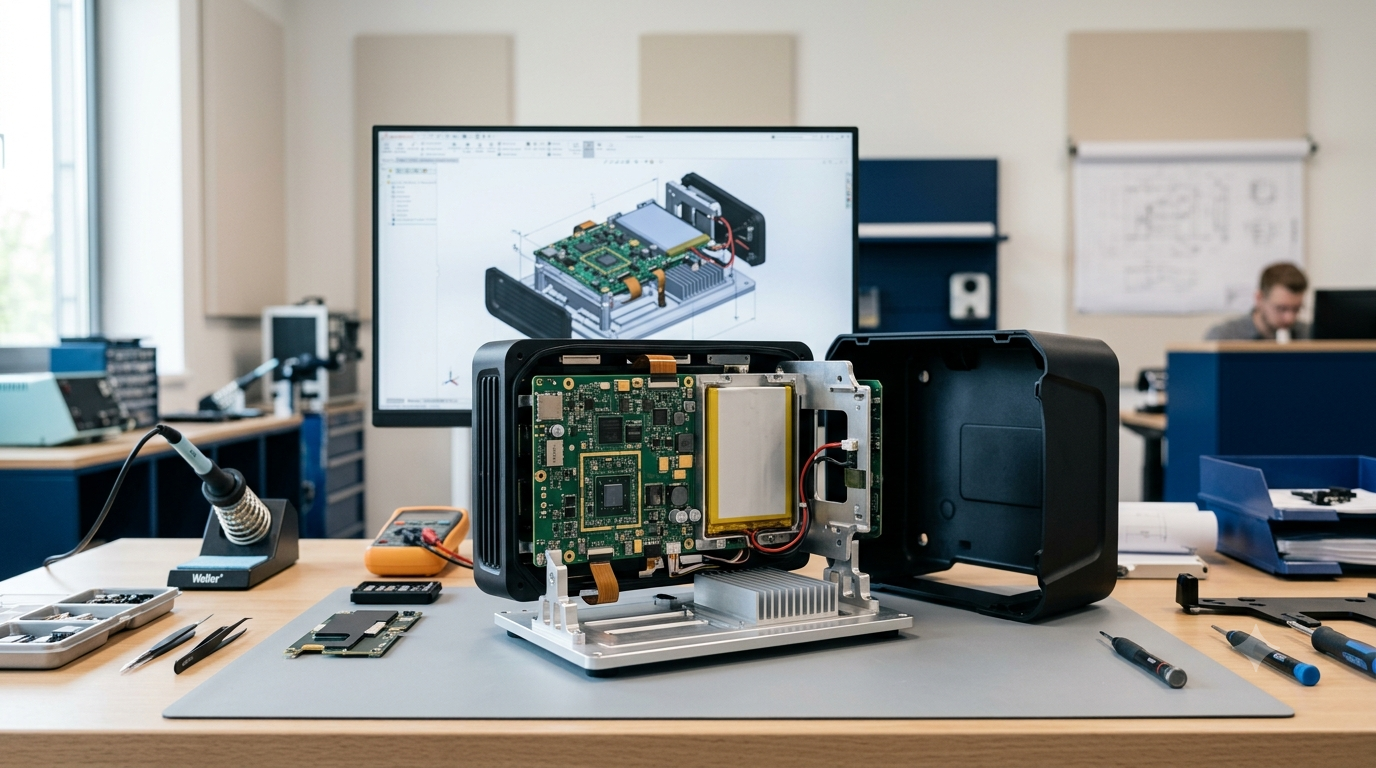
Consider a compact industrial monitoring device containing a PCB, battery, connectors, and mounting hardware. Before detailed CAD begins, engineers must determine how these elements will fit together, how the electronics will be installed, how the housing will be assembled and serviced, and which manufacturing process will support the expected production volume. Validation: Engineers evaluate these requirements together before finalizing the mechanical architecture and detailed CAD. Engineering Insight: Early architectural decisions can affect manufacturing, assembly, serviceability, and downstream component design. Key Takeaway: Defining these relationships early helps prevent costly redesigns later.3.Design the Product Around Its Manufacturing Process
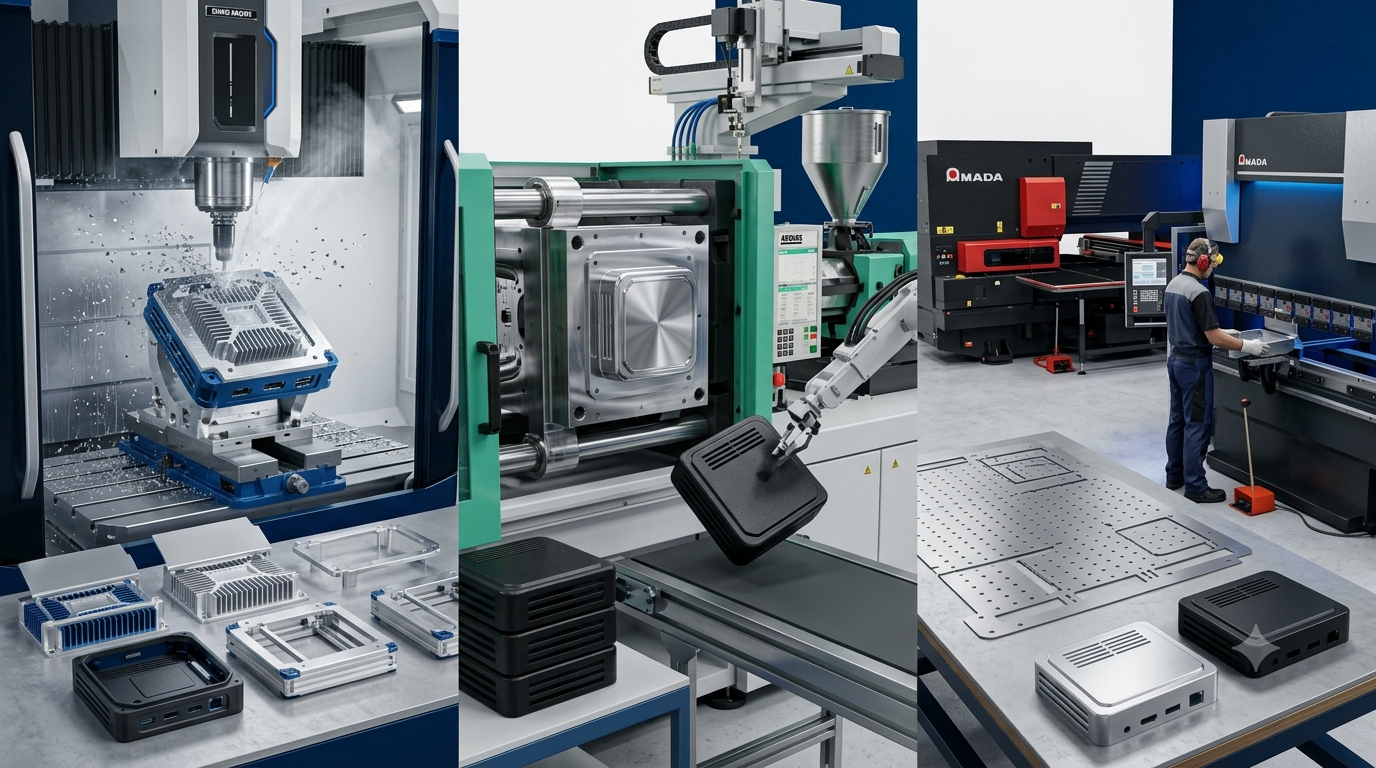 Once the architecture is established, mechanical engineering turns the requirements into physical components and assemblies. This includes 3D CAD, component design, assemblies, interfaces, material selection, tolerances and engineering drawings.
Production Consideration
Production volume can change what constitutes an appropriate design. A geometry suitable for a low-volume CNC prototype may need to be reconsidered when the product moves toward injection molding.
The important distinction is that mechanical design should be developed with the eventual manufacturing process in mind.
Designing for CNC Machining For CNC machining, engineers may need to consider tool access, internal corner radii, feature depth, workholding and the number of machining setups.| Manufacturing Process | Design Considerations |
|---|---|
| Injection molding | Draft, wall thickness, ribs, bosses, undercuts, parting lines, gate locations and ejection strategy |
| CNC machining | Tool access, internal corner radii, feature depth, workholding and number of machining setups |
| Sheet metal | Bend radii, bend sequence, material thickness and feature placement |
Design Decision
The manufacturing process should influence the geometry before detailed CAD is finalized—not be treated only as a downstream decision.
4. Small Design Decisions Can Create Major Production Problems
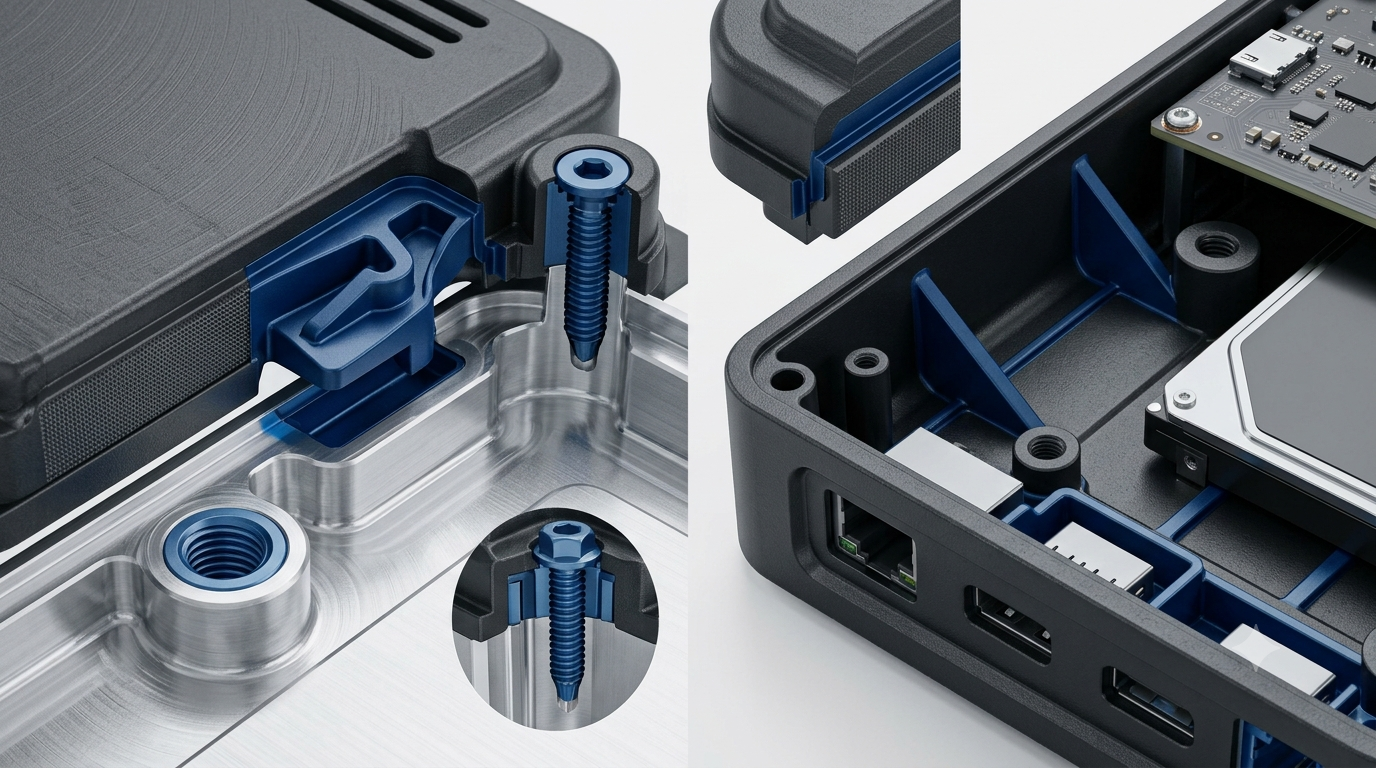 Snap-Fits
A snap-fit can eliminate screws and simplify assembly, but its suitability depends on the material, geometry, deflection, assembly force and expected use.
Snap-Fits
A snap-fit can eliminate screws and simplify assembly, but its suitability depends on the material, geometry, deflection, assembly force and expected use.
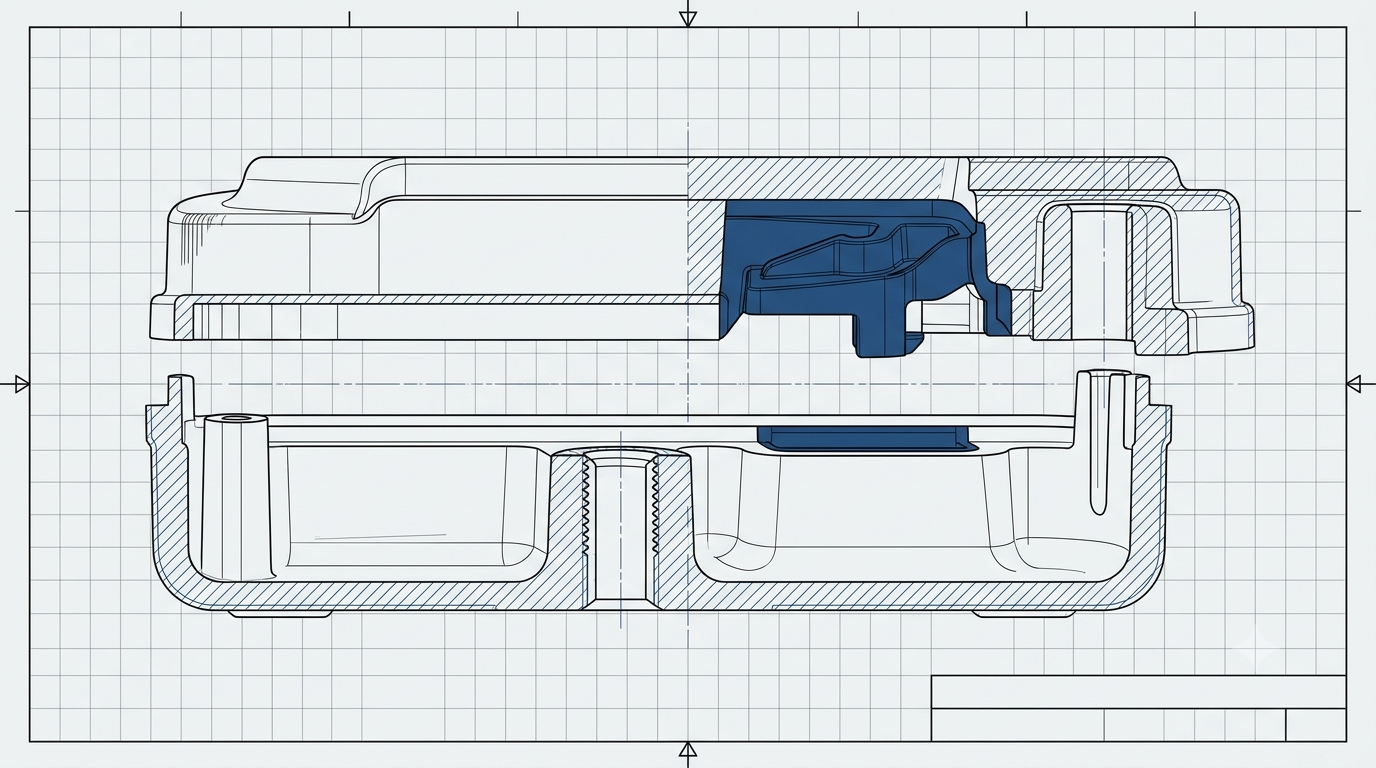 For a plastic enclosure, a snap-fit that appears functional in CAD may still require engineering evaluation for repeated assembly, stress concentration and manufacturing limitations.
Engineering Scenario: When a Snap-Fit Works in CAD but Not in Practice
A plastic enclosure uses snap-fits to reduce screws and simplify assembly. The feature works in CAD, but prototype testing shows that it requires excessive assembly force and may not withstand repeated opening and closing.
Engineers review material behaviour, allowable deflection, stress concentration, assembly direction, operating temperature, and moulding constraints before finalizing the feature.
Validation:
Physical testing confirms whether the snap-fit can be assembled consistently and perform reliably under expected use.
Key Insight:
A feature that works geometrically in CAD may still require changes when real material behavior, manufacturing variation, and actual use are considered.
For a plastic enclosure, a snap-fit that appears functional in CAD may still require engineering evaluation for repeated assembly, stress concentration and manufacturing limitations.
Engineering Scenario: When a Snap-Fit Works in CAD but Not in Practice
A plastic enclosure uses snap-fits to reduce screws and simplify assembly. The feature works in CAD, but prototype testing shows that it requires excessive assembly force and may not withstand repeated opening and closing.
Engineers review material behaviour, allowable deflection, stress concentration, assembly direction, operating temperature, and moulding constraints before finalizing the feature.
Validation:
Physical testing confirms whether the snap-fit can be assembled consistently and perform reliably under expected use.
Key Insight:
A feature that works geometrically in CAD may still require changes when real material behavior, manufacturing variation, and actual use are considered.
| Before | Engineering Review | Production Decision |
|---|---|---|
| Prototype design: separate components may make early iteration easier. | Evaluate consolidation, wall thickness, draft, fastening, material and assembly. | Consolidate components only where the overall manufacturing and lifecycle impact makes sense. |
Design Insight
Fewer parts ≠ automatically better design.
The design also needs to consider the direction of assembly, allowable deflection, material behaviour over the product’s operating temperature range and whether the feature can be molded consistently.
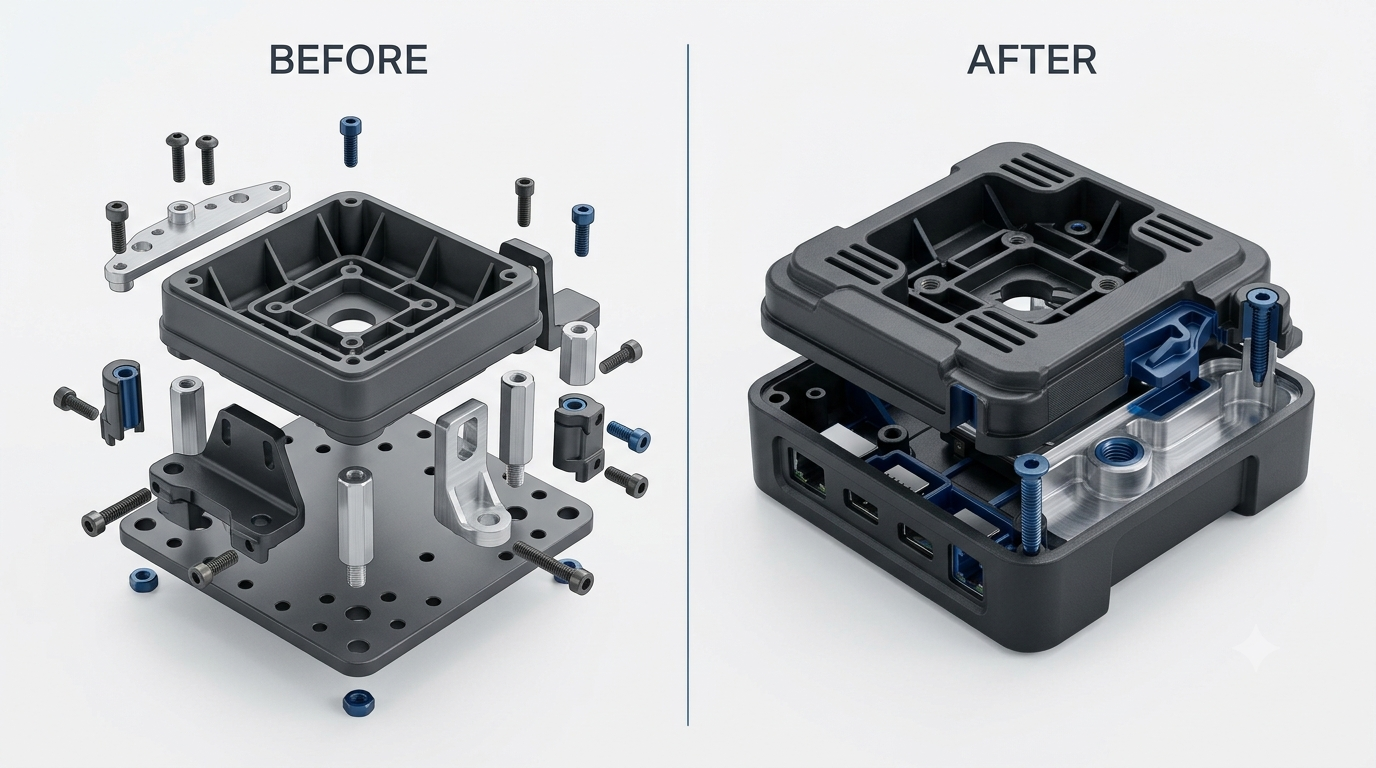
What can go wrong?
Looks simple in CAD → can create problems in production.
Tolerances and Datums
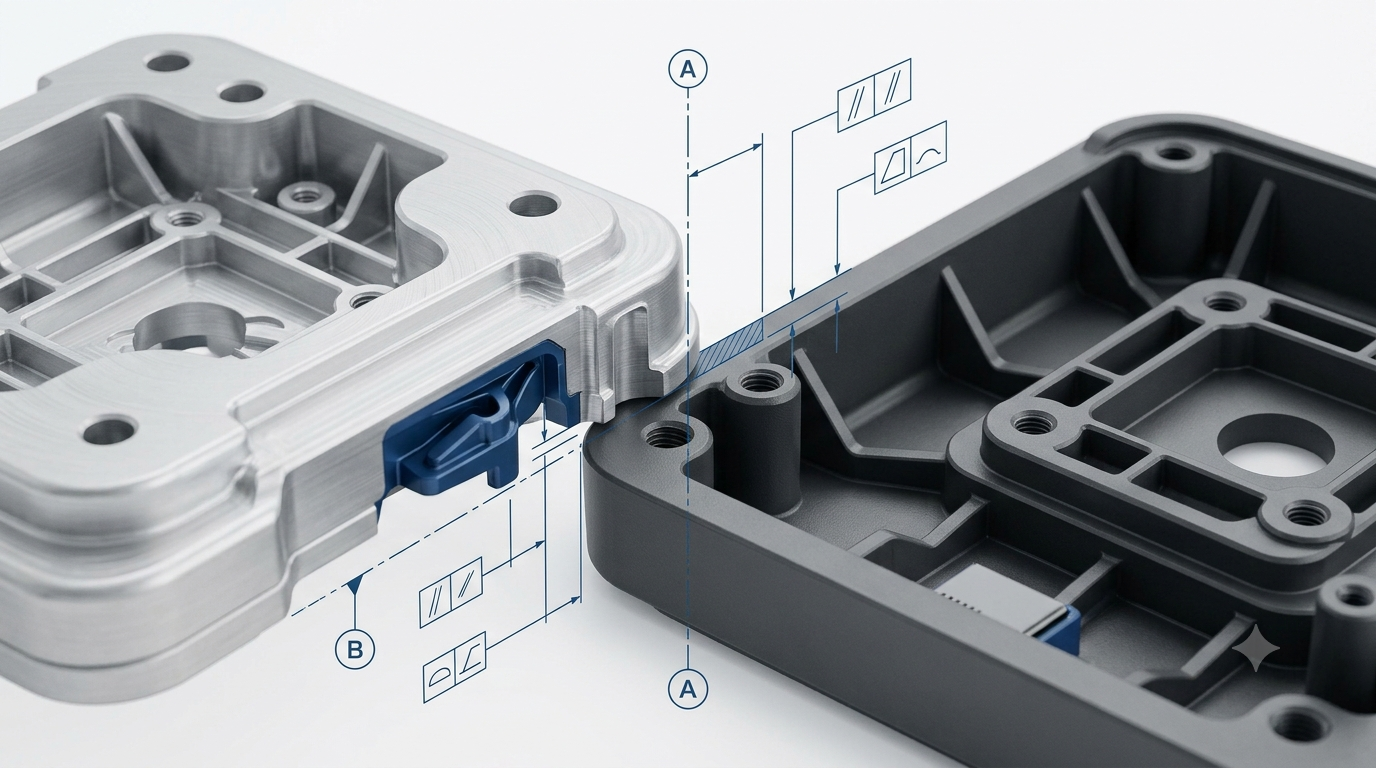
What can go wrong?
Fewer components → potentially more complex tooling, maintenance or repair.
5. Use Prototyping to Find Problems Before Production
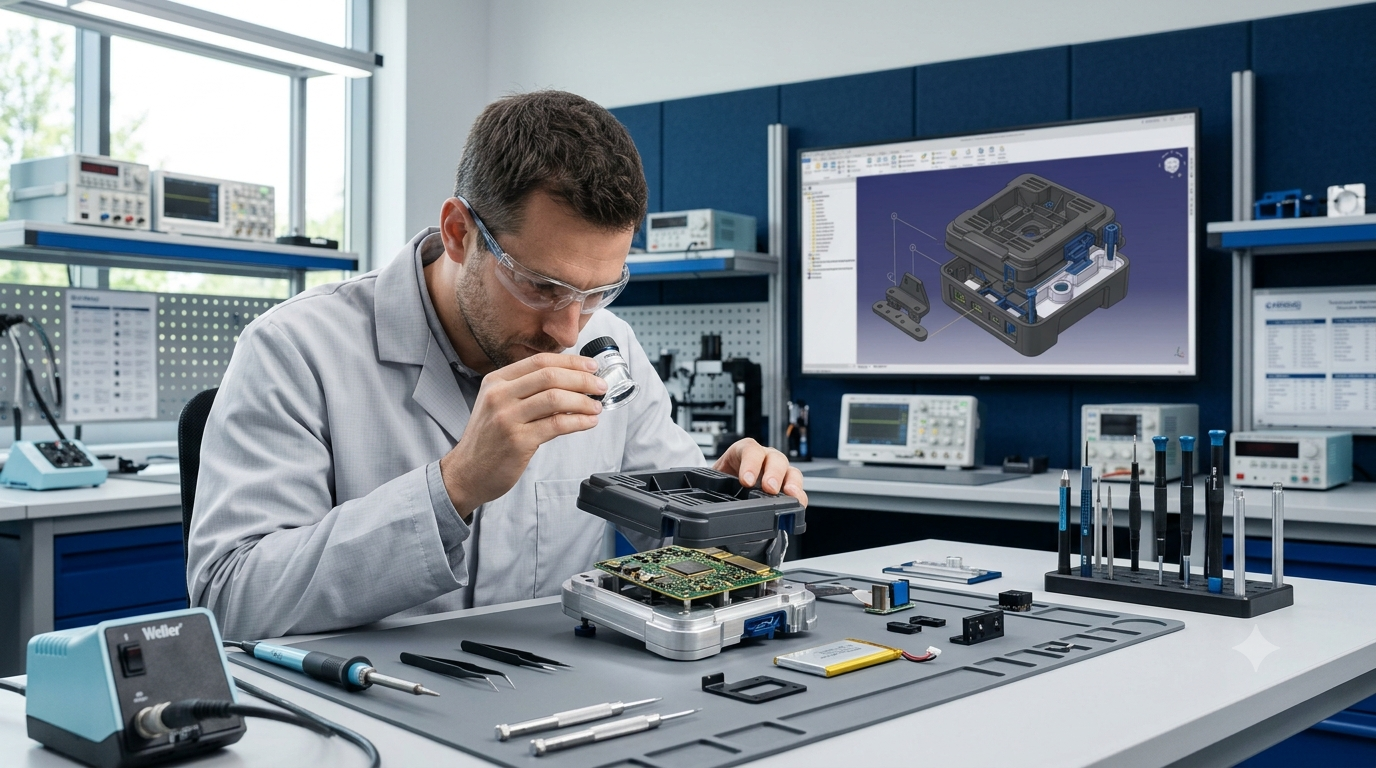
A prototype is often the first opportunity to evaluate how the product behaves outside the CAD environment.
What can go wrong?
Tighter tolerances → not necessarily better quality.
- Component interference
- Assembly sequence
- Fastener accessibility
- Clearances
- Ergonomics
- Structural behaviour
Material selection
Example: When Everything Fits but the Product Is Difficult to Assemble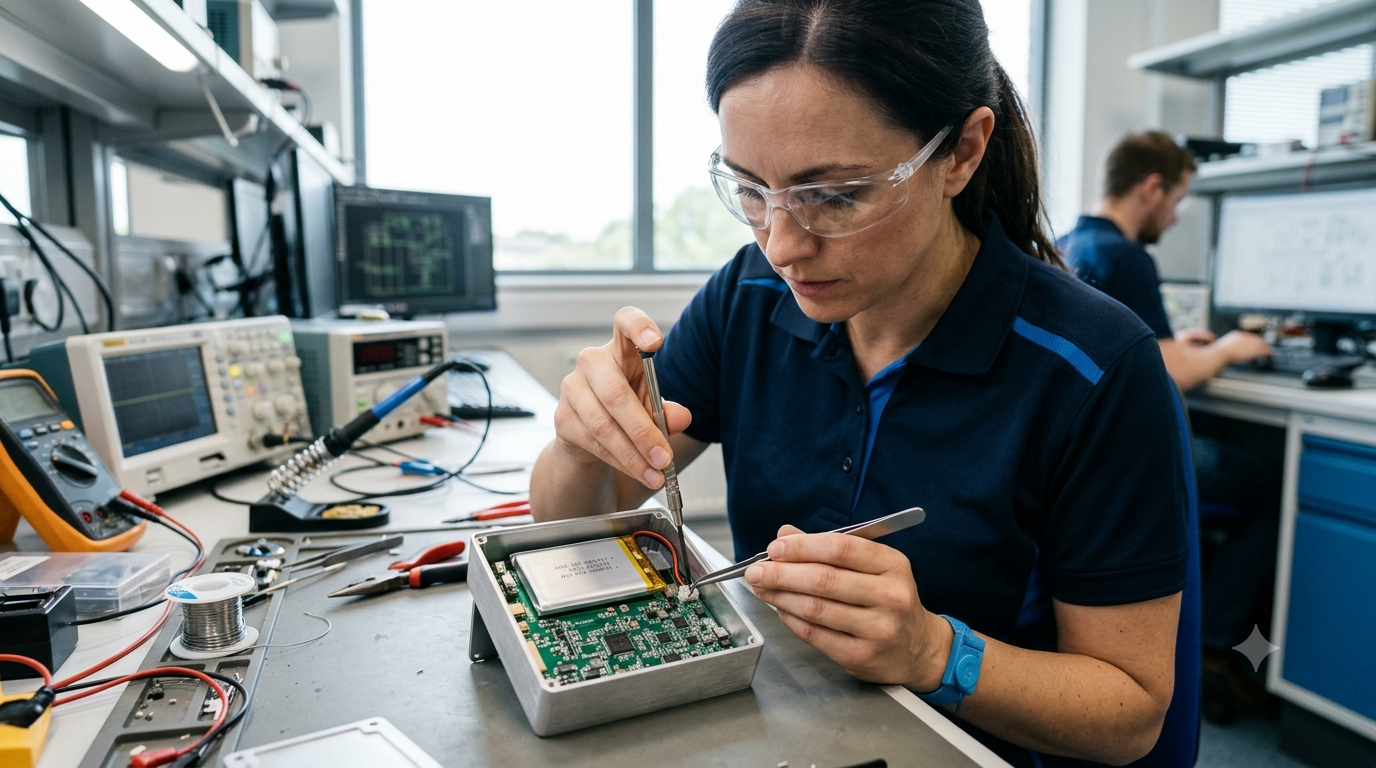 A PCB, battery, and several connectors all fit correctly in the CAD assembly. On the first physical prototype, however, the team discovers a problem: one connector must be installed before another component can be positioned, and access becomes difficult once the housing is partially assembled.
The dimensions are correct. The assembly process is not.
Validation reveals the gap: a small change to the component interface or assembly sequence can make the product easier to assemble before production tooling is committed.
A PCB, battery, and several connectors all fit correctly in the CAD assembly. On the first physical prototype, however, the team discovers a problem: one connector must be installed before another component can be positioned, and access becomes difficult once the housing is partially assembled.
The dimensions are correct. The assembly process is not.
Validation reveals the gap: a small change to the component interface or assembly sequence can make the product easier to assemble before production tooling is committed.
Engineering Insight
Digital fit confirms that components can occupy the required space. Physical validation confirms whether they can be installed, accessed, aligned, and assembled consistently.Key Takeaway
Prototype development should be treated as an engineering feedback loop, not simply a demonstration that the concept works.Each prototype should reveal practical issues—such as assembly access, sequencing, tolerances, and component interfaces—before they become expensive production problems.
6. Validate Performance Before Production
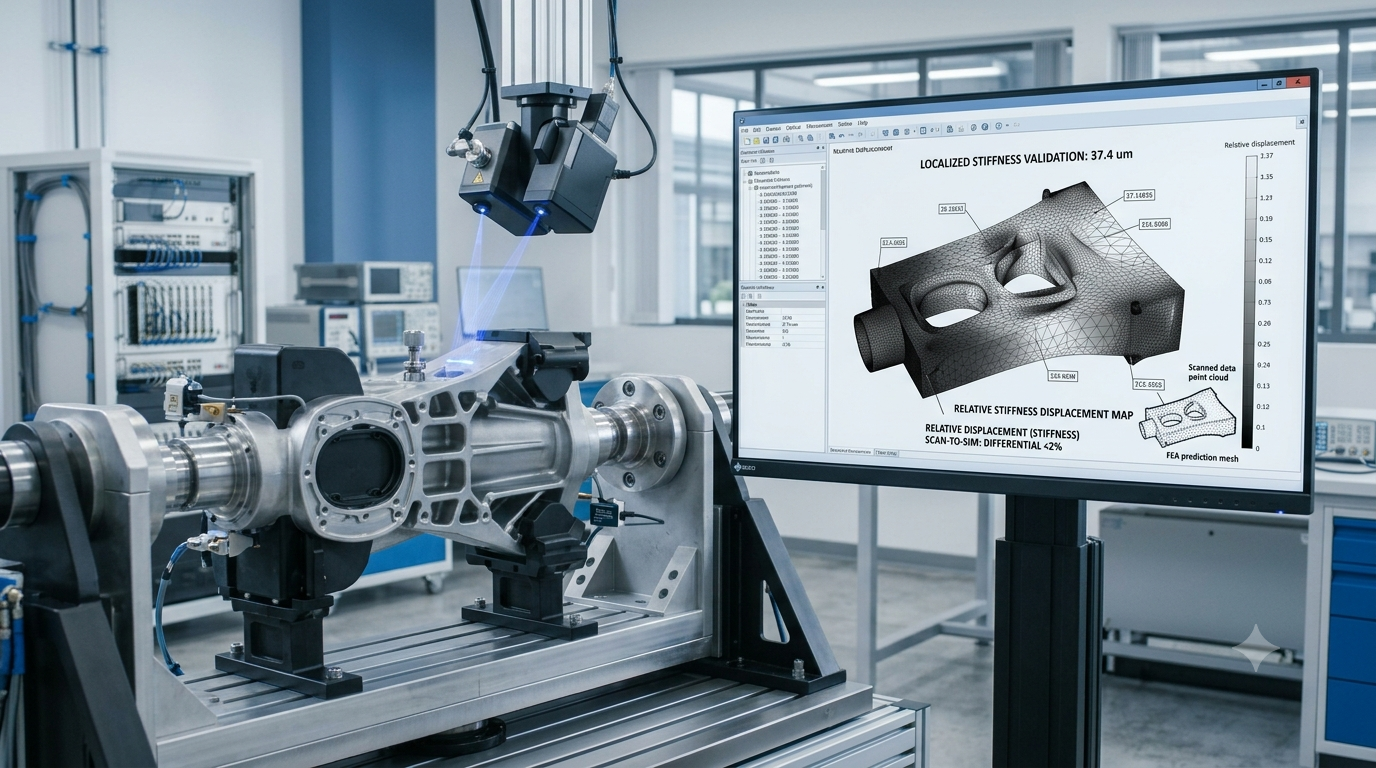 Not every product requires the same level of analysis. A simple mechanical component may require dimensional and functional checks, while a structural or thermally sensitive product may require more extensive engineering analysis.
What Product Validation Can Include
Not every product requires the same level of analysis. A simple mechanical component may require dimensional and functional checks, while a structural or thermally sensitive product may require more extensive engineering analysis.
What Product Validation Can Include
- FEA
- Structural analysis
- Thermal analysis
- Functional testing
- Load testing
- Fit and assembly checks
- Failure analysis
Engineering Example: Reducing Weight Without Compromising Performance
Goal: Reduce component weight without compromising performance. Engineering question: Where can material be removed without negatively affecting stress, deformation, or other critical performance requirements? Validation: Use FEA and physical testing, where appropriate, to confirm that the revised design still meets the required performance criteria. Key Takeaway: The objective is not simply to make a component lighter. It is to reduce weight while maintaining the required product performance.7. Transition From Prototype to Production Without Redesign Surprises
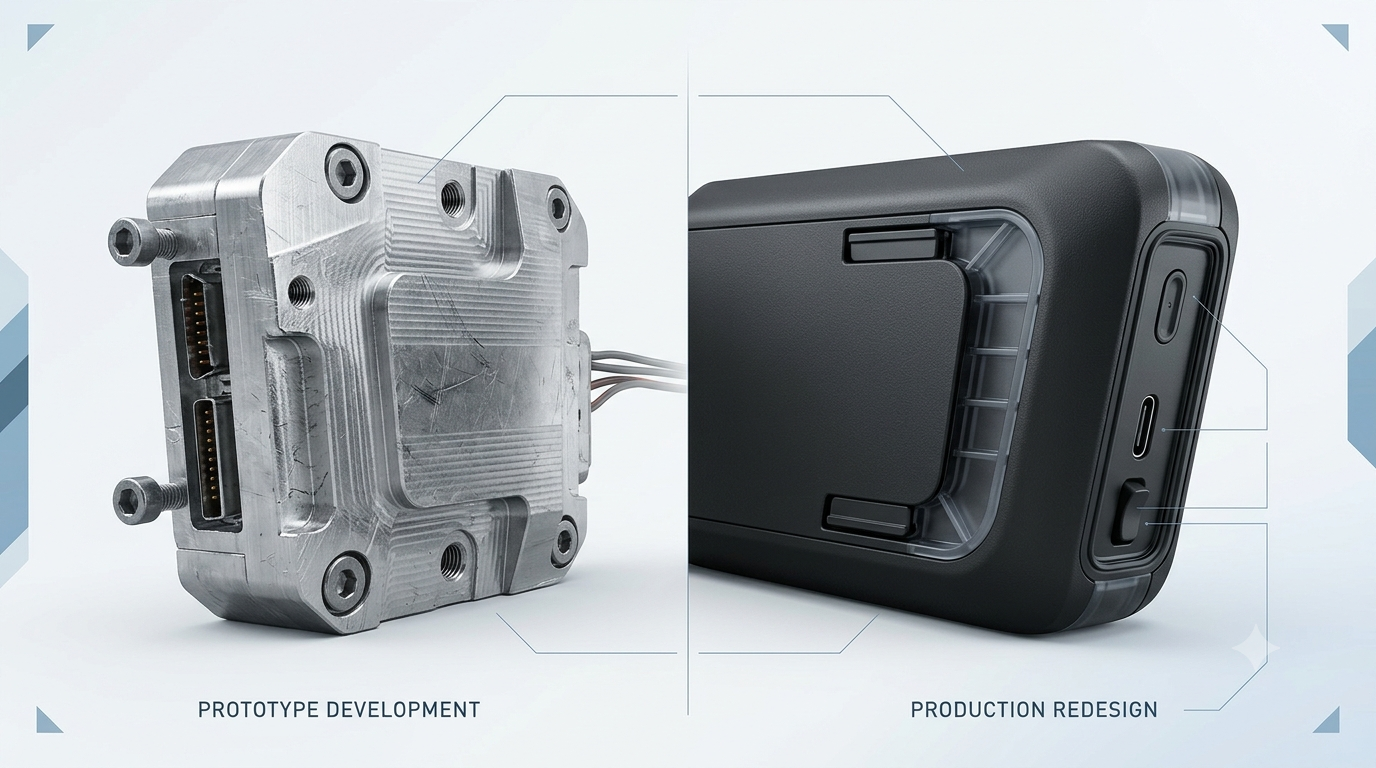 One of the most significant engineering transitions occurs when a prototype has demonstrated that the product works and the company begins preparing for production.
The manufacturing process may change. A prototype may have been produced using 3D printing or CNC machining because those methods are practical at low volumes. A production product may require injection molding, die casting, sheet metal fabrication or another process depending on volume, material, geometry and commercial requirements.
One of the most significant engineering transitions occurs when a prototype has demonstrated that the product works and the company begins preparing for production.
The manufacturing process may change. A prototype may have been produced using 3D printing or CNC machining because those methods are practical at low volumes. A production product may require injection molding, die casting, sheet metal fabrication or another process depending on volume, material, geometry and commercial requirements.
Example: CNC Prototype to Injection-Molded Product
A startup successfully prototypes an enclosure using CNC machining. As production volumes grow, injection molding becomes more practical. Now the design must account for wall thickness, draft angles, ribs, bosses, parting lines, and ejection. Engineers must also check for difficult tooling actions and ensure critical cosmetic and functional surfaces can be produced consistently.Key Insight
The prototype has not failed. It has done its job by proving the product concept.The engineering task has changed from “Can we make this product?” to “How should we design this product for its intended production process?”
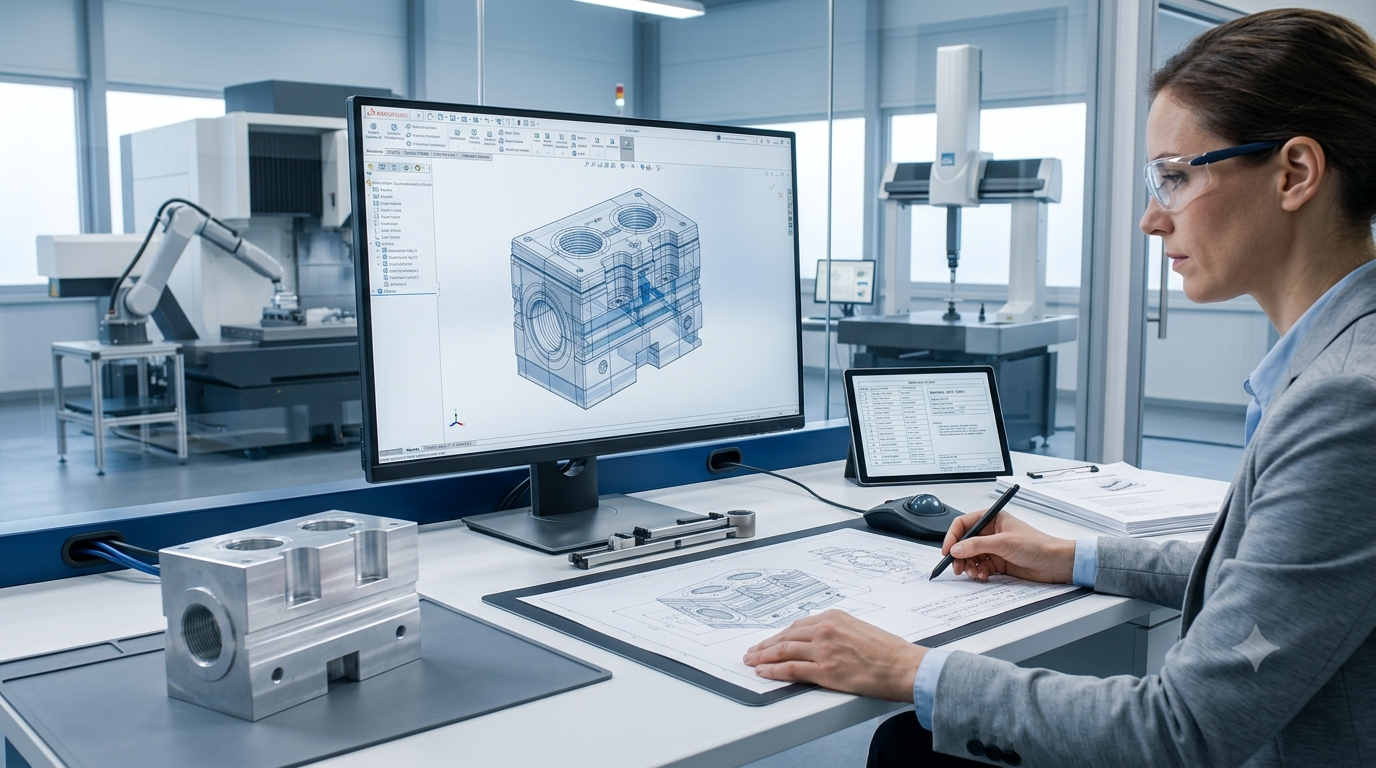 As the product approaches production, engineering information needs to be complete, consistent, and clear enough for manufacturers and suppliers to work from.
What a Manufacturing-Ready Package Should Include
· Final CAD models
· Engineering drawings
· Bill of materials (BOM)
· Material specifications
· Critical dimensions
· Tolerances
· Manufacturing requirements
· Assembly information
· Revision history
· Supplier documentation
· Engineering change records
The quality of this information directly affects how reliably the design can move from the engineering environment into manufacturing.
A manufacturer should not have to interpret design intent from an incomplete CAD model. The manufacturing-ready package should provide enough information for suppliers to quote, manufacture, inspect, and assemble the product without relying on undocumented assumptions.
Questions to Ask Before Release
· Are the critical dimensions genuinely function-critical?
· Are the specified tolerances achievable with the selected manufacturing process?
· Can critical features be inspected consistently?
· Are material and finish requirements clearly specified?
· Is the assembly sequence practical?
· Are supplier and manufacturing assumptions documented?
· Can the design be revised without creating unnecessary downstream confusion?
As the product approaches production, engineering information needs to be complete, consistent, and clear enough for manufacturers and suppliers to work from.
What a Manufacturing-Ready Package Should Include
· Final CAD models
· Engineering drawings
· Bill of materials (BOM)
· Material specifications
· Critical dimensions
· Tolerances
· Manufacturing requirements
· Assembly information
· Revision history
· Supplier documentation
· Engineering change records
The quality of this information directly affects how reliably the design can move from the engineering environment into manufacturing.
A manufacturer should not have to interpret design intent from an incomplete CAD model. The manufacturing-ready package should provide enough information for suppliers to quote, manufacture, inspect, and assemble the product without relying on undocumented assumptions.
Questions to Ask Before Release
· Are the critical dimensions genuinely function-critical?
· Are the specified tolerances achievable with the selected manufacturing process?
· Can critical features be inspected consistently?
· Are material and finish requirements clearly specified?
· Is the assembly sequence practical?
· Are supplier and manufacturing assumptions documented?
· Can the design be revised without creating unnecessary downstream confusion?
9. Manage Engineering Changes Before They Become Expensive
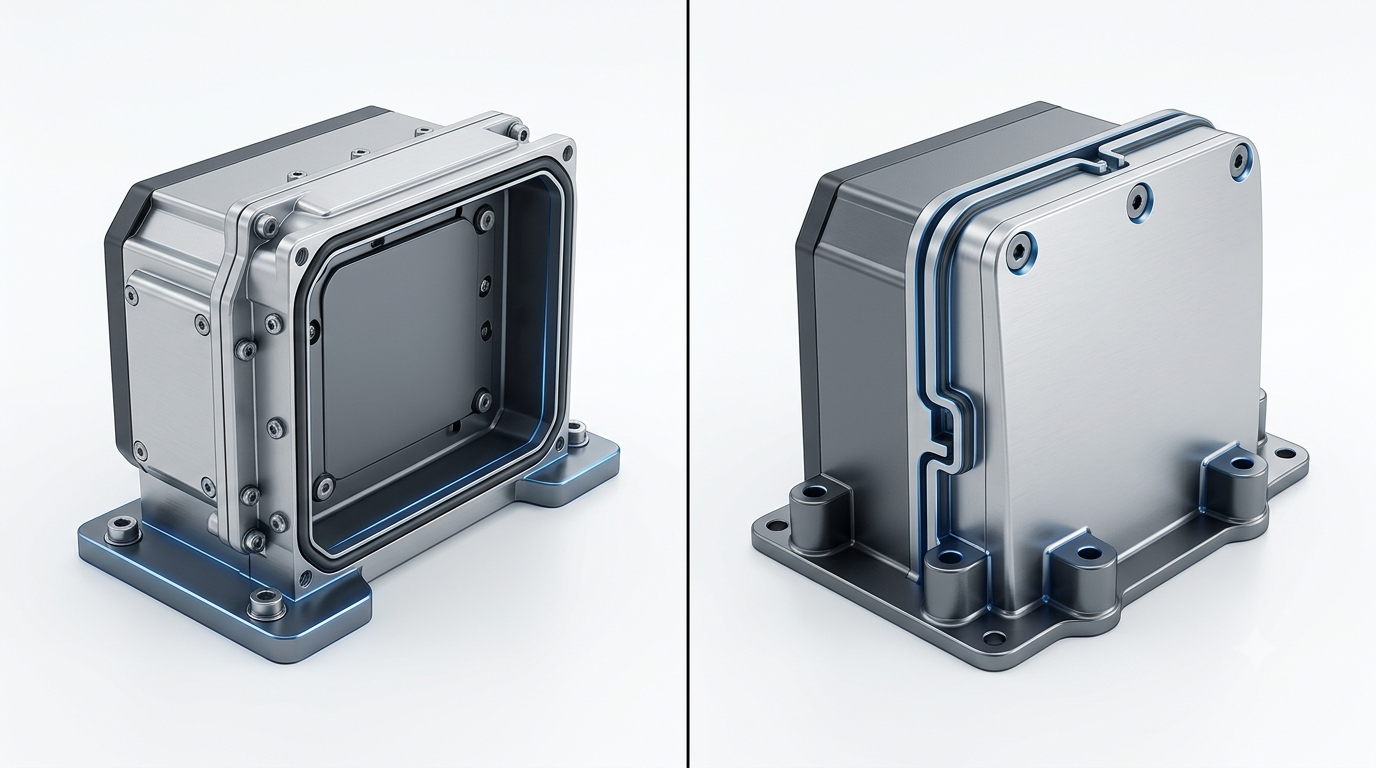 Early design changes are a normal part of product development.
A change to the enclosure during concept development may affect only a few CAD files. The same change after prototypes have been produced can affect physical parts. After tooling has been commissioned, it can affect molds, production schedules and supplier coordination. Once production has started, the change may also involve inventory, quality documentation and manufacturing processes.
This is why experienced product engineering teams try to identify high-impact decisions early.
The goal is not to eliminate design changes. That is unrealistic in hardware development. The goal is to make the right changes at the right stage.
A useful engineering mindset is to ask not only “Can we change this?” but also “What else does this change affect?” A seemingly small enclosure revision can affect PCB fit, sealing, fastener locations, tooling, packaging, assembly instructions and inspection requirements. Understanding those dependencies is part of managing product risk.
Early design changes are a normal part of product development.
A change to the enclosure during concept development may affect only a few CAD files. The same change after prototypes have been produced can affect physical parts. After tooling has been commissioned, it can affect molds, production schedules and supplier coordination. Once production has started, the change may also involve inventory, quality documentation and manufacturing processes.
This is why experienced product engineering teams try to identify high-impact decisions early.
The goal is not to eliminate design changes. That is unrealistic in hardware development. The goal is to make the right changes at the right stage.
A useful engineering mindset is to ask not only “Can we change this?” but also “What else does this change affect?” A seemingly small enclosure revision can affect PCB fit, sealing, fastener locations, tooling, packaging, assembly instructions and inspection requirements. Understanding those dependencies is part of managing product risk.
| Engineering Mindset Don’t ask only “Can we change this?” Ask “What else does this change affect?” |
| Key Takeaway The earlier the change, the fewer downstream dependencies it is likely to affect. |
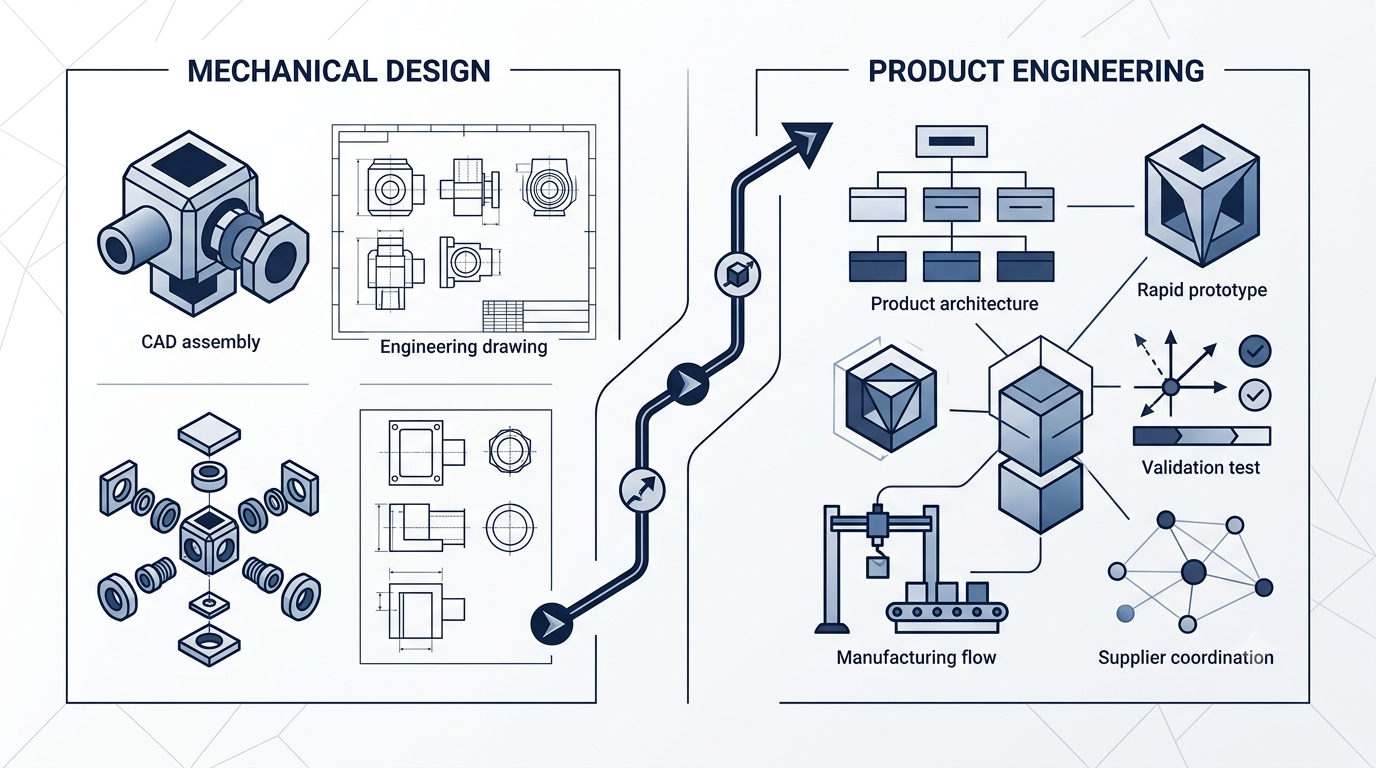
10. Mechanical Design vs. Product Engineering: What’s the Difference?
| Mechanical Design | Product Engineering |
|---|---|
| Develops components and assemblies | Connects product requirements to production |
| Creates CAD geometry | Considers architecture and interfaces |
| Produces engineering drawings | Considers manufacturing and assembly |
| Defines mechanical features | Evaluates materials and tolerances |
| Develops physical design | Supports prototyping and validation |
| Documents the design | Supports manufacturing readiness |
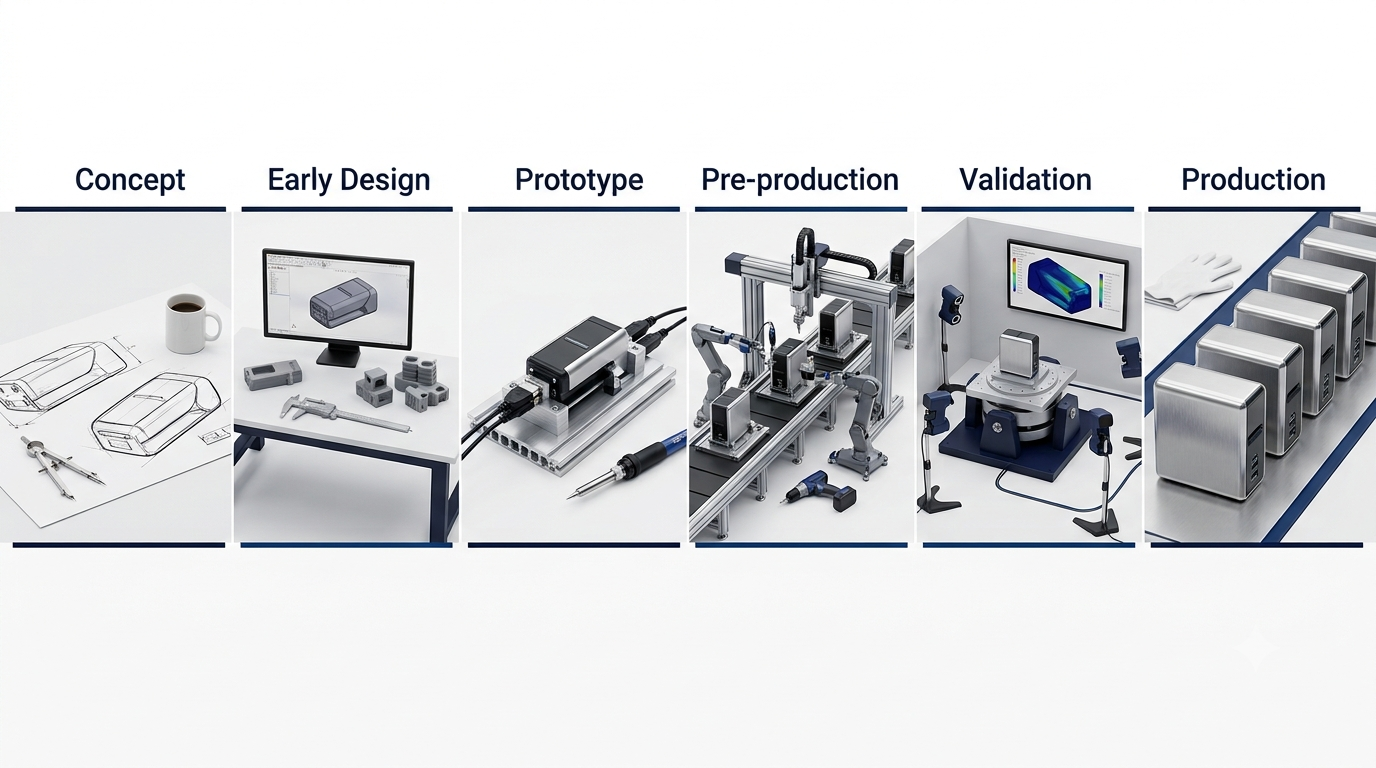
11. What Engineering Support Does Your Product Need?
| Development Stage | Typical Engineering Focus |
|---|---|
| Concept | Feasibility, architecture and requirements |
| Early Design | Mechanical design, CAD and component integration |
| Prototype | Design iteration, fit and functional evaluation |
| Pre-Production | DFM, DFA, tolerances and manufacturing preparation |
| Validation | Engineering analysis and physical testing |
| Production | Documentation, supplier coordination and engineering changes |
12. How to Choose a Hardware Product Engineering Partner
Look Beyond CAD Capability
The right engineering partner should be able to work with the product at its current stage while understanding what comes next. For an early concept, that may mean helping establish the mechanical architecture. For an existing CAD model, it may mean identifying manufacturing or assembly issues.Evaluate Prototype-to-Production Experience
For a working prototype, it may involve redesigning components for a production process. For a product approaching manufacturing, it may involve final drawings, BOM development, supplier coordination and engineering change management.Look for Connected Engineering Support
The important capability is not simply the ability to produce CAD. It is the ability to connect engineering decisions across the product-development cycle. A capable engineering partner should also be able to explain why a particular design decision is appropriate for the intended manufacturing process—not simply confirm that the geometry can be modelled. That distinction is often what separates CAD execution from genuine product engineering.| Buyer Checklist Look beyond CAD capability • Evaluate prototype-to-production experience • Look for connected engineering support • Ask how design decisions are tied to the intended manufacturing process. |
From Concept to a Manufacturing-Ready Product
The path from a product idea to production is a sequence of connected engineering decisions. The concept establishes the product architecture. Mechanical design turns that architecture into physical components. Prototyping tests the design in the real world. Validation provides evidence that critical requirements are being met. Manufacturing engineering adapts the design to the selected production process. Engineering documentation communicates the final requirements to suppliers and manufacturers. When these stages are treated as separate activities, problems can emerge at the interfaces between them. When they are treated as one connected product-development process, decisions can be made with a clearer understanding of their downstream consequences. That is ultimately what experienced product engineering brings to hardware development: the ability to anticipate how today’s design decisions will affect tomorrow’s manufacturing, assembly, quality and cost. For hardware companies, that is the real value of product engineering: not simply creating a design, but developing a product that is ready to move from engineering into manufacturing with fewer surprises.Get a Free Product Engineering Assessment
Have a hardware concept, prototype or existing CAD design that needs engineering support?
Share your current product stage and requirements with Engon’s engineering team. We can help identify the appropriate development scope, manufacturing considerations and next steps toward a production-ready design.
TALK TO OUR ENGINEERING EXPERTS