
1. Skipping or Rushing Early-Stage Design Reviews (PDR/CDR)
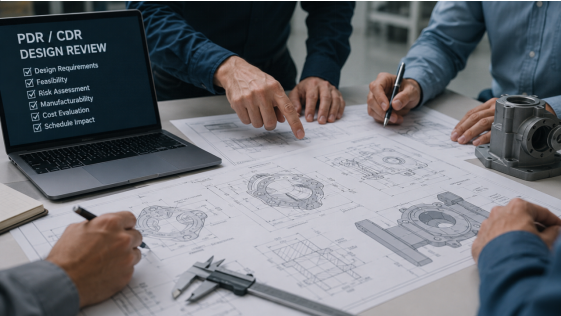
The Preliminary Design Review (PDR) and Critical Design Review (CDR) are two of the most valuable checkpoints in the Product Development cycle, yet they are often rushed when schedules tighten. The Preliminary Design Review (PDR) confirms that the overall design approach is sound before detailed engineering work begins, while the Critical Design Review (CDR) verifies that the design is ready for release to manufacturing.
Skipping or compressing these milestones makes it much harder to identify technical and manufacturing risks before design freeze. Once a design is frozen, the cost of late design changes rises sharply because tooling, fixtures, supplier commitments, and production planning may already be in motion.
Early stakeholder alignment during PDR and CDR helps prevent unexpected problems from surfacing downstream, when they are far more expensive and time-consuming to fix.
2. No Cross-Functional Team Involvement
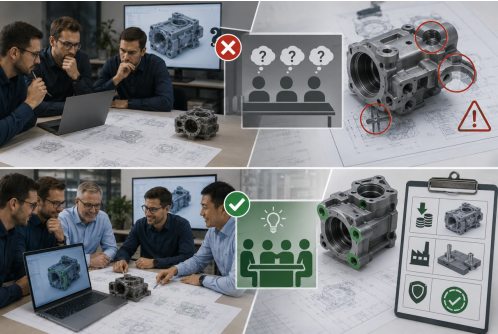
A Mechanical Design Review that only includes engineers misses critical perspectives. The strongest reviews bring together Engineering, Manufacturing, Procurement, Quality Assurance, Supply Chain, and Service & Maintenance teams, each contributing a different lens on the same design.
A cross-functional design review brings together stakeholders with different responsibilities and decision-making priorities, helping teams identify technical, manufacturing, sourcing, quality, and service risks before they become production problems.
- Manufacturing flags process limitations before they become production blockers.
- Procurement identifies sourcing constraints early in the cycle.
- Quality Assurance raises inspection and tolerance concerns early in the process.
- Supply Chain flags lead-time and component risk.
- Service & Maintenance teams highlight long-term serviceability needs.
These assembly and serviceability considerations can significantly affect production efficiency and cost; learn more about design decisions that reduce assembly time and manufacturing costs →
The benefit of collaborative decision-making is that issues surface while they are still inexpensive to fix, rather than after commitments have already been made.
When these perspectives are included early, teams can make better-informed design decisions and reduce the likelihood of costly redesigns, production interruptions, and late-stage changes.
3. Poor Version Control and Engineering Change Management (ECM)
When multiple versions of a drawing circulate without clear labeling, different teams end up working from different versions of the design. This creates a serious risk of manufacturing errors, incorrect purchasing decisions, and costly rework. Production might be machining to Rev C while procurement ordered materials against Rev B specs. This mismatch often isn’t caught until parts fail to fit or an inspector flags a discrepancy, by which point time and material are already lost.
Engineering Change Orders (ECO)
An ECO is the formal instruction to implement an approved change, whether it’s a dimension update, material substitution, or process revision. It typically documents what’s changing, why, who approved it, and the effective date.
A well-controlled ECO process ensures that engineering changes are formally reviewed, approved, documented, and communicated before they affect production.
Without a proper ECO process, changes get made informally through emails or verbal instructions, which are easy to miss and impossible to audit later.
Engineering Change Notices (ECN)
While an ECO authorizes a change, an ECN communicates that a change has happened. It’s the notification that pushes updated information out to everyone affected, manufacturing, quality, purchasing, and suppliers, so no one is left working from stale data. This communication step is critical because an approved engineering change is only effective when every affected team receives and implements the updated information.
Skipping this step is a common reason outdated drawings keep resurfacing even after a design has already been revised.
Drawing management
This covers how drawings are stored, labeled, and retrieved so the current revision is always easy to identify. Simple conventions, like consistent revision blocks, clear naming, and restricted edit access, prevent the everyday mix-ups that cause the biggest downstream headaches.
A controlled drawing management process should also make it clear which revision is approved for manufacturing and prevent obsolete drawings from being used accidentally.
PLM/PDM systems
Product Lifecycle Management and Product Data Management systems give this process real teeth by centralizing files, enforcing revision control, and tracking approval history automatically. Rather than relying on individuals to remember which version is current, the system itself controls access and visibility, cutting down on human error significantly.
These systems also provide traceability, making it easier to identify when a change was made, who approved it, and which teams or suppliers need to act on the updated information.
Preventing outdated files from reaching production
The final safeguard is making sure obsolete drawings simply cannot reach the shop floor. This means locking down superseded files, controlling who can release documents to production, and building checkpoints that verify the latest approved revision before work begins, so an old file never gets a chance to cause expensive rework
Strong drawing management, supported by PLM/PDM systems and a formal engineering change process, prevents outdated files from reaching production and reduces one of the most avoidable sources of manufacturing errors, rework, and production delays.
4. Overlooking Material Availability and Supplier Capabilities
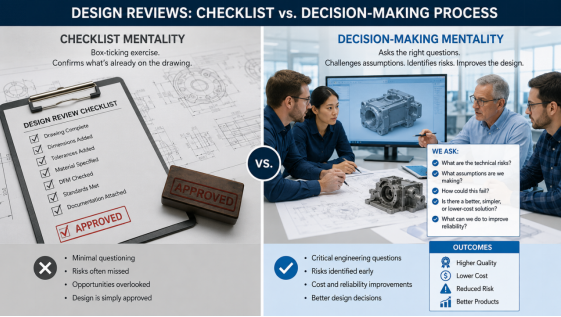
Even a technically sound design can experience production delays if material availability and supplier capabilities are not considered during the design review.
Material availability
Even a flawless design can stall if material lead times aren’t considered during review. Long-lead items, single-source materials, or components facing global shortages can quietly derail a schedule if they’re only discovered after production release.
Reviewing material availability early gives the team time to identify alternative materials, evaluate substitute components, or plan around potential supply delays before they become urgent.
Factoring availability into the review itself, rather than treating it as a purchasing problem to solve later, gives the team room to plan around delays or identify substitutes before they become urgent.This is an important part of determining whether a product is truly ready for mass production →
Supplier capabilities
A design that looks sound on paper can still run into trouble if it exceeds what a supplier can reliably produce. Understanding supplier manufacturing capabilities up front, including tolerances they can consistently hold and processes they’re actually equipped for, prevents mismatches between design intent and shop-floor reality.
Teams should also consider supplier capacity, material capabilities, production volumes, and the availability of alternative suppliers when evaluating critical components or processes.
Building in alternative material or vendor options at the review stage also helps teams avoid surprises tied to component obsolescence or single-supplier dependency.
Cost implications and broader supply chain risks should be discussed openly during the review rather than discovered after purchase orders have already been placed.
5. Treating Design Reviews as a Checklist Instead of a Decision-Making Process
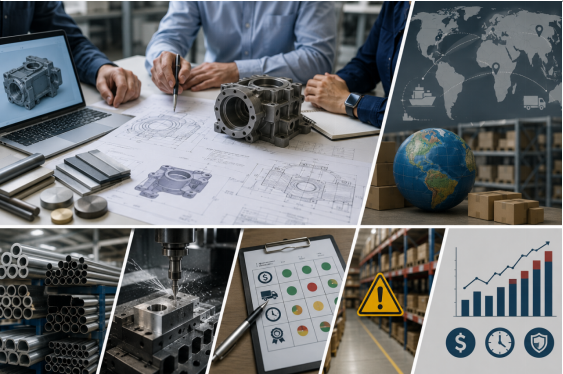
A design review should not be treated as a formality where teams simply confirm that each item on a checklist has been completed. The purpose of the review is to challenge assumptions, evaluate technical risks, and make informed engineering decisions.
Reviewers should ask “why” and “what if” questions:
- Why was this material selected over alternatives?
- What happens at peak load or under worst-case tolerances?
- Can the supplier consistently manufacture this feature?
- Are there simpler or more cost-effective alternatives?
These questions push teams to justify decisions with data rather than assumptions and help surface gaps early.
A strong review should also challenge design assumptions and actively look for technical risks, such as single points of failure, unproven components, tight tolerance stacks, thermal concerns, and fatigue risks. Tools such as FMEA can help teams prioritize the risks that require the most attention.
Fresh eyes can also identify cost optimization opportunities, including over-specified tolerances, unnecessary custom parts, redundant features, and excessive design complexity.
Treating a review as a genuine technical stress test rather than a formality can improve product reliability, reduce warranty risk, and prevent costly redesigns after tooling or production has begun.
6. Ignoring GD&T, Tolerancing, and Assembly Fit Issues
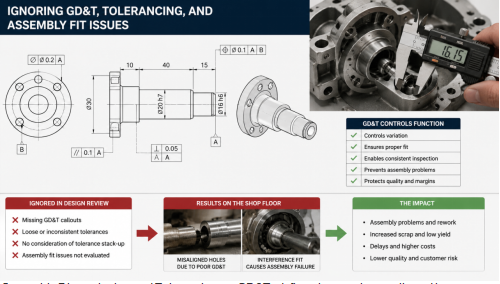
Geometric Dimensioning and Tolerancing, or GD&T, defines how parts are allowed to vary while still functioning correctly together. When GD&T is applied loosely or skipped during review, the result is manufacturing variation that shows up later as assembly failures.
A design review should evaluate whether critical dimensions, datums, and geometric tolerances adequately support the intended function and assembly requirements.
Improper tolerances make parts difficult or impossible to inspect consistently, and they often lead to a direct impact on production yield. Catching tolerance stack-up problems and assembly fit issues during the design review, rather than on the assembly line, keeps the program on schedule and protects margins.
Designing for Manufacturability (DFM) means accounting for how a part will actually be made, not just how it looks in a CAD model. Reviews that fail to consider Design for Manufacturability (DFM) early often run into trouble across multiple processes.
DFM should be considered while the design can still be changed easily and before tooling, supplier commitments, or production planning are finalized.
- Designing for machining without considering tool access or fixturing.
- Injection molding considerations, such as wall thickness and draft angles.
- Sheet metal limitations around bend radii and material thickness.
- Assembly-friendly design that simplifies the build sequence and reduces error.
The specific DFM risks will vary depending on the manufacturing process, but the objective remains the same: ensure that the design can be manufactured consistently, efficiently, and at the required quality level.
Reducing manufacturing complexity at the design stage prevents tooling modifications later and supports overall Manufacturing Readiness once the design reaches production.
Early DFM review can also help identify unnecessary complexity, avoid late-stage redesigns, and reduce the risk of discovering manufacturing constraints after tooling has already begun.
8. Skipping Prototype Testing and Validation
Prototype Validation is one of the last opportunities to catch a problem before committing to full production. Functional prototypes confirm that a design performs as intended, while engineering prototypes and pilot production runs reveal how it behaves at scale.
Prototype validation should test not only whether the product functions as intended, but also whether it can be assembled, manufactured, and used reliably under expected operating conditions.
User testing and manufacturing validation, conducted together, are often the only reliable way of identifying hidden design flaws that do not show up in simulation or early-stage review.
Where possible, validation should also include manufacturing and assembly checks to identify issues related to process variation, fit, repeatability, and production readiness before full-scale production begins.
This helps ensure that a design is not only technically functional but also ready to transition reliably into manufacturing.
9. Failing to Document Design Review Decisions and Action Items
A design review generates lasting value only when it produces a clear, traceable record. Meeting documentation should capture every discussion point, decision, and open issue in a way that is unambiguous and easy to revisit later. Each action item should have a clearly assigned owner, a defined due date, and a clear description of the required action. This ensures that accountability does not dissolve once the meeting ends.
Without this discipline, critical concerns can quietly slip through the cracks between sessions.
Equally important is treating risk tracking as an ongoing process rather than a one-time exercise. Logging risks continuously and revisiting them in scheduled follow-up reviews ensures nothing is forgotten or deprioritized.
Follow-up reviews should confirm whether action items have been completed, whether identified risks have been addressed, and whether new issues have emerged since the previous review.
Together, these practices transform a single review meeting into a true accountability system, one capable of guiding a design safely and confidently all the way through to final release.
10. Not Involving Your Product Design or Engineering Partner Early
An independent design review from an outside engineering partner often catches issues that internal teams, close to the project, can miss. Because external engineering partners bring an objective perspective, they can challenge design assumptions and identify risks that may be overlooked when internal teams are focused on meeting project deadlines.
External DFM expertise brings fresh cost optimization suggestions and an objective view of Manufacturing Readiness.
An experienced engineering partner can also help evaluate manufacturability, tolerance risks, tooling implications, supplier capabilities, and potential production constraints before they become expensive problems.
Bringing in that perspective early supports faster design iterations and meaningfully reduces production risk later in the program.
Engineering Scenario: How a Missed Design Review Delayed Production by Six Weeks
A company developing a plastic electronics enclosure ran its design review without manufacturing engineers in the room. As a result, important considerations related to material selection, wall thickness consistency, and draft angles were overlooked.
Tooling modifications became necessary after mold making had already begun, pushing the production launch back by approximately six weeks. Additional tooling costs also exceeded the original tooling budget by a wide margin.For more on the design decisions that can increase injection mold tooling costs →, see our related guide.
The lesson is straightforward: involving manufacturing experts during design reviews helps identify DFM issues before tooling begins, avoiding costly redesigns and schedule delays.
Design Review Best Practices Checklist
- Conduct reviews at every major design milestone.
- Include cross-functional stakeholders.
- Review GD&T and tolerances.
- Verify DFM requirements.
- Confirm material availability.
- Validate supplier capabilities.
- Test prototypes before production.
- Maintain revision control.
- Document decisions and action items.
- Complete a final Manufacturing Readiness review before design release.
Conclusion
Effective design review sessions reduce engineering risk at every stage of the product development process. They work best when treated as genuine decision-making sessions rather than approval meetings designed to move quickly through a checklist.
Structured engineering design review practices deliver improved manufacturability, lower costs, shorter development cycles, and fewer production delays. Businesses that build these practices into their process, or partner with experienced engineering teams who already follow them, can bring products to market faster and with fewer unexpected problems.