
IP67 IoT Enclosure Design Services are essential for building reliable products. Modern IoT hardware operates in tough environments. Whether a smart meter in a snow-covered utility area, an outdoor sensor on a pole in Arizona, a gateway on a construction site, or a device attached to heavy equipment, the enclosure plays a crucial role in the system’s survival against real-world stress. For U.S. and Western European buyers who prioritize long-term reliability, regulatory compliance, and predictable field performance, enclosure engineering directly affects product success, warranty cost, and customer trust.
For U.S. brands in industrial, consumer, or commercial sectors, enclosure engineering is now essential for product reliability, rather than just an afterthought during mechanical design. Companies in the U.S., Germany, France, the Netherlands, and the Nordics increasingly demand IP67 sealing, thermal stability, and impact performance as mandatory—not optional—criteria before approving a design partner or outsourcing engineering.
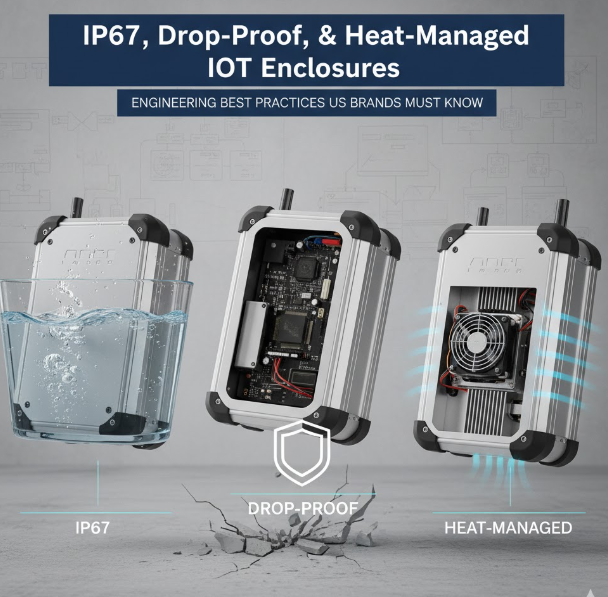
An enclosure that has IP67 protection, withstands drops, and manages heat effectively is the new standard for rugged IoT products. Engon Technologies has extensive experience in these areas. This guide reveals the engineering basics U.S. teams must embrace to create reliable, field-ready IoT hardware.
For buyers seeking faster time-to-market, extended device lifetime, and reduced maintenance cost, these best practices directly map to measurable ROI.
Why High-Performance Enclosures Matter in the U.S. Market – IP67 IoT Enclosure Design Services
The United States faces a mix of environmental and operational challenges. From humid conditions on the East Coast to the extreme heat of the Southwest, and from the cold Midwest winters to stormy Gulf areas, IoT devices must function reliably year-round. These climate differences are just part of the picture. Many IoT systems are used in industries like construction, public utilities, logistics, manufacturing, and agriculture. These settings expose devices to dust, vibrations, handling, temperature changes, and unpredictable weather.
Key Reliability Expectations from U.S. & EU Engineering Buyers
U.S. and European buyers look for partners who can guarantee:
- Proven IP67/IP68 sealing performance
- Ability to pass UL, CE, NEMA, IK, ASTM, and MIL-STD tests
- Low failure rates during deployment (critical for enterprise and government buyers)
- Designs optimized for scalable manufacturing and reduced warranty claims
- Engineering teams with simulation, DFM, and ruggedization expertise
That’s why creating rugged IoT enclosure systems with IP67 sealing, drop resistance, heat stability, and UV protection is essential. U.S. customers expect products to endure real-life handling, and regulatory agencies often require specific durability tests. A smartly designed waterproof IoT enclosure keeps services running, reduces failures in the field, and shields sensitive electronics from moisture, dust, and accidental submersion. A well-constructed drop-proof enclosure ensures the product can handle unintentional drops or rough treatment by technicians during installation and maintenance. Finally, a heat-managed IoT enclosure prevents overheating and extends the lifespan of internal components.
These points directly influence purchasing approval cycles and are often key decision criteria in U.S. and EU RFPs.
Understanding IP67 Requirements for IoT Devices – IP67 IoT Enclosure Design Services
IP67 certification is a common goal for outdoor and industrial IoT products. The “6” ensures full protection against dust, while the “7” indicates water resistance for up to one meter deep for 30 minutes. Getting this rating involves more than just adding a gasket. It requires precise engineering of every mechanical interface, including mating surfaces, screw bosses, ventilation designs, PCB positioning, and manufacturing tolerances.
Why IP67 Matters When Outsourcing Mechanical Design
This level of engineering rigor is exactly what U.S. & EU buyers expect when outsourcing mechanical design for enclosure development—especially in industrial, energy, EV charging, metering, environmental monitoring, and smart-city applications.
In the U.S., IP67 is largely viewed as equal to or a functional alternative to specific NEMA enclosure ratings depending on the application. Many brands aim for a single enclosure design that meets both global and local standards. This makes robust IP67 plastic enclosure design critical for compliance and market acceptance.
Engineering an IP67 Enclosure: Principles That Cannot Be Ignored – IP67 IoT Enclosure Design Services
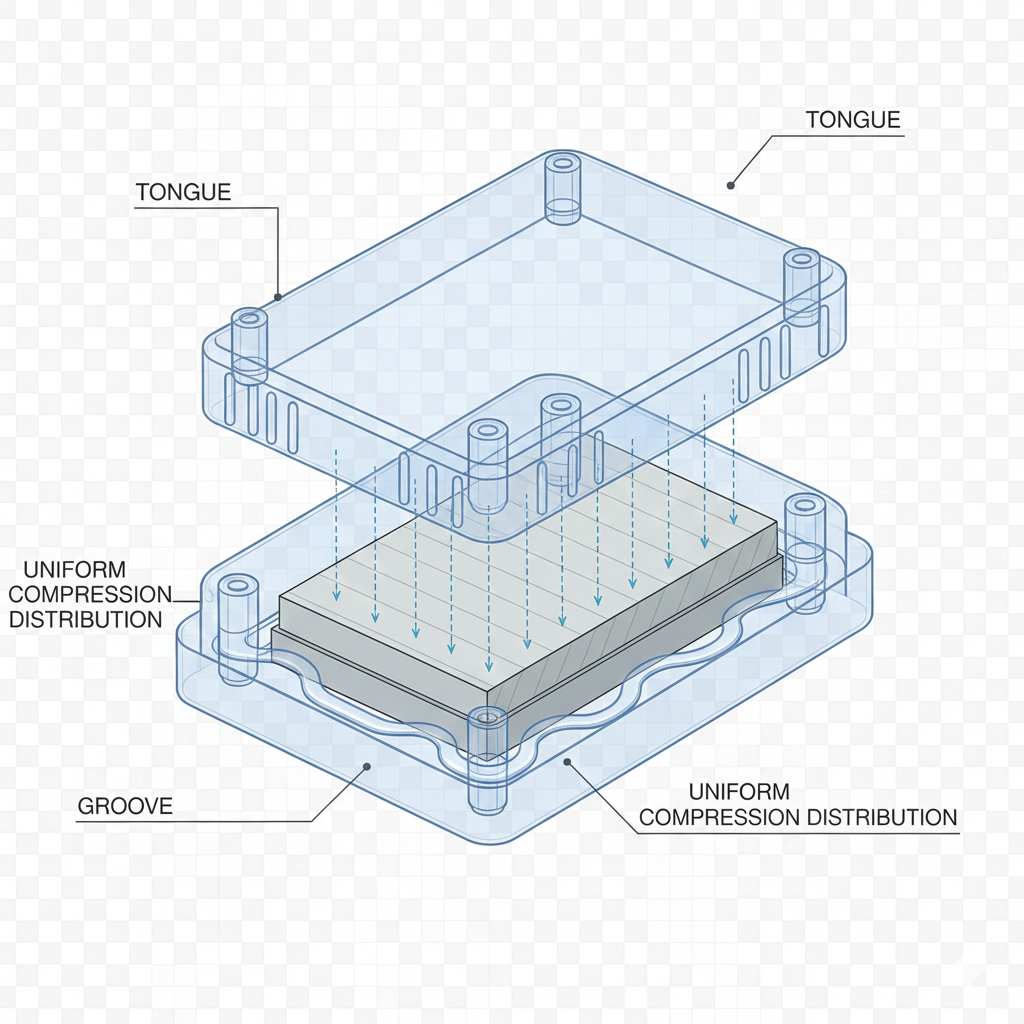
An effective IP67 IoT enclosure design revolves around controlled sealing and predictable mechanical behaviour. Key elements include the geometry of mating surfaces, gasket reliability, material stability, tolerances, screw load distribution, and surface smoothness. A good housing typically uses a tongue-and-groove or stepped design to ensure a controlled sealing path. This setup stops water from bypassing the joint and creates a uniform compression area for the gasket.
Buyers in the U.S./EU often evaluate suppliers based on repeatable gasket compression quality, automated QC processes, and sealing consistency at scale—core requirements for reducing failure rates during mass deployment.

Sealing & Gasket Engineering Best Practices
Gasket design matters just as much. The gasket must maintain long-term compression without losing its elasticity, even when exposed to sunlight or going through repeated temperature shifts. Silicone is often preferred due to its durability, resilience, and consistent performance. For products meant for long outdoor use, UV-resistant silicone or EPDM materials often perform better. The gasket track design must support the right compression. Too much compression harms the seal, while too little fails to provide waterproofing. Consistent gasket placement and not relying on adhesive for sealing are vital best practices.
Manufacturing Tolerances & QC
Also, IP67 sealing design relies heavily on managing manufacturing tolerances. Variations in enclosure walls, mating surfaces, or screw bosses can lead to small gaps that break waterproofing. Draft angles, Mold shrinkage, and part warpage must be accounted for at the design stage. This is why successful IP67 mechanical design guidelines stress close cooperation among design engineers, material specialists, and melding teams.
These factors also drive cost savings for buyers by reducing retooling iterations and accelerating NPI timelines.
SEALING METHODS COMPARISON
Sealing Method | Strength | Weakness | Best For |
Silicone Gasket | Long life, flexible | Needs precise compression | IP67 industrial devices |
EPDM Gasket | UV resistant | Less flexible | Outdoor sunlight-heavy use |
Liquid Gasket | Automated application | Hard to rework | Mass-production |
Overmolded Seal | Best sealing | High tooling cost | Rugged devices, zero leakage |
Material Selection: The Foundation of a Rugged Outdoor IoT Device – IP67 IoT Enclosure Design Services
Choosing the material for an outdoor IoT device enclosure is a critical decision in enclosure engineering. The U.S. climate requires materials that resist UV damage, temperature changes, and humidity exposure. Plastics like PC-ABS, ASA, polycarbonate, and glass-filled nylon are commonly used for their excellent impact strength and long-term stability. ASA and UV-stabilized polycarbonate are particularly effective in outdoor conditions with constant sunlight.
UV-Resistant & Impact-Proof Plastics for U.S./EU Deployments
Most U.S. and EU buyers prioritize materials that:
- Offer long-term UV resistance
- Survive extreme heat and cold cycles
- Maintain structural integrity during 4–6 ft drop tests
- Support UL, CE, and NEMA approvals
- Reduce long-term field failure rates
An impact-resistant plastic enclosure needs to survive a drop test while resisting cracking in cold weather and deforming in high heat. This balance is crucial for smart meters, outdoor sensors, industrial IoT nodes, and consumer products that might be left in vehicles or exposed to direct sunlight. Material choice significantly affects drop performance, UV resistance, heat stability, and overall lifespan.
For IoT products requiring electromagnetic shielding, metal inserts or conductive coatings may be necessary. These should be integrated carefully to prevent compromising sealing paths or causing heat spots inside the enclosure.
MATERIAL COMPARISON
Material | UV Resistance | ImpactStrength | Heat Stability | Outdoor Use |
ASA | Excellent | Medium | Good | Best for harsh sunlight |
Polycarbonate | Good | Excellent | Very Good | Rugged,clear/opaque options |
PC-ABS | Medium | Excellent | Good | Balanced performance |
GF Nylon | Good | High | Excellent | High-load, industrial use |
Drop-Proof Engineering: Surviving Real-World Handling – IP67 IoT Enclosure Design Services
Meeting MIL-STD Drop-Test Requirements for Rugged IoT Devices
Each enclosure must be designed with a solid grasp of the drop test standards for IoT enclosures. In the U.S., the usual benchmark involves a series of drops from four to six feet onto various edges, corners, and faces. The enclosure must remain whole and sealed after impact.
Drop-proofing is accomplished through careful geometry, not just by thickening the enclosure walls. Rounding corners and edges helps distribute impact force. Internal ribbing should reinforce weak areas without directing impact energy toward the PCB. The internal mounting of electronics is crucial. PCB standoffs, screw bosses, and internal walls must be positioned to prevent direct force transfer during an impact.
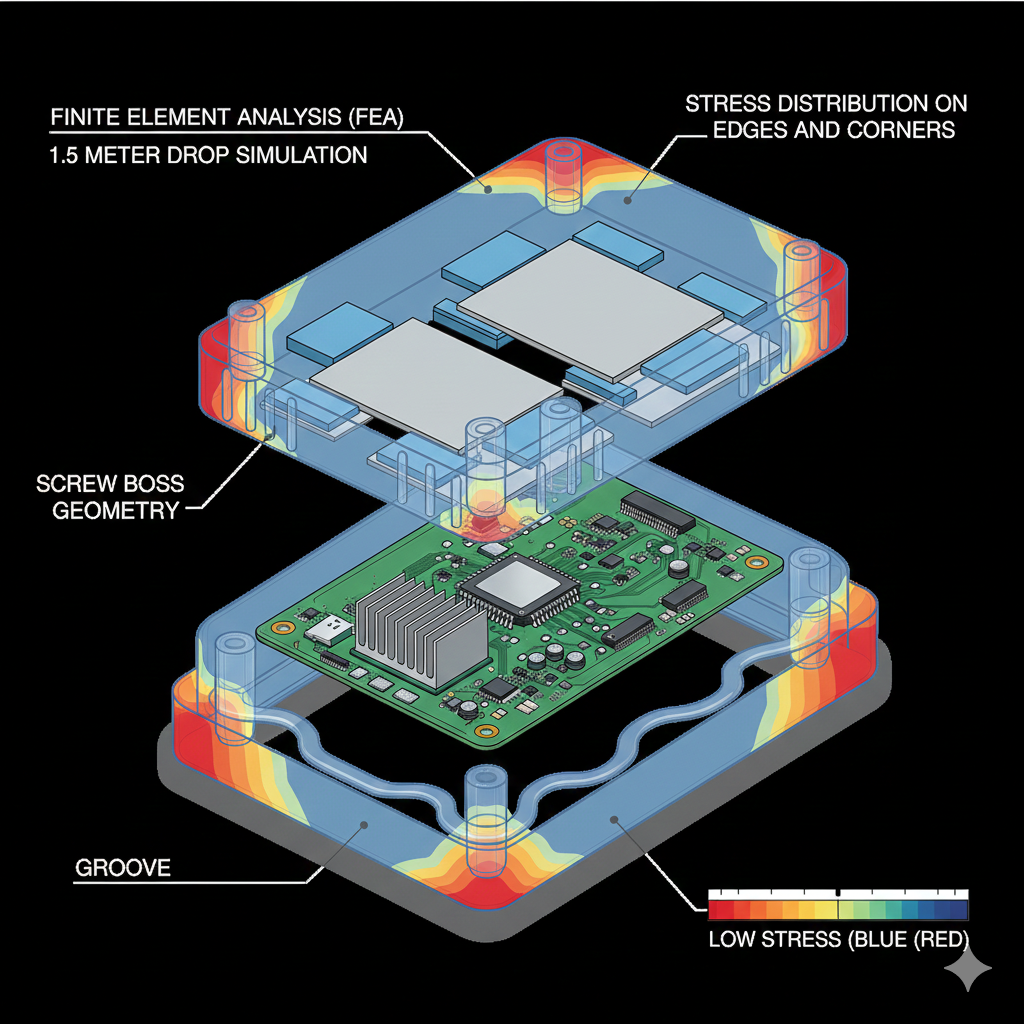
Effective shock absorption designs for IoT products may include elastomeric internal mounts or cushions for the PCB. This prevents damage to solder joints, connectors, and sensitive components. The goal is to ensure the enclosure absorbs the impact instead of the electronics.
This level of ruggedization is directly aligned with procurement expectations in utilities, industrial automation, oil & gas, facility management, and smart infrastructure—high-value U.S. and European sectors.
Heat Management: Engineering Strategies for Small, Sealed Enclosures – IP67 IoT Enclosure Design Services
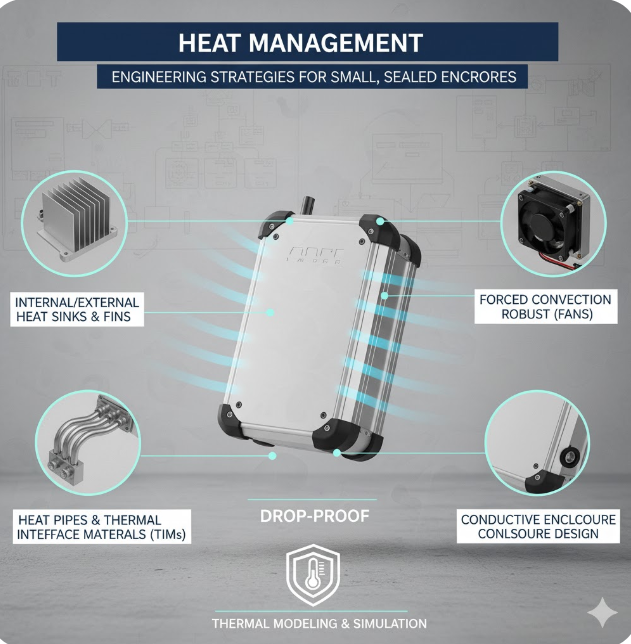
A fully sealed enclosure makes thermal design for compact devices particularly challenging. Components like processors, radios, power modules, and batteries generate heat, and sealed IP67 enclosures can’t count on ventilation. Without proper management, internal temperatures can rise quickly, causing performance drops or permanent damage.
Thermal Pathways & Heat Dissipation in Rugged IoT Devices
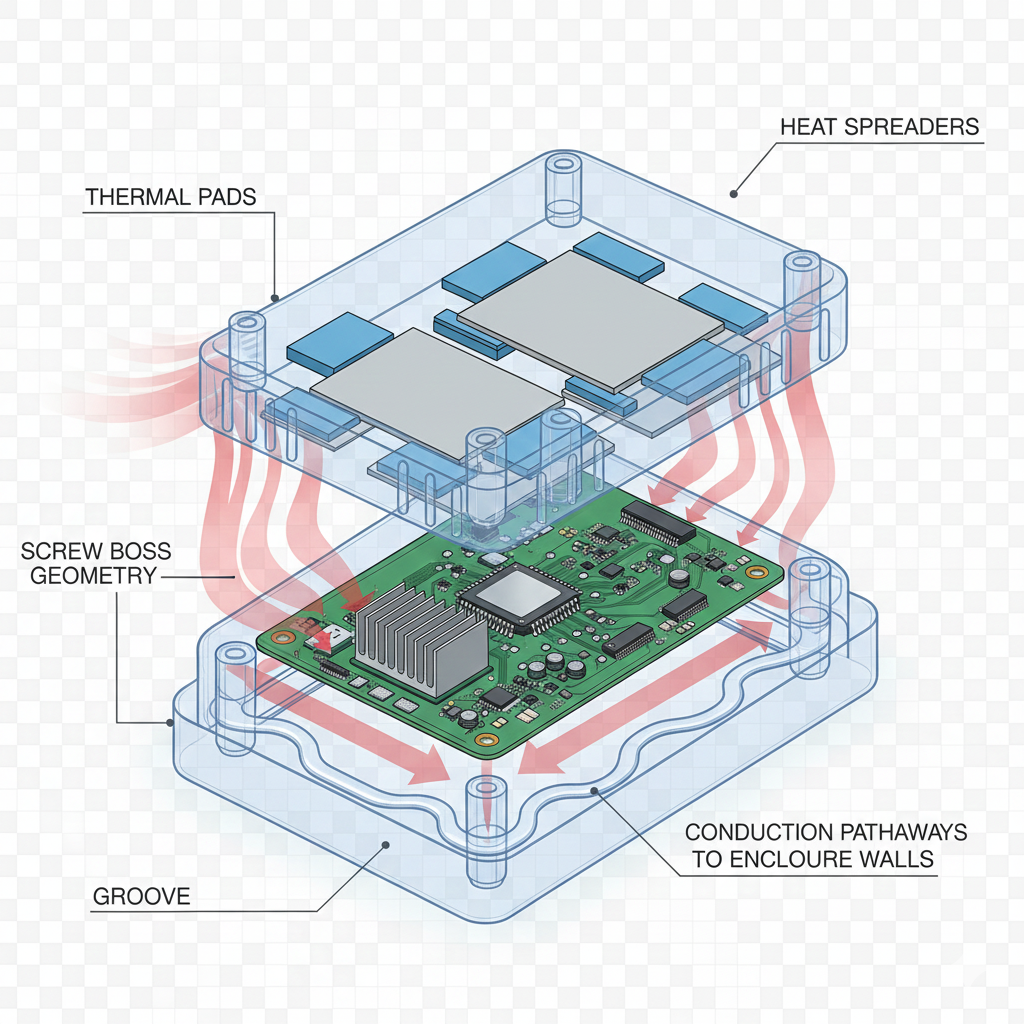
Effective heat management in IoT enclosure design starts with understanding thermal pathways. Heat must transfer from internal components to the enclosure walls and dissipate into the surrounding air. This requires careful PCB layout, strategic component placement, and thermal interface materials. Metal inserts, conductive pads, and heat spreaders can guide heat toward the enclosure surface.
Why Thermal Simulation Is Mandatory for U.S. & EU Engineering Buyers
A thorough thermal analysis for electronics looks at heat loads under various environmental conditions, including peak summer temperatures, direct sunlight, and the thermal cycles typical in industrial environments. Simulations help identify hot spots, airflow limits, and how thick the heat-conductive pathways need to be. For compact devices, early thermal simulation can be the difference between success and needing to redesign.
Most Western buyers consider early thermal simulation and heat management a decisive factor when selecting an engineering partner because it reduces redesign cycles, avoids field failures, and accelerates certification.
THERMAL MANAGEMENT METHODS
Method | Handling | Cost | Best Use |
Thermal Pads | Component-to-wall conduction | Low | Small enclosures |
Heat Spreaders | Excellent | Medium | RF/GSM/MCU hotspots |
Thermal Vias | Good | Medium | PCB-heavy cooling |
Metal Inserts | Perfect | Higher | High-watt sealed devices |
Cooling Fins | Excellent | Medium | Outdoor gateways |
PCB Enclosure Design: Ensuring Stability and Reliability – IP67 IoT Enclosure Design Services
PCB Stability, RF Windows & Connector Waterproofing
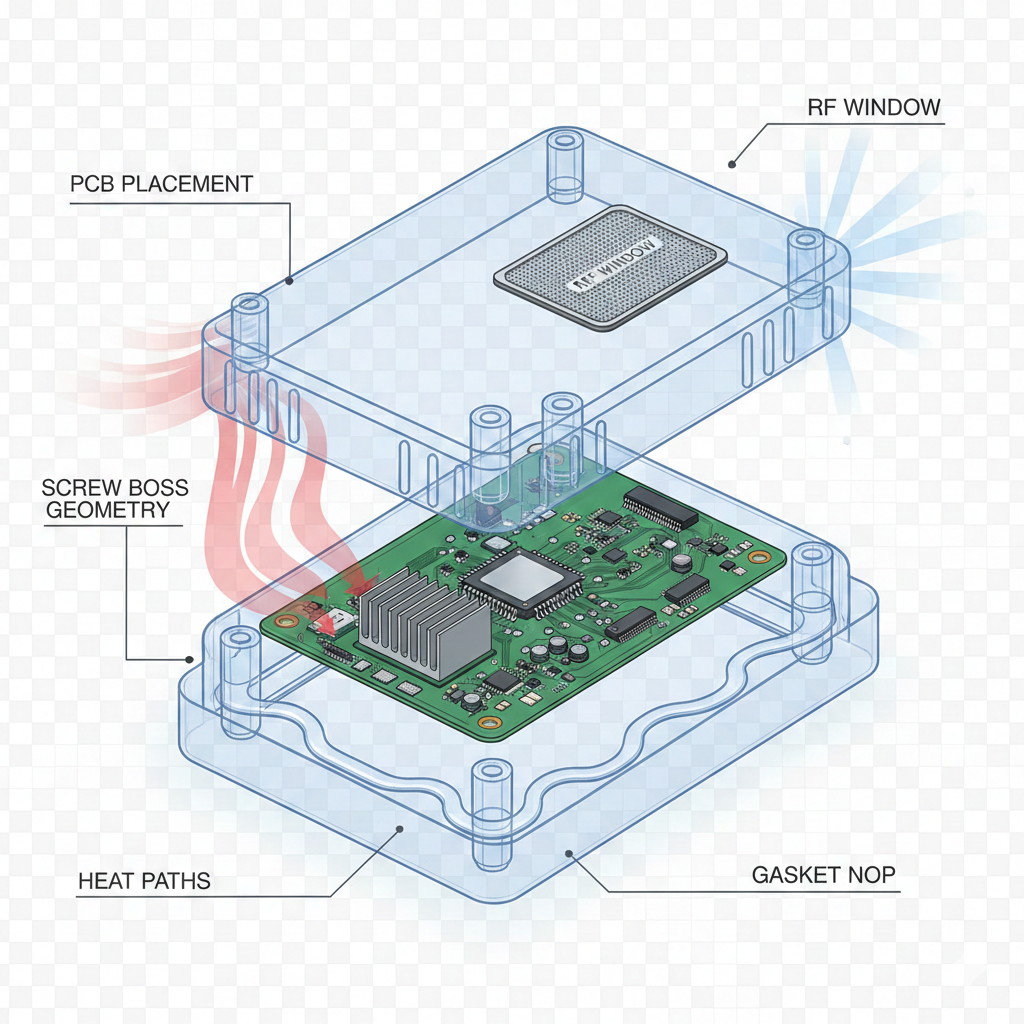
The connection between the PCB and enclosure is often overlooked. An effective PCB enclosure design aligns mechanical, thermal, and electrical requirements. The PCB should be placed to reduce stress during drops and vibrations. It must line up precisely with external cutouts like antenna windows, charging ports, or sensors, without hurting the IP67 sealing.
Connector choice is another crucial aspect. Only sealed, rugged connectors should be used in IP67 devices. The enclosure design should support the connector from the inside to avoid stressing solder joints. For antennas, an RF window made from material that maintains signal strength while ensuring waterproofing is key.
These design considerations directly address typical buyer pain points like connector failure, RF signal loss, and PCB cracking—common problems that U.S. and European brands seek to eliminate.
Gasket, Screws, and Fasteners: The Details That Make-or-Break IP67 – IP67 IoT Enclosure Design Services
The leading cause of IP67 failures is uneven gasket compression. Thoughtfully designed gaskets for IoT devices ensure even compression around the entire perimeter. Screw placement affects this directly. Screws should be evenly spaced to avoid bending the housing or creating stress points. Thread inserts might be needed for enclosures that need to be opened multiple times.
Fastener Selection for Long-Term Durability
Fastener choices must take corrosion resistance into account for outdoor conditions. Stainless steel is commonly used, but it’s essential to ensure compatibility with the plastic housing to avoid cracking or chemical reactions.
U.S./EU buyers often evaluate enclosure suppliers based on their mastery of these “micro-details” because they determine whether large-scale deployments succeed or fail.
Best Practices for Heat, Water, and Impact in a Single Enclosure – IP67 IoT Enclosure Design Services
Integrated Mechanical + Thermal + Environmental Design
Creating an enclosure that is waterproof, drop-resistant, and thermally stable requires balancing various trade-offs. For example, thicker walls enhance drop impact resistance but lower heat dissipation. A softer exterior improves shock absorption but might compromise sealing paths if not designed carefully. Achieving a good balance involves a mix of simulation, prototyping, testing, and refining.
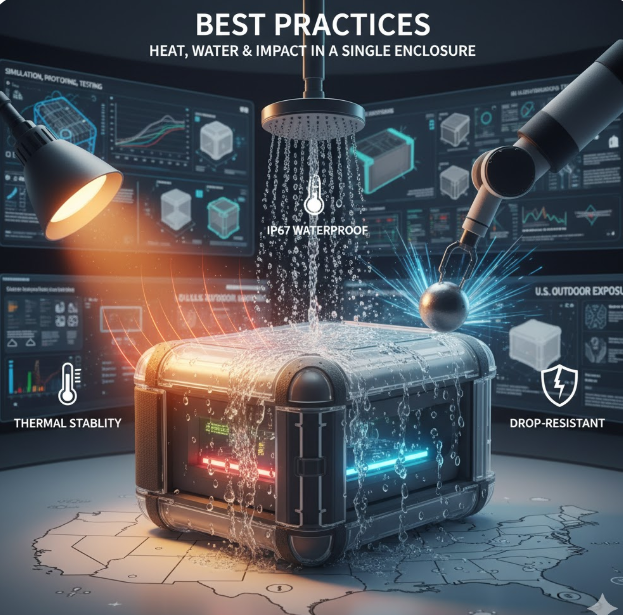
A systematic approach—integrating best practices for IP67 plastic housing design, thermal simulation, drop test evaluation, and outdoor exposure testing—ensures the enclosure can withstand real-world conditions in the U.S.
This integrated approach is highly valued by procurement teams in the U.S. and Europe because it reduces development risk and speeds up certification.
Testing & Validation for IP67, Drop-Proof & Thermal Reliability – IP67 IoT Enclosure Design Services
U.S./EU Validation Standards & Qualification Testing
Creating a rugged IoT enclosure is incomplete without thorough testing. Water immersion tests confirm IP67 capabilities. Drop tests check mechanical strength. Thermal chamber tests simulate real environmental cycles. UV exposure tests assess long-term durability. Vibration tests mimic transportation and industrial settings. Each step helps confirm that the enclosure design performs well in every scenario.
These tests directly address what U.S. and EU buyers expect: proven reliability before mass production, reduced risk of field failures, and minimized warranty costs.
Conclusion: Building Next-Generation Rugged IoT Devices for the U.S. & Europe Market
For U.S. IoT brands, reliable enclosures offer a competitive edge. A well-designed enclosure serves not just as protection but as a complete mechanical and environmental strategy that ensures device security, stable performance, and long-lasting durability. With expertise in industrial IoT enclosure design, sealing engineering, outdoor device materials, and thermal-mechanical optimization, Engon Technologies assists brands in creating IP67, drop-proof, and thermally resilient IoT products ready for real-world use.
For U.S. and European buyers looking to reduce product failures, accelerate launch timelines, and build rugged devices that last 5–10 years in the field, these engineering principles directly translate into performance, cost savings, and competitive advantage.
Partner With Experts Who Deliver — Contact Our Enclosure Engineering Professionals Now
We deliver:
- Outsourcing mechanical design
- Prototype to production workflows
- Fast turnaround rugged enclosure development
- Full IP67, thermal, and drop-test engineering