
Engineering Cost Breakdown: In-house vs Outsourced Mechanical Design for Small Manufacturers
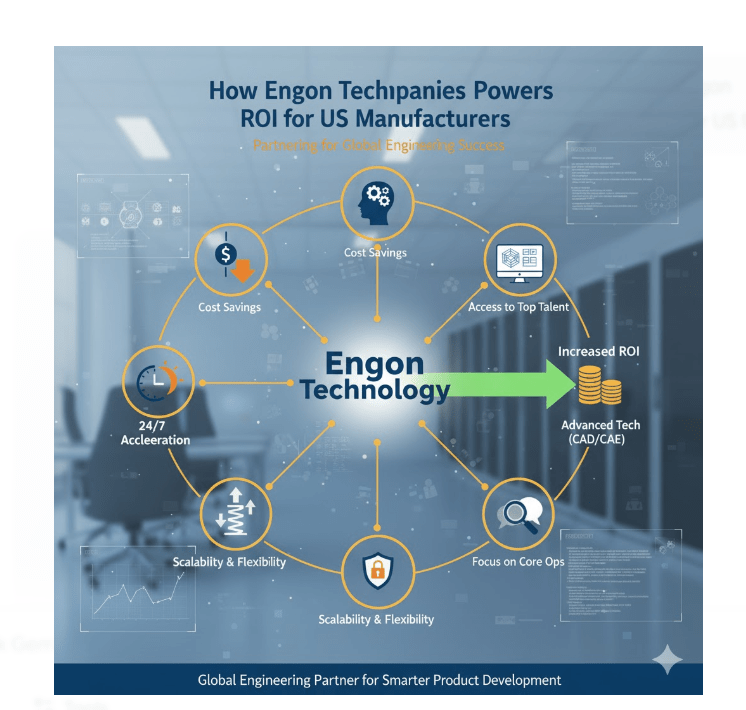
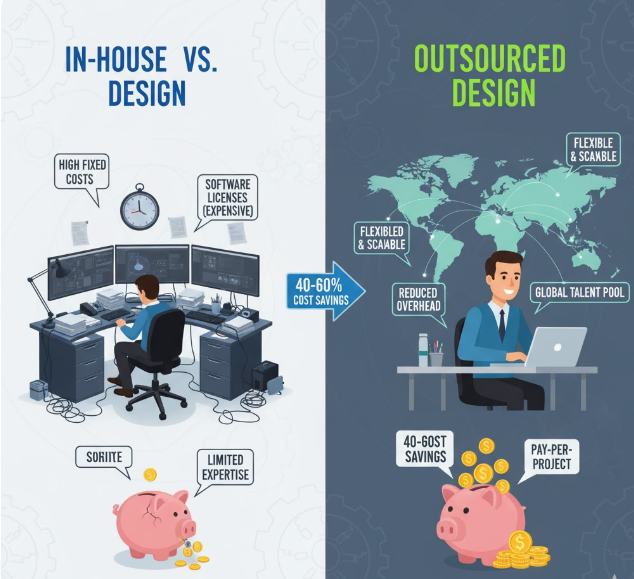
For small-to-medium enterprises (SMEs) focused on product innovation, understanding outsourced mechanical design cost is essential when deciding whether to outsource mechanical design or hire internally plays a vital role in profitability and speed to market. The common belief that “in-house control” is cheaper often hides the true costs of having internal engineering teams. This analysis offers a detailed comparison of engineering costs, providing a framework to evaluate the real costs of outsourcing mechanical engineering against the fixed and hidden expenses of internal staffing. This comparison is important because specialized engineering services can lead to substantial cost savings, often allowing small manufacturers to reduce their overall product development expenses by 40 to 60% while accessing top-notch expertise. Understanding this engineering cost breakdown for product design is the first step in optimizing your SME engineering budget. In-House Engineering Costs vs. Outsourced Mechanical Design Cost When manufacturers compare in-house and outsourced engineering team cost, they often only consider employee salaries. However, the costs of hiring a mechanical engineer go beyond their pay check, creating a significant and often underappreciated financial obligation. The total expenses—fixed no matter the workload—can drain small business resources. Decoding the Hiring Cost of a Mechanical Engineer To fully understand the commitment involved in hiring internally, one must consider the entire compensation package. Let’s break down the costs of hiring a mechanical engineer in the U.S. as a typical example:- Base Salary: A mid-level mechanical design engineer in the U.S. usually earns between $75,000 and $100,000 annually. This is the minimum fixed expense. (Source: BLS Mechanical Engineer Salary Data, SBA Payroll Tax Guide) Payroll Taxes and Benefits: Employers must cover FICA, state, and federal taxes, unemployment insurance, and worker’s compensation. Additionally, offering competitive benefits (like health, dental, 401k match, paid time off, and sick leave) typically adds another 30% to 45% on top of the base salary. Example: For a $90,000 base salary, the real cost of an in-house engineering team, including benefits, jumps to about $117,000 to $130,500, even before considering overhead. This sharply contrasts with a project-based engineering salary versus outsourcing, where you pay only for completed work. The True Cost: Overhead and Hidden Expenses in Outsourced Mechanical Design Cost Analysis One of the most overlooked parts of the engineering cost comparison is the overhead related to the engineering team. These costs exist whether your engineer is actively working on a product or waiting for the next project phase. When companies evaluate outsourced mechanical design cost, this hidden overhead becomes a critical factor—often revealing how outsourcing can eliminate non-productive expenses and improve overall engineering efficiency. Software and Tooling: Accessing professional-grade tools is essential. Annual license fees for advanced CAD/CAE software (like SolidWorks, Fusion 360, or specialized analysis tools) can range from $5,000 to $20,000 per seat per year. Physical Infrastructure: Costs for office space, dedicated desks, high-performance workstations, utilities, and IT support add significantly to fixed expenses. Training and Development: To maintain skills, mandatory training, conferences, and certifications can add several thousand dollars each year. (Guidelines: WIPO IP Guide, USPTO IP Policy) Recruitment and Turnover: The cost of recruiting a specialized engineer—including agency fees, interview time, and onboarding—represents a major, non-recoverable expense. Capacity Constraints and Inflexibility The in-house model is often rigid. When demand spikes, the team can become overloaded, leading to delays. When demand drops, which is common in cyclical product development phases, manufacturers still pay 100% of the engineer’s salary and overhead costs. This fixed-cost model lacks the flexibility small manufacturers need to stay competitive. By comparing these fixed expenses with outsourced mechanical design costs, it becomes clear that outsourcing offers a more scalable, cost-efficient alternative that aligns engineering resources with actual project demand. Analysing the Mechanical Engineering Outsourcing Cost The main benefit of outsourcing mechanical design is turning a large fixed cost into a precise, variable project expense. Small manufacturers pay only for the specific expertise and hours they require, making the engineering cost comparison tilt heavily in favour of outsourcing for non-continuous or specialized work. When evaluating outsourced mechanical design cost, it becomes clear that this model helps businesses control spending while accessing exactly the level of engineering support they need. Flexible Models for Outsourced Mechanical Design Outsourcing provides various engagement models, offering significant flexibility for the SME engineering budget:- Project-Based (Fixed Price): This model works best for well-defined deliverables (like designing a specific enclosure or optimizing a single part). The manufacturer gets a fixed engineering cost breakdown upfront, preventing budget overruns. Time & Materials (Hourly): This model suits ongoing development, troubleshooting, or tasks with an undefined scope. It directly connects to mechanical design hourly rates. Retainer Model: This option offers dedicated capacity at a better rate. The retainer model is ideal for manufacturers with predictable yet intermittent monthly engineering needs. Calculating the Outsourced CAD Design Cost and CAD/CAE Cost Per Hour External firms typically use a transparent pricing structure based on specific deliverables or hourly rates:- Hourly Rates: While a U.S.-based consulting firm may charge $120 to $200 per hour, this rate includes software licenses, overhead, and benefits. Clients do not pay for employee downtime or training. Global Sourcing (Offshore): Hiring an offshore engineering team can significantly lower rates, sometimes down to $40 to $80 per hour, depending on the specialization and location. This reduction can greatly decrease the outsourced CAD design cost for high-volume modelling work. (Industry data: Statista Outsourcing Data) Focus on Output: Unlike internal engineers, whose costs accrue regardless of output, external teams charge based on completing milestones. The effective CAD/CAE cost per hour becomes a performance metric rather than a fixed expense. When SMEs analyze outsourced mechanical design cost, they often find that this milestone-based model brings far greater efficiency and accountability. This analysis shows that the outsourcing cost model protects the SME engineering budget from the steep fixed commitment of $148,000 for a single internal engineer. Scenario Analysis: Project-Based Needs Consider a small manufacturer needing 500 hours of product development work over the year for two new products. In-House Cost: $148,000 (The manufacturer still pays 100% of