

October 2025

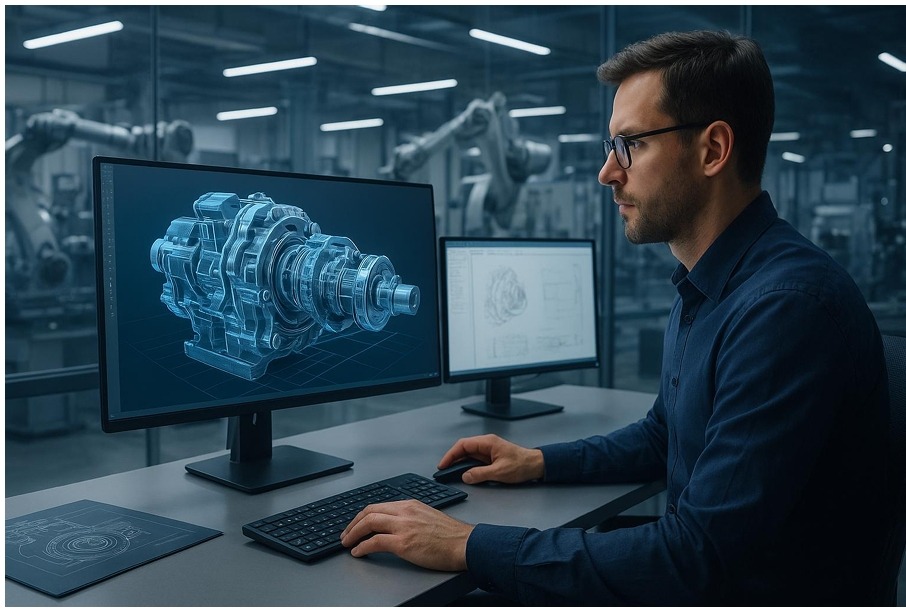
US company collaborating with Indian mechanical engineers for CAD design

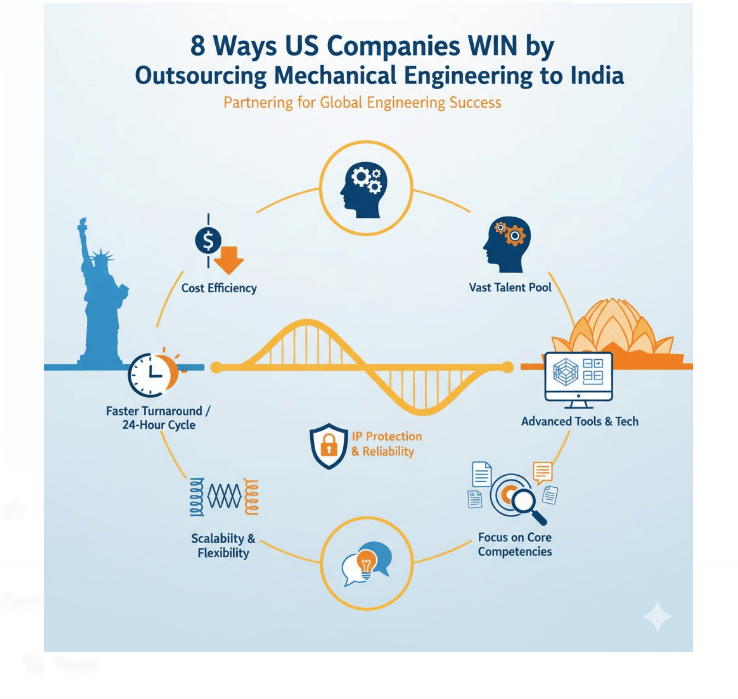
8 Ways US Companies Gain by Outsourcing Mechanical Engineering to India

In today’s fast-paced product development ecosystem, agility, precision, and cost-effectiveness determine who leads and who lags. For many US-based manufacturing and product design companies, balancing innovation with operational efficiency has become increasingly complex. This is where outsourcing mechanical engineering to India is transforming the competitive landscape. India has evolved into a powerhouse for mechanical design, prototyping, and simulation services, offering not only cost advantages but also world-class engineering expertise. With a strong pool of mechanical engineers, advanced CAD/CAE proficiency, and a growing culture of innovation, India provides more than just a workforce — it offers partnership in problem-solving. For US companies, collaboration with Indian firms like Engon Technologies enables faster project turnaround, higher design precision, and scalability without inflating operational costs. Engon’s engineering teams combine technical excellence with a deep understanding of international manufacturing standards, helping startups and OEMs alike bring complex ideas to market efficiently. Here are eight powerful ways in which US companies gain a tangible edge by outsourcing mechanical engineering design and development to India — and how Engon Technologies is helping bridge that global innovation gap. Cost Efficiency Without Compromising Quality One of the primary reasons US companies turn to India for mechanical engineering support is the significant cost advantage. Outsourcing can reduce project expenses by up to 50–60%, freeing up budgets for research, innovation, and marketing. However, cost savings are only part of the story — quality engineering delivery remains the key differentiator. Indian mechanical engineers are highly skilled in CAD platforms like SolidWorks, Creo, and AutoCAD, ensuring designs meet both aesthetic and functional goals. Firms like Engon Technologies go beyond standard outsourcing by implementing multi-level design quality checks and simulation-based validation before project delivery. This balance of affordability and precision allows US manufacturers to scale operations, experiment with multiple prototypes, and refine product features without the typical cost constraints. Moreover, Engon’s engineering processes adhere to ISO and ASME standards, ensuring every component and assembly aligns with global benchmarks. For startups and mid-sized US businesses, this means having access to premium engineering support that rivals in-house teams — but at a fraction of the cost. Outsourcing to India, when done through a specialized partner like Engon, transforms cost efficiency into strategic value. Access to a Vast Pool of Skilled Engineers India’s mechanical engineering talent pool is among the largest and most diverse in the world. Every year, thousands of engineers graduate with specialized expertise in design, thermodynamics, materials science, and production engineering. This creates a ready ecosystem of technical talent that US firms can tap into for a wide variety of design and development needs. Engon Technologies, for example, leverages this talent advantage by building dedicated engineering teams for US clients across domains like product design, simulation, reverse engineering, and prototyping. Their engineers are trained in global best practices and equipped to collaborate seamlessly across time zones using modern communication tools and project management systems. This scalability helps US businesses overcome a key challenge — shortage of skilled engineers locally. Whether it’s a startup developing a custom enclosure for IoT devices or an established OEM needing component redesigns, Engon can instantly onboard experts tailored to the project’s needs. By outsourcing to India, US companies gain not just manpower, but specialized minds who understand complex geometries, design optimization, and real-world manufacturing constraints — ensuring innovation is both practical and production-ready. Faster Turnaround and Time-Zone Advantage In product development, speed to market is everything. Outsourcing to India offers a distinct time-zone advantage that accelerates project timelines. When the US workday ends, Indian teams begin theirs — effectively creating a 24-hour engineering cycle. This means design iterations, simulations, and revisions can continue overnight, leading to faster project delivery and reduced time-to-market. Engon Technologies maximizes this benefit by operating on a “follow-the-sun” model, ensuring continuous progress. For example, a US client can share project inputs at the end of their day, and Engon’s engineers can have updates ready by the next morning. This seamless workflow drastically reduces delays in design validation, prototyping, and documentation. Moreover, Engon combines agile methodologies with engineering design principles, allowing clients to receive frequent updates, feedback loops, and quick design refinements. For industries where deadlines dictate competitiveness — such as automotive, consumer electronics, and industrial equipment — this model ensures US companies stay ahead of the curve. By outsourcing to India through Engon Technologies, US businesses not only gain speed but also ensure engineering precision under tight deadlines, a critical advantage in today’s innovation-driven economy. Access to Advanced Engineering Tools and Technologies Modern mechanical design demands cutting-edge software and tools for CAD modelling, CAE simulation, FEA analysis, and product lifecycle management. Outsourcing to India provides US companies access to the latest engineering technologies without heavy capital investment. Engon Technologies, for instance, employs a full suite of tools such as SolidWorks, Creo, CATIA, Ansys, and Autodesk Inventor, ensuring compatibility with global design ecosystems. This allows clients to receive deliverables in formats that integrate seamlessly into their internal processes. Beyond software, Engon uses virtual prototyping, 3D simulation, and digital twin approaches to validate designs before production. This reduces errors, improves design reliability, and enhances manufacturability — saving both time and money in the long run. For smaller US companies, this is a game-changer. Instead of spending thousands on licenses and high-end hardware, they can access world-class design environments through Engon’s infrastructure. Engon’s engineering ecosystem enables clients to innovate freely without infrastructure constraints, turning ideas into production-ready designs faster and more accurately. By outsourcing mechanical engineering to India, US firms gain the technological leverage they need to compete globally — powered by partners like Engon who invest heavily in tools, training, and process automation. Scalability and Flexibility for Every Project Size One of the most overlooked advantages of outsourcing mechanical engineering to India is scalability. Whether a US company needs support for a single prototype or an entire product line redesign, Indian engineering firms can quickly adapt to changing project scopes. Engon Technologies offers flexible engagement models — from project-based assignments to dedicated design teams — allowing

8 Ways US Companies Gain by Outsourcing Mechanical Engineering to India Read More »
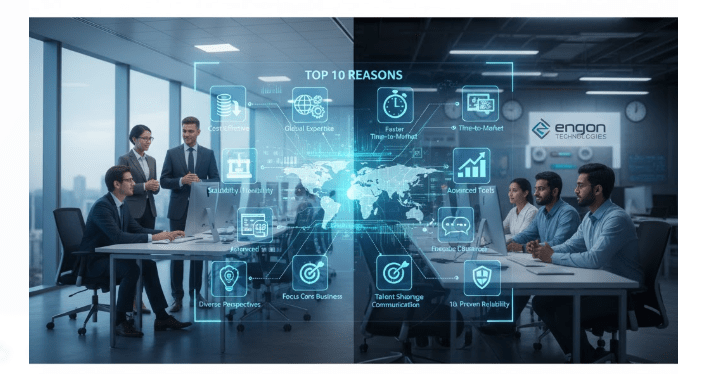
Top 10 Reasons US Businesses Choose Offshore Mechanical Engineering Partners

In today’s competitive manufacturing landscape, U.S. businesses are under constant pressure to innovate faster, optimize costs, and maintain high-quality engineering output. One strategic solution gaining momentum is offshore mechanical engineering partnerships. From startups developing IoT hardware to large-scale OEMs designing industrial machinery, companies are increasingly turning to overseas engineering firms to meet their design, prototyping, and production needs. These collaborations not only bridge skill gaps but also provide access to advanced technologies, flexible resources, and faster development cycles—without compromising precision or quality. Partnering with experienced global firms like Engon Technologies enables U.S. manufacturers to scale their mechanical design outsourcing capabilities efficiently and cost-effectively. Let’s explore the top 10 reasons why U.S. businesses are choosing offshore mechanical engineering partners and how this approach is transforming modern product development. Cost-Effective Engineering Without Quality Compromise Outsourcing mechanical design services offshore is one of the most effective ways to control costs whilfor e maintaining global standards. Labor and operational expenses in countries like India are significantly lower than in the U.S., enabling companies to achieve more for less. However, cost-effectiveness doesn’t mean cutting corners. Reputed firms like Engon Technologies combine affordable engineering talent with certified design processes and advanced CAD/CAE tools to deliver exceptional results. Clients gain access to expert mechanical engineers capable of executing projects with high precision—from initial CAD/ CAE engineering USA modelling to complex finite element analysis (FEA). By optimizing budgets and minimizing overheads, U.S. businesses can allocate resources more strategically—focusing on R&D, innovation, and market expansion—while their offshore mechanical engineering partner manages the technical heavy lifting. Access to Specialized Global Expertise Global mechanical design firms offer a wide range of domain expertise that’s often difficult or expensive to maintain in-house. Offshore teams bring experience across industries such as automotive, consumer electronics, aerospace, and industrial machinery. Engon Technologies, for instance, provides end-to-end mechanical engineering services for US companies, including CAD modelling, simulation, reverse engineering, and prototype validation. Their engineers are proficient in leading tools like SolidWorks, Creo, and AutoCAD, ensuring precision-driven results that align with U.S. industry standards. Access to specialized skill sets enables American companies to address complex mechanical challenges quickly—whether it’s optimizing enclosure design, improving thermal management, or re-engineering legacy components. This knowledge diversity helps accelerate product design outsourcing innovation while maintaining reliability and safety. Faster Time-to-Market In highly competitive markets, the speed of innirmsovation often determines success. Offshore mechanical design partnerships significantly reduce product development cycles through 24/7 workflows. When a U.S. company collaborates with an overseas partner like Engon Technologies, time zone differences become an advantage. While the U.S. team concludes its day, the offshore team continues progress overnight—resulting in continuous project movement and faster turnaround times. Moreover, these digital collaboration tools enable real-time updates, version tracking, and faster design reviews—ensuring no time is wasted in communication gaps or redundant iterations. Engon Technologies uses structured sprint cycles and milestone tracking, allowing clients to monitor every stage of development. This approach not only accelerates delivery but also improves overall design accuracy and accountability. By aligning design speed with market demands, businesses gain the agility to adapt to changing customer needs and emerging technologies—turning mechanical design into a true competitive advantage. Scalability and Resource Flexibility One of the biggest challenges for U.S. manufacturers is managing fluctuating project demands. Offshore engineering partnerships provide instant scalability—allowing businesses to ramp design teams up or down based on workload. Instead of hiring and training new engineers for every project, U.S. firms can rely on offshore mechanical engineering teams that are ready to deploy skilled professionals as needed. This flexibility minimizes fixed costs and maximizes operational efficiency. Engon Technologies offers scalable engagement models, from dedicated teams to project-based collaborations. This adaptability ensures that clients always have the right level of support—whether for a short-term design sprint or a full product lifecycle engagement. Additionally, scalability plays a crucial role in helping businesses stay resilient during uncertain market cycles. When demand spikes—such as during a new product launch or large client order—offshore partners can immediately augment design capacity without disrupting timelines. Conversely, during slower periods, U.S. companies can scale down without the burden of maintaining idle resources or additional payroll commitments. This elasticity empowers organizations to stay clean, efficient, and competitive. With Engon Technologies, companies also benefit from structured onboarding frameworks that make scaling seamless—ensuring new engineers integrate quickly into ongoing projects, adhere to established design standards, and maintain consistent quality output. Such a partnership not only saves time and money but also enhances project agility. Whether it’s accelerating a prototype phase, conducting mechanical stress simulations, or refining CAD assemblies, Engon’s team ensures every scale-up or scale-down transition happens smoothly. Ultimately, scalable offshore models redefine how U.S. manufacturers operate—transforming mechanical design capacity into a truly on-demand service that grows and adapts alongside business goals. Access to Advanced Tools and Technologies Modern mechanical design requires advanced software, simulation tools, and rapid prototyping technologies. However, maintaining these systems in-house can be prohibitively expensive. Offshore partners often invest heavily in state-of-the-art tools to stay competitive. With firms like Engon Technologies, U.S. clients gain access to a full suite of modern platforms—ranging from mechanical CAD modelling (Creo, SolidWorks) to CAE (ANSYS, Hyper Mesh) and 3D printing. These technologies enhance design precision, optimize material usage, and enable quick virtual testing before physical prototyping. By leveraging offshore partners’ technology infrastructure, U.S. companies benefit from world-class design capabilities without the financial burden of software licenses or specialized hardware investments. Overcoming Engineering Talent Shortages The U.S. faces a persistent shortage of skilled mechanical engineers, especially in advanced manufacturing sectors. According to industry reports, demand for mechanical engineering firms in India  is outpacing supply, making it challenging for businesses to maintain in-house design teams. Offshore mechanical engineering partnerships bridge this gap. Companies like Engon Technologies employ highly trained engineers who bring strong technical foundations and global exposure. By tapping into this international talenesign t pool, U.S. firms can fill expertise gaps quickly—without the delays and costs of recruitment or relocation. This access ensures continuity, innovation, and a reliable pipeline of engineering excellence regardless of

Top 10 Reasons US Businesses Choose Offshore Mechanical Engineering Partners Read More »

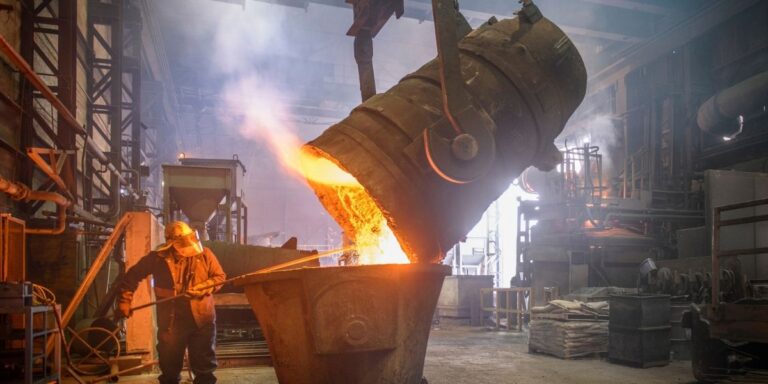
Challenges Faced by Mechanical Design Consultants in Industrial Design Projects

Industrial projects today demand precision, speed, and innovation. Whether it’s developing complex machinery, optimizing production layouts, or designing next-generation enclosures, mechanical design consultants play a crucial role in transforming ideas into tangible engineering solutions. However, the journey from concept to completion isn’t without its roadblocks. Design consultants often navigate multiple challenges—from misaligned project goals and resource constraints to communication breakdowns and changing client requirements. These hurdles can directly impact cost, quality, and time-to-market. To stay competitive and deliver high-performing solutions, consultants need a mix of technical expertise, project foresight, and adaptive collaboration models. This article explores the most common challenges faced by mechanical design consultancy in industrial projects—and, more importantly, how to solve them effectively. Companies like Engon Technologies have set benchmarks in overcoming these challenges with robust design frameworks, advanced simulation tools, and a problem-solving mindset that consistently ensures project success. Challenge: Unclear Project Requirements and Scope Creep One of the biggest hurdles in industrial mechanical design projects is a vague or evolving project scope. Often, clients come with a basic idea of what they need but lack clarity on design parameters, performance metrics, or manufacturing constraints. This ambiguity leads to frequent design revisions, scope creep, and delayed approvals—eventually derailing timelines and budgets. How to Solve It: The key lies in establishing clear communication and documentation from the start. Before diving into CAD or simulation, consultants must conduct requirement workshops, gather detailed use-case data, and define technical boundaries. A structured Design Requirement Document (DRD) helps in aligning expectations and reducing back-and-forth during execution. Companies like Engon Technologies implement a phase-gated design approach, where each phase (concept, design, validation, and handover) has defined deliverables and checkpoints. This ensures that every stakeholder—from the client to the production team—remains aligned, minimizing last- minute surprises and optimizing design turnaround time. Challenge: Managing Cross-Functional Collaboration Industrial design projects are rarely solo efforts. Mechanical, electrical, automation, and production teams must work hand-in-hand. Yet, communication silos and incompatible software ecosystems often create bottlenecks. When electrical and mechanical teams design in isolation, issues like interference, assembly misfits, or conflicting tolerances surface during production, leading to costly rework. How to Solve It: Integrated collaboration is the answer. Using shared platforms like SolidWorks PDM, Creo Windchill, or Teamcenter ensures real-time access to design data, version control, and seamless handoffs between departments. Regular design reviews and concurrent engineering practices keep teams synchronized and agile. Engon Technologies bridges interdisciplinary gaps through digital design ecosystems and cloud-based design management. Their teams collaborate across continents using synchronized platforms that allow designers, fabricators, and clients to review models simultaneously. This reduces communication lags and ensures that every subsystem—from a gear assembly to a robotic arm—is designed in harmony. Effective collaboration transforms project complexity into a unified engineering effort, boosting efficiency and reliability across all mechanical design stages. Challenge: Balancing Cost, Quality, and Turnaround Time In industrial design, clients often expect high-quality designs within tight budgets and aggressive timelines. This balancing act between cost, quality, and speed is one of the most demanding aspects of consulting. Cutting corners on materials or simulation depth can compromise product reliability, while over-engineering increases costs and delays delivery. How to Solve It: The key is to apply value engineering—designing for optimal performance at minimal cost. Advanced simulation tools like ANSYS or SolidWorks Simulation allow consultants to predict product behaviour, identify design flaws early, and minimize physical prototyping expenses. Time-efficient processes like parametric modeling and modular design speed up iteration cycles. Engon Technologies employs a design optimization framework that emphasizes data-driven decisions and simulation-led engineering. Their team uses real-world testing feedback to refine virtual models, ensuring that clients receive robust, manufacturable designs within budget. By aligning early-stage concept validation with production realities, consultants can deliver faster, cost-effective, and high-quality outcomes—strengthening client trust and long-term partnerships. Challenge: Integrating New Technologies and Tools The mechanical design landscape is evolving rapidly. Emerging technologies like AI-assisted design, IoT integration, and digital twins are redefining how products are conceptualized and validated. However, not all consultants are equipped to integrate these advancements efficiently. Resistance to change, lack of training, or incompatible legacy systems often hinder innovation and slow progress. How to Solve It: Consultants must cultivate a culture of continuous learning. Regular tool upgrades, simulation automation, and exposure to global design trends help teams stay relevant. Adopting digital twin simulations, for instance, allows real-time performance prediction and remote monitoring, reducing post-deployment failures. At Engon Technologies, innovation is not optional—it’s integral. The company leverages AI-based design validation and generative modeling tools to create optimized geometries that balance strength, weight, and manufacturability. Their engineers also integrate IoT-ready design features, preparing products for smart manufacturing ecosystems. Incorporating emerging tools doesn’t just enhance design efficiency—it positions consultants as technology leaders capable of handling complex industrial demands with modern precision. Staying ahead of the curve ensures that mechanical design consultants deliver future-ready solutions to their industrial clients. Challenge: Handling Design Revisions and Change Management Industrial projects evolve over months, sometimes years. During this journey, design changes are inevitable—whether due to updated client needs, compliance revisions, or supplier constraints. Without an efficient change management process, revisions can lead to confusion, outdated drawings, and production errors. How to Solve It: The solution is a robust revision control system that tracks every modification and maintains version integrity. Design consultants should adopt standardized file-naming conventions, change request protocols, and audit trails. Tools like PLM systems or versioned CAD vaults simplify this process by automating notifications, approvals, and backups. Engon Technologies integrates advanced PLM tools into its workflow, ensuring traceable and controlled design changes. Each update is validated through impact analysis—so if one component is altered, its effects on the entire assembly are automatically reviewed. This structured approach not only reduces design errors but also builds client confidence through transparency. Clear documentation ensures that every stakeholder—from design engineers to production managers—works with the latest, approved version of the design. Challenge: Ensuring Manufacturability and Assembly Feasibility A design that looks perfect on screen may fail during production if manufacturability isn’t prioritized. Oversized tolerances, difficult-to-machine geometries, or

Challenges Faced by Mechanical Design Consultants in Industrial Design Projects Read More »