

Case Study

Is Your Product Really Ready for Mass Production?

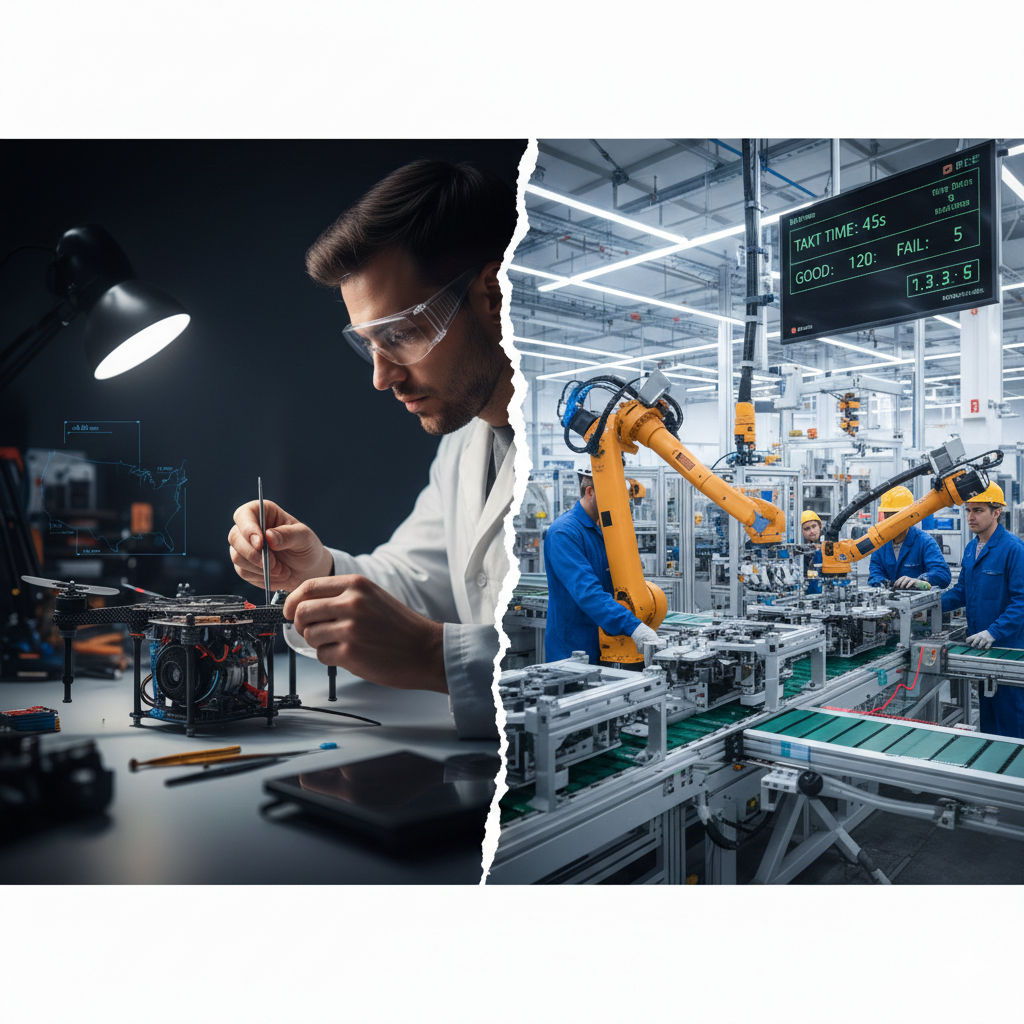
9 Common SME Pitfalls Derailing US & European SMEs Many SMEs across the United States (US) and Europe (EU) believe they are ready for mass production because the prototype works, customers are interested, and initial builds look promising. Yet scale-up failure is rarely caused by a single catastrophic mistake. It is usually the cumulative result of weak manufacturing readiness discipline across design, suppliers, tooling, cost, and validation. Without a structured Production Readiness Audit for SMEs, these hidden scale risks often remain invisible until ramp-up. This audit is a core part of our broader framework at Engon Technologies for engineering outsourcing for US manufacturing SMEs, helping manufacturers de-risk scale early. Below are nine systemic pitfalls that repeatedly derail otherwise promising products during industrialization. Prototype ≠ Production-Ready in US and European Manufacturing One of the most common SME mistakes is confusing functional validation with manufacturing validation. A prototype proving that the product works does not mean the design is production ready. Functional Validation vs Manufacturing Validation Engineering Validation Test (EVT) builds confirm functional performance. Design Validation Test (DVT) verifies compliance and robustness. Production Validation Test (PVT), however, validates manufacturability, repeatability, and yield under line conditions. Recognizing this gap early is exactly why a Production Readiness Audit for SMEs should feed into your engineering outsourcing strategy — for example, our structured services for engineering outsourcing for US manufacturing SMEs build readiness into every phase. The difference between prototype and production design lies in process robustness, tolerance capability, assembly efficiency, and material stability—not just performance. Prototype Materials vs Production Materials SMEs often use substitute materials in prototypes: CNC aluminum instead of die-cast, 3D prints instead of injection-molded parts. These materials behave differently under stress, heat, and assembly load. When production materials are introduced, dimensional shifts and failure modes appear. Hand-Built vs Line-Built Differences Hand-built assemblies tolerate rework, fitting, and technician intuition. Line-built units depend on standardized work, fixtures, takt time, and operator skill consistency. Many pilot build failures in SMEs stem from ignoring this transition. Design Hardening for Volume Design for mass production requires tolerance optimization, fastening simplification, poka-yoke features, and Cp/Cpk-driven tolerancing. Without this hardening, why prototypes fail in mass production becomes painfully obvious during ramp-up. DFMA Is Treated as a One-Time Check + Tolerance Stack-Ups Ignored DFMA (Design for Manufacturing and Assembly) is frequently misunderstood as a checklist exercise rather than a cross-phase discipline. DFMA vs DFM vs DFA DFM focuses on manufacturability of individual parts. DFA addresses ease of assembly. DFMA integrates both. Treating DFM and DFA separately causes interface failures and assembly tolerance issues. DFMA as an Iterative Process DFMA analysis must occur during concept, detailed design, and pre-tooling phases. It must also be updated after supplier feedback and pilot builds. Static DFMA documentation leads to DFMA failures in mass production. Assembly Sequence-Driven Design Parts must be designed around real assembly flow. Excess fasteners, orientation ambiguity, and inaccessible joints create design for assembly errors. Line balancing constraints must inform geometry and fastening strategy. Part Count Reduction & Functional Integration Reducing components improves cost and reliability—but excessive consolidation may complicate tooling or increase scrap sensitivity. DFMA best practices for scale-up require balancing integration with process capability. Tolerance Stack-Up Analysis Tolerance stack up analysis is critical. Worst-case stacking leads to over-constrained fits. Statistical stack-ups require Cp/Cpk alignment. Poor datum strategy creates cosmetic and functional misalignment. Tolerance stack up problems in assemblies often appear only during ramp. Ignoring tolerance discipline results in yield loss, shimming, forced fits, and post-tooling ECOs. Tooling Reality Is Ignored CAD intent rarely reflects tooling design constraints. Tool Design Constraints vs CAD Draft angles, undercuts, parting lines, gate location, and ejection strategy define manufacturability. Mold design limitations frequently contradict aesthetic or structural assumptions made in early design. Mold Flow & Steel Selection Mold flow analysis identifies weld lines, sink risk, and fill imbalance. Tool steel selection determines life expectancy and wear resistance. Poor choices lead to tooling cost overruns and premature degradation. Cycle Time Assumptions Cycle time drives cost. SMEs often assume theoretical cooling times that prove unrealistic. Real-world thermal gradients, part geometry, and machine capability extend cycle time, eroding margin. Early tooling feasibility analysis prevents why tooling fails after design freeze scenarios. Supplier Capability Is Assumed, Not Verified Supplier capability assessment must be evidence-based. Cp, Cpk and Drawing Alignment Machine capability must align with drawing requirements. If a drawing specifies ±0.05 mm but supplier Cp/Cpk supports ±0.12 mm, yield loss is inevitable. Supplier Audits Technical audits verify process controls, maintenance systems, calibration, and training. The supplier qualification process should include statistical validation, not just commercial evaluation. A structured Production Readiness Audit for SMEs formalizes this validation by reviewing Cp/Cpk evidence, SPC discipline, maintenance systems, and process controls before volume ramp. It ensures supplier capability is statistically verified rather than commercially assumed. Silent Substitutions Manufacturing supplier risk increases when suppliers substitute materials or processes without formal approval. Regional supplier maturity differences can compound risk. To avoid supplier failures during scale up, SMEs must verify—never assume—capability. No Process FMEA Before Scale Process FMEA (PFMEA) is often neglected until defects appear. DFMEA vs PFMEA DFMEA identifies design risks. PFMEA manufacturing identifies process-level manufacturing failure modes. Identifying Failure Modes Process risks include misalignment, torque variation, contamination, incorrect assembly order, and operator error. Each must be ranked by severity, occurrence, and detection. Linking PFMEA to Control Plans PFMEA manufacturing outputs must drive control plan manufacturing documentation: inspection frequency, error-proofing, and reaction plans. Using PFMEA during pilot builds allows validation of risk assumptions. Updating PFMEA during ramp-up supports structured production risk management. Missing PFMEA is a common cause of manufacturing defects due to missing PFMEA discipline. Cost Is Estimated, Not Engineered Quoting suppliers is not manufacturing cost engineering. Should-Cost Modeling Should cost analysis decomposes BOM cost breakdown, cycle time, scrap rate, labor, overhead, and tooling amortization. It validates whether quoted cost aligns with process physics. Production Cost Drivers Cycle time, yield loss, scrap sensitivity, and labor content are primary production cost drivers. Small tolerance changes may double machining time. Yield Loss & Rework

Is Your Product Really Ready for Mass Production? Read More »
Benefits of digital engineering outsourcing USA

Why U.S. Manufacturers Prefer a Digital Engineering Outsourcing Company for Faster Product Development

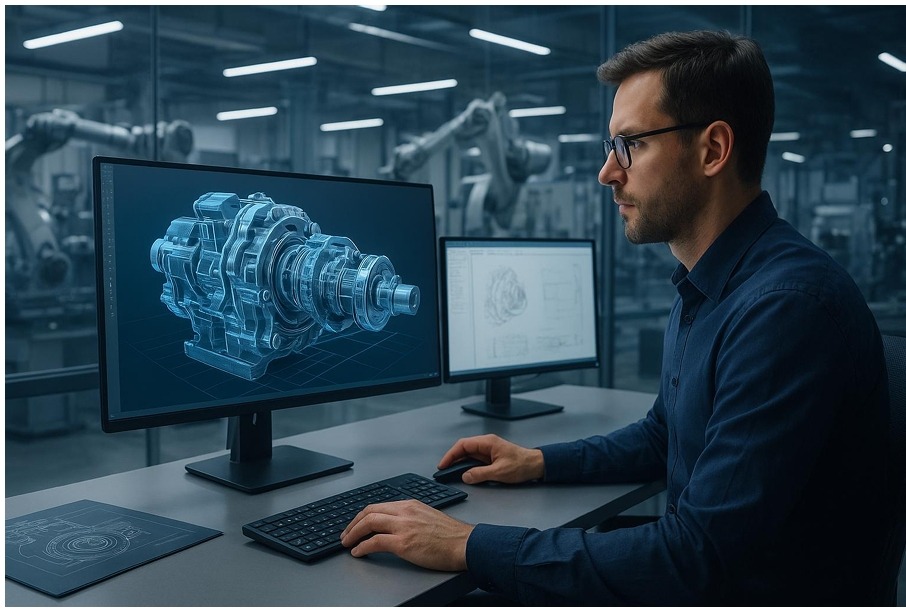
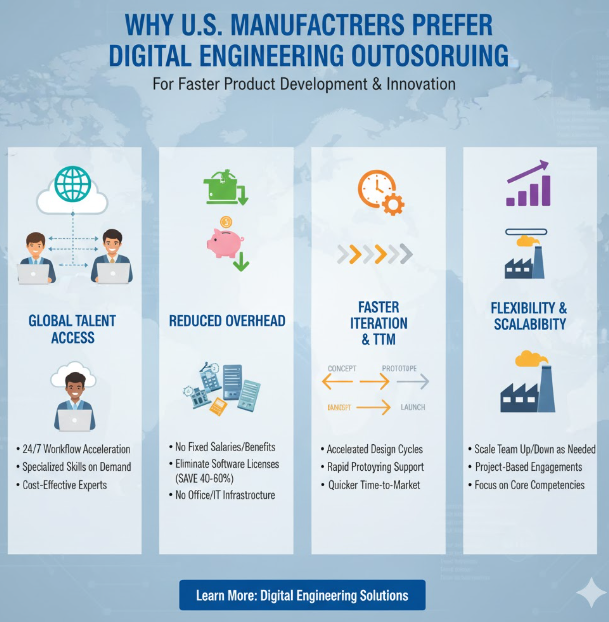
In the competitive U.S. manufacturing landscape, companies face constant pressure to launch innovative products quickly. Whether in consumer electronics, industrial systems, smart devices, automotive components, or industrial machinery, every segment demands speed, precision, and flexibility. Traditional engineering systems cannot keep up with market expectations. As product lifecycles shorten and customer demands increase, manufacturers increasingly turn to digital engineering outsourcing USA firms to speed up development, lower engineering costs, and stay ahead of the competition.  Digital engineering has evolved beyond simple CAD modelling. It now includes simulation, automation, digital twins, generative design, virtual prototyping, and collaborative cloud platforms. By outsourcing these functions, manufacturers access skilled engineers, cutting-edge tools, and efficient processes without the burden of building expensive internal teams. Many companies also rely on specialized mechanical engineering design services for handling complex CAD and simulation workloads. Engon Technologies has become a preferred partner for U.S. companies looking for quicker, more flexible, and reliable product development support. This article discusses why U.S. manufacturers choose digital engineering outsourcing companies and how this strategy helps shorten time-to-market while maintaining high engineering quality.  The Growing Shift Toward Digital Engineering USA Trends in U.S. Manufacturing How U.S. Manufacturers Improve Speed and Accuracy with Digital Engineering USA U.S. manufacturers are undergoing a digital transformation in designing, developing, and launching products. Digital engineering has replaced traditional methods. Virtual Prototyping and Digital Twins in Digital Engineering USA This shift allows companies to create virtual prototypes, simulate real-world behaviour, and validate designs long before physical testing begins. With advanced tools and digital product development services, companies can reduce manual tasks, spot errors early, and iterate quickly.  Rather than relying solely on internal teams, manufacturers now prefer to work with outsourcing partners specializing in engineering design, simulation, CAD development, prototyping, and automation. These partners bring global expertise and deep engineering knowledge that enable faster execution. This trend reflects a broader industry movement where data-driven engineering and outsourced collaboration become vital for achieving innovation in a competitive market.  Why U.S. Manufacturers Choose Digital Engineering Outsourcing USA Companies Faster Time-to-Market with Digital Engineering Outsourcing USA The primary reason U.S. manufacturers opt for outsourcing is speed. Collaborating with experienced digital engineering outsourcing firms significantly shortens product development timelines. Internal engineering teams often face heavy workloads, limited skill sets, and time-consuming processes. Outsourced teams offer immediate access to resources, allowing companies to move from concept to prototype faster than ever.  Outsourcing speeds up new product launches by enabling multiple design and simulation tasks to run simultaneously. Digital engineering allows teams to validate concepts through virtual simulations, quickly refine CAD models, and identify issues early. Reducing delays is crucial for manufacturers in fast-moving markets, where saving even a week can create a significant competitive edge.  Access to Specialized CAD & Simulation Talent Through Engineering Outsourcing USA Another reason U.S. companies prefer engineering outsourcing is access to specialized talent. Modern product development requires experts in advanced CAD modelling, CAE simulation, industrial design, materials engineering, digital twin creation, FEA analysis, and design automation. Building such a diverse internal team is costly, slow, and hard to maintain. A digital engineering outsourcing firm provides a global engineering team with all the necessary skills, ensuring manufacturers have specialists available at every step of the product lifecycle. Familiarity with tools like Creo, SolidWorks, CATIA, Ansys, and NX further enhances engineering accuracy and efficiency.  Industry research from the American Society of Mechanical Engineers shows that digital engineering workflows and simulation-driven design significantly improve engineering efficiency and reduce development time. Reducing Engineering Costs with Digital Engineering Outsourcing USA Cost optimization is another major factor driving this outsourcing trend. Hiring full-time engineers, purchasing costly software licenses, investing in digital infrastructure, and maintaining internal R&D departments place a heavy financial burden on manufacturers. Outsourcing offers cost-effective engineering resources, allowing companies to pay only for the services they need. This approach cuts overhead while ensuring quality engineering output. For startups and medium-sized manufacturers, this is particularly beneficial as it helps them compete with larger companies without excessive spending.  Communication efficiency has also improved significantly thanks to modern digital tools. U.S. manufacturers now collaborate smoothly with offshore teams through shared platforms, cloud-based design systems, daily virtual meetings, and real-time file access. Engineering design outsourcing partners integrate well with internal teams and act as an extension of the manufacturer’s R&D department. The result is a unified engineering process where decisions are made faster, documentation improves, and design iterations flow smoothly.  How Digital Engineering Outsourcing from USA Enhances Mechanical Design and CAD Workflows Mechanical design outsourcing has become essential for U.S. manufacturers because it supports everything from concept sketches to production-ready designs. By relying on skilled CAD engineers, manufacturers avoid bottlenecks and ensure that modelling, assemblies, tolerance studies, and detailed drawings are completed accurately. Outsourced CAD design teams manage large assemblies, complex mechanisms, enclosures, sheet metal parts, and plastic components, delivering production-ready models that meet engineering standards.    Mechanical Design Outsourcing Benefits for U.S. Manufacturers Working across diverse industries and various products cultivates powerful cross-functional expertise. his broad exposure allows teams to meet unique industry needs, including smart devices requiring IoT enclosure design services that combine durability with manufacturability., or applying financial rigor to operational logistics. This proficiency is invaluable as it breaks down organizational silos, enabling a holistic view of challenges and opportunities. A cross-functionally proficient team member can effectively translate needs between departments, anticipate downstream impacts, and drive innovation by adopting best practices regardless of their origin. Ultimately, this expertise leads to more efficient processes, better problem-solving, and more successful product outcomes. Small organizations get diverse expertise (tooling engineers, Production engineers, Reverse engineers, Analysis engineers, etc) and best systems & methods under single roof to solve their problems. Strategic Advantages of Offshore Engineering Partnerships for U.S. Companies Using India Engineering Outsourcing Partnering in India opens the door to a vast and diverse talent pool, offering an unparalleled scale of skilled professionals. This strategic access assures a continuous, reliable supply of high-caliber manpower essential for sustained growth and operational scaling. 24/7 Engineering Cycles with India Engineering Outsourcing An

Why U.S. Manufacturers Prefer a Digital Engineering Outsourcing Company for Faster Product Development Read More »

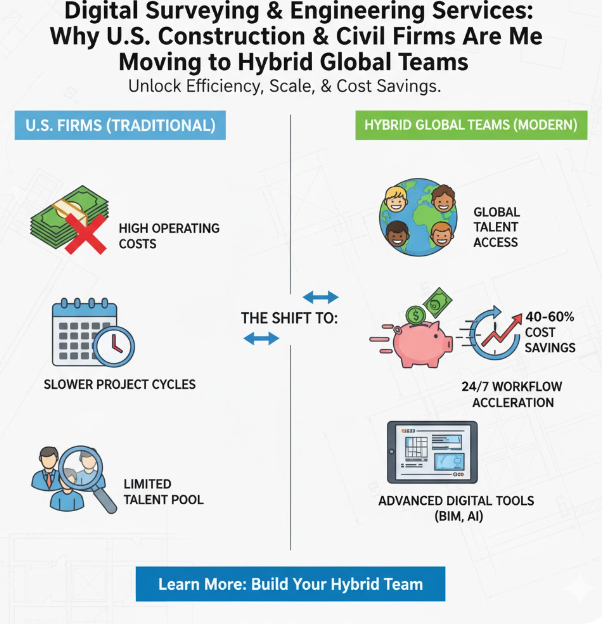
Digital Surveying Services USA infographic comparing traditional U.S. firms with hybrid global engineering teams.

Digital Surveying and Engineering Services: Why U.S. Construction and Civil Firms Are Turning to Hybrid Global Teams

Q: Why are U.S. construction firms shifting to hybrid global engineering teams? A: Because hybrid teams help firms process survey data faster, reduce BIM/CAD bottlenecks, and maintain 24/7 engineering workflows. They also cut engineering costs by 30–50% while improving accuracy and project delivery speed. The construction and civil engineering landscape in the United States is changing rapidly. Urbanization, increased spending on infrastructure, labour shortages, strict regulations, and growing project complexities have pushed the industry to adopt a more digital, data-driven, and collaborative approach. In this shifting environment, Digital Surveying Services USA are key to executing projects faster, more efficiently, and more accurately.  At the core of this change is a new operating model: hybrid global engineering teams. These teams blend U.S.-based project leaders with offshore engineering and digital surveying expertise. This structure enables construction and civil firms to work around the clock, cut overhead costs, speed up design approvals, and enhance overall project outcomes. Firms are increasingly viewing civil engineering outsourcing not just as a cost-saving measure, but as a way to drive innovation, scalability, and timely project delivery.  24/7 Engineering Cycles That Speed Up Project Delivery As U.S. firms adopt more digital tools, the demand for digital surveying services USA, civil engineering outsourcing, and hybrid global engineering teams continues to rise. Learn more about our full-range engineering services Top Benefits of Hybrid Global Teams Faster survey data processing Lower engineering costs 24/7 design cycle Reduced BIM rework Faster approvals     Engon Technologies is leading the way in supporting U.S. construction, infrastructure, and EPC companies with digital surveying solutions, BIM and CAD outsourcing, and comprehensive construction engineering support. This article explores why hybrid global teams have become essential for U.S. firms, how outsourcing speeds up civil project delivery, and how digital surveying improves precision in land development, transportation, energy, and large-scale construction projects.  Rise of Digital Surveying Services USA in Construction and Civil Engineering Why Hybrid Global Engineering Teams Are Increasing in the U.S. Traditionally, the construction industry has been slow to embrace new technologies, but the last decade has seen significant change. This shift is driven by the need for faster execution, better accuracy, and more efficient use of resources. Today, U.S. firms rely on digital tools like LiDAR scanning, GIS platforms, advanced drones, 3D mapping, and geospatial services to enhance the quality of land surveys and site data. These advancements also increase demand for 3D laser scanning services USA, especially for high-accuracy infrastructure projects.” Digital Tools Powering Modern Digital Surveying Services USA  (LiDAR, Drones, GIS, 3D Mapping) Old surveying methods can no longer meet the demands of modern infrastructure. Digital surveying solutions, paired with cloud-based engineering tools, enable contractors and engineering teams to create detailed, high-accuracy digital representations of job sites. These datasets are crucial for planning, design, permitting, and clash detection. As reliance on digital tools increases, so does the need for skilled engineering teams to process large amounts of data, pushing companies to embrace hybrid outsourcing models.  U.S. construction project engineering workflows have become complex. They now involve topographical surveys, structural design, utility coordination, environmental analysis, BIM modelling, CAD drafting, and digital validation techniques. This complexity demands diverse talent, advanced software skills, and the ability to manage multiple tasks at once. Hybrid global teams offer the ideal solution by merging local decision-making with global technical execution. Independent infrastructure-efficiency research by McKinsey shows how hybrid global engineering teams shorten project cycles and reduce project-development costs.  Why U.S. Firms Choose Civil Engineering Outsourcing & Digital Surveying Services USA for Faster, More Accurate Project Delivery Addressing the U.S. Shortage of BIM, CAD & Surveying Talent The rise in outsourcing is driven by several challenges affecting the construction and civil sectors. One major issue is the nationwide shortage of qualified engineers, surveyors, and drafting professionals. Construction firms have difficulty hiring and keeping full-time specialists in surveying, 3D mapping, BIM, and CAD modelling. This shortage leads to delays, inefficiencies, and higher project risks.  The ongoing labor shortage among U.S. civil engineers reported by ASCE highlights why firms struggle to hire surveying, drafting, and BIM specialists in-house. According to BLS civil-engineer projections (2024–34), demand for engineering talent will continue outpacing supply, making outsourcing essential for maintaining productivity. By adopting civil engineering outsourcing models, companies can quickly access a skilled global workforce. These teams can handle surveying data processing, CAD development, structural drafting, planning documentation, and digital engineering analytics. Outsourcing allows U.S. teams to focus on site management, contract administration, inspections, client coordination, and regulatory approvals, while offshore teams take care of the technical work needed for project progression.  Growing Demand for CAD Drafting Outsourcing USA Cost optimization also drives outsourcing. Keeping a full-time, in-house engineering team is costly, especially for firms managing multiple projects with varying engineering needs. A hybrid team offers a flexible engineering workforce, letting companies adjust staffing based on project phases. This flexibility helps maintain budgets, improve profitability, and minimize the risks linked to overstaffing or understaffing.  Another reason firms outsource digital surveying and engineering services is the demand for faster land survey data processing. Digital surveying tools produce vast amounts of raw geospatial data, including point clouds, terrain maps, elevation models, and 3D site scans. Many contractors now rely on LiDAR surveying USA to capture detailed terrain and elevation data. Processing this data manually is time-consuming and labour-intensive. Offshore engineering teams, skilled in advanced software and large-scale data processing, can convert raw data into usable deliverables quickly, ensuring that planning and construction schedules stay on track.  How Hybrid Global Teams Accelerate Construction and Civil Project Delivery  Faster Survey-to-CAD and Survey-to-BIM Processing Pipelines Hybrid global engineering teams work around the clock, keeping work moving even after U.S. teams finish their day. This 24-hour engineering cycle significantly reduces delivery timelines. When surveyors or field teams upload datasets, offshore engineers begin processing them right away. By the next morning in the U.S., refined drawings, terrain models, and design updates are ready for review. This level of efficiency is hard to achieve with only local teams.  The combination of digital surveying solutions

Digital Surveying and Engineering Services: Why U.S. Construction and Civil Firms Are Turning to Hybrid Global Teams Read More »

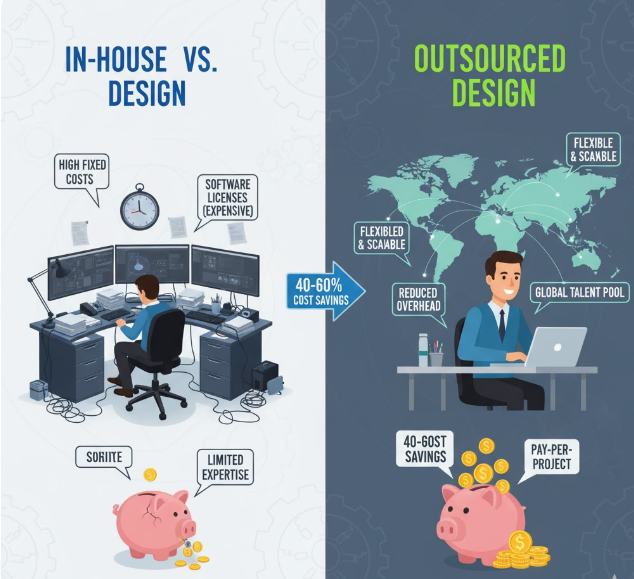
In-house vs outsourced mechanical engineering design cost comparison highlighting 40–60% savings for manufacturers in the USA and Western Europe.

Engineering Cost Breakdown: In-house vs Outsourced Mechanical Design for Small Manufacturers

For small-to-medium enterprises (SMEs) focused on product innovation, understanding outsourced mechanical design cost is essential when deciding whether to outsource mechanical design or hire internally plays a vital role in profitability and speed to market. The common belief that “in-house control” is cheaper often hides the true costs of having internal engineering teams. This analysis offers a detailed comparison of engineering costs, providing a framework to evaluate the real costs of outsourcing mechanical engineering against the fixed and hidden expenses of internal staffing. This comparison is important because specialized engineering services can lead to substantial cost savings, often allowing small manufacturers to reduce their overall product development expenses by 40 to 60% while accessing top-notch expertise. Understanding this engineering cost breakdown for product design is the first step in optimizing your SME engineering budget. In-House Engineering Costs vs. Outsourced Mechanical Design Cost When manufacturers compare in-house and outsourced engineering team cost, they often only consider employee salaries. However, the costs of hiring a mechanical engineer go beyond their pay check, creating a significant and often underappreciated financial obligation. The total expenses—fixed no matter the workload—can drain small business resources. Decoding the Hiring Cost of a Mechanical Engineer To fully understand the commitment involved in hiring internally, one must consider the entire compensation package. Let’s break down the costs of hiring a mechanical engineer in the U.S. as a typical example:- Base Salary: A mid-level mechanical design engineer in the U.S. usually earns between $75,000 and $100,000 annually. This is the minimum fixed expense. (Source: BLS Mechanical Engineer Salary Data, SBA Payroll Tax Guide) Payroll Taxes and Benefits: Employers must cover FICA, state, and federal taxes, unemployment insurance, and worker’s compensation. Additionally, offering competitive benefits (like health, dental, 401k match, paid time off, and sick leave) typically adds another 30% to 45% on top of the base salary. Example: For a $90,000 base salary, the real cost of an in-house engineering team, including benefits, jumps to about $117,000 to $130,500, even before considering overhead. This sharply contrasts with a project-based engineering salary versus outsourcing, where you pay only for completed work. The True Cost: Overhead and Hidden Expenses in Outsourced Mechanical Design Cost Analysis One of the most overlooked parts of the engineering cost comparison is the overhead related to the engineering team. These costs exist whether your engineer is actively working on a product or waiting for the next project phase. When companies evaluate outsourced mechanical design cost, this hidden overhead becomes a critical factor—often revealing how outsourcing can eliminate non-productive expenses and improve overall engineering efficiency. Software and Tooling: Accessing professional-grade tools is essential. Annual license fees for advanced CAD/CAE software (like SolidWorks, Fusion 360, or specialized analysis tools) can range from $5,000 to $20,000 per seat per year. Physical Infrastructure: Costs for office space, dedicated desks, high-performance workstations, utilities, and IT support add significantly to fixed expenses. Training and Development: To maintain skills, mandatory training, conferences, and certifications can add several thousand dollars each year. (Guidelines: WIPO IP Guide, USPTO IP Policy) Recruitment and Turnover: The cost of recruiting a specialized engineer—including agency fees, interview time, and onboarding—represents a major, non-recoverable expense. Capacity Constraints and Inflexibility The in-house model is often rigid. When demand spikes, the team can become overloaded, leading to delays. When demand drops, which is common in cyclical product development phases, manufacturers still pay 100% of the engineer’s salary and overhead costs. This fixed-cost model lacks the flexibility small manufacturers need to stay competitive. By comparing these fixed expenses with outsourced mechanical design costs, it becomes clear that outsourcing offers a more scalable, cost-efficient alternative that aligns engineering resources with actual project demand. Analysing the Mechanical Engineering Outsourcing Cost The main benefit of outsourcing mechanical design is turning a large fixed cost into a precise, variable project expense. Small manufacturers pay only for the specific expertise and hours they require, making the engineering cost comparison tilt heavily in favour of outsourcing for non-continuous or specialized work. When evaluating outsourced mechanical design cost, it becomes clear that this model helps businesses control spending while accessing exactly the level of engineering support they need. Flexible Models for Outsourced Mechanical Design Outsourcing provides various engagement models, offering significant flexibility for the SME engineering budget:- Project-Based (Fixed Price): This model works best for well-defined deliverables (like designing a specific enclosure or optimizing a single part). The manufacturer gets a fixed engineering cost breakdown upfront, preventing budget overruns. Time & Materials (Hourly): This model suits ongoing development, troubleshooting, or tasks with an undefined scope. It directly connects to mechanical design hourly rates. Retainer Model: This option offers dedicated capacity at a better rate. The retainer model is ideal for manufacturers with predictable yet intermittent monthly engineering needs. Calculating the Outsourced CAD Design Cost and CAD/CAE Cost Per Hour External firms typically use a transparent pricing structure based on specific deliverables or hourly rates:- Hourly Rates: While a U.S.-based consulting firm may charge $120 to $200 per hour, this rate includes software licenses, overhead, and benefits. Clients do not pay for employee downtime or training. Global Sourcing (Offshore): Hiring an offshore engineering team can significantly lower rates, sometimes down to $40 to $80 per hour, depending on the specialization and location. This reduction can greatly decrease the outsourced CAD design cost for high-volume modelling work. (Industry data: Statista Outsourcing Data) Focus on Output: Unlike internal engineers, whose costs accrue regardless of output, external teams charge based on completing milestones. The effective CAD/CAE cost per hour becomes a performance metric rather than a fixed expense. When SMEs analyze outsourced mechanical design cost, they often find that this milestone-based model brings far greater efficiency and accountability.  This analysis shows that the outsourcing cost model protects the SME engineering budget from the steep fixed commitment of $148,000 for a single internal engineer. Scenario Analysis: Project-Based Needs Consider a small manufacturer needing 500 hours of product development work over the year for two new products. In-House Cost: $148,000 (The manufacturer still pays 100% of

Engineering Cost Breakdown: In-house vs Outsourced Mechanical Design for Small Manufacturers Read More »

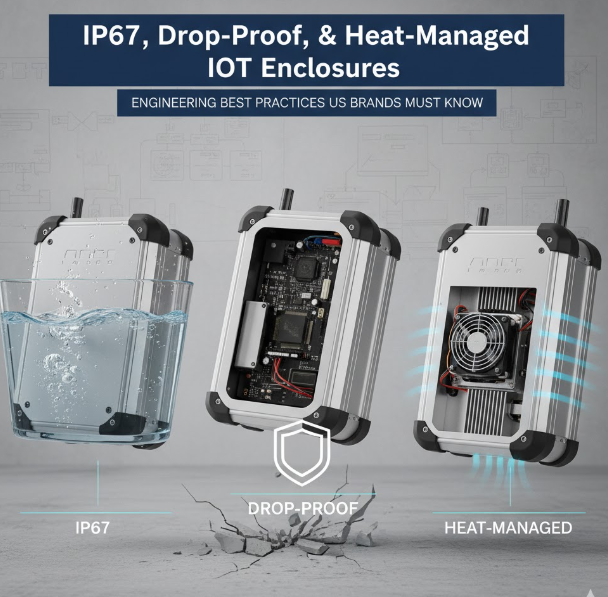
IP67IOT enclosure design services for waterproof, drop-proof, heat-managed IoT enclosures.

IP67, Drop-Proof, and Heat-Managed IoT Enclosures: Engineering Best Practices US & European Brands Must Know

IP67 IoT Enclosure Design Services are essential for building reliable products. Modern IoT hardware operates in tough environments. Whether a smart meter in a snow-covered utility area, an outdoor sensor on a pole in Arizona, a gateway on a construction site, or a device attached to heavy equipment, the enclosure plays a crucial role in the system’s survival against real-world stress. For U.S. and Western European buyers who prioritize long-term reliability, regulatory compliance, and predictable field performance, enclosure engineering directly affects product success, warranty cost, and customer trust. For U.S. brands in industrial, consumer, or commercial sectors, enclosure engineering is now essential for product reliability, rather than just an afterthought during mechanical design. Companies in the U.S., Germany, France, the Netherlands, and the Nordics increasingly demand IP67 sealing, thermal stability, and impact performance as mandatory—not optional—criteria before approving a design partner or outsourcing engineering. An enclosure that has IP67 protection, withstands drops, and manages heat effectively is the new standard for rugged IoT products. Engon Technologies has extensive experience in these areas. This guide reveals the engineering basics U.S. teams must embrace to create reliable, field-ready IoT hardware. For buyers seeking faster time-to-market, extended device lifetime, and reduced maintenance cost, these best practices directly map to measurable ROI. Why High-Performance Enclosures Matter in the U.S. Market – IP67 IoT Enclosure Design Services The United States faces a mix of environmental and operational challenges. From humid conditions on the East Coast to the extreme heat of the Southwest, and from the cold Midwest winters to stormy Gulf areas, IoT devices must function reliably year-round. These climate differences are just part of the picture. Many IoT systems are used in industries like construction, public utilities, logistics, manufacturing, and agriculture. These settings expose devices to dust, vibrations, handling, temperature changes, and unpredictable weather. Key Reliability Expectations from U.S. & EU Engineering Buyers U.S. and European buyers look for partners who can guarantee: Proven IP67/IP68 sealing performance Ability to pass UL, CE, NEMA, IK, ASTM, and MIL-STD tests Low failure rates during deployment (critical for enterprise and government buyers) Designs optimized for scalable manufacturing and reduced warranty claims Engineering teams with simulation, DFM, and ruggedization expertise That’s why creating rugged IoT enclosure systems with IP67 sealing, drop resistance, heat stability, and UV protection is essential. U.S. customers expect products to endure real-life handling, and regulatory agencies often require specific durability tests. A smartly designed waterproof IoT enclosure keeps services running, reduces failures in the field, and shields sensitive electronics from moisture, dust, and accidental submersion. A well-constructed drop-proof enclosure ensures the product can handle unintentional drops or rough treatment by technicians during installation and maintenance. Finally, a heat-managed IoT enclosure prevents overheating and extends the lifespan of internal components. These points directly influence purchasing approval cycles and are often key decision criteria in U.S. and EU RFPs. Understanding IP67 Requirements for IoT Devices – IP67 IoT Enclosure Design Services IP67 certification is a common goal for outdoor and industrial IoT products. The “6” ensures full protection against dust, while the “7” indicates water resistance for up to one meter deep for 30 minutes. Getting this rating involves more than just adding a gasket. It requires precise engineering of every mechanical interface, including mating surfaces, screw bosses, ventilation designs, PCB positioning, and manufacturing tolerances. Why IP67 Matters When Outsourcing Mechanical Design This level of engineering rigor is exactly what U.S. & EU buyers expect when outsourcing mechanical design for enclosure development—especially in industrial, energy, EV charging, metering, environmental monitoring, and smart-city applications. In the U.S., IP67 is largely viewed as equal to or a functional alternative to specific NEMA enclosure ratings depending on the application. Many brands aim for a single enclosure design that meets both global and local standards. This makes robust IP67 plastic enclosure design critical for compliance and market acceptance. Engineering an IP67 Enclosure: Principles That Cannot Be Ignored – IP67 IoT Enclosure Design Services An effective IP67 IoT enclosure design revolves around controlled sealing and predictable mechanical behaviour. Key elements include the geometry of mating surfaces, gasket reliability, material stability, tolerances, screw load distribution, and surface smoothness. A good housing typically uses a tongue-and-groove or stepped design to ensure a controlled sealing path. This setup stops water from bypassing the joint and creates a uniform compression area for the gasket. Buyers in the U.S./EU often evaluate suppliers based on repeatable gasket compression quality, automated QC processes, and sealing consistency at scale—core requirements for reducing failure rates during mass deployment. Sealing & Gasket Engineering Best Practices Gasket design matters just as much. The gasket must maintain long-term compression without losing its elasticity, even when exposed to sunlight or going through repeated temperature shifts. Silicone is often preferred due to its durability, resilience, and consistent performance. For products meant for long outdoor use, UV-resistant silicone or EPDM materials often perform better. The gasket track design must support the right compression. Too much compression harms the seal, while too little fails to provide waterproofing. Consistent gasket placement and not relying on adhesive for sealing are vital best practices. Manufacturing Tolerances & QC Also, IP67 sealing design relies heavily on managing manufacturing tolerances. Variations in enclosure walls, mating surfaces, or screw bosses can lead to small gaps that break waterproofing. Draft angles, Mold shrinkage, and part warpage must be accounted for at the design stage. This is why successful IP67 mechanical design guidelines stress close cooperation among design engineers, material specialists, and melding teams. These factors also drive cost savings for buyers by reducing retooling iterations and accelerating NPI timelines. SEALING METHODS COMPARISON Sealing Method Strength Weakness Best For Silicone Gasket Long life, flexible Needs precise compression IP67 industrial devices EPDM Gasket UV resistant Less flexible Outdoor sunlight-heavy use Liquid Gasket Automated application Hard to rework Mass-production Overmolded Seal Best sealing High tooling cost Rugged devices, zero leakage Material Selection: The Foundation of a Rugged Outdoor IoT Device – IP67 IoT Enclosure Design Services Choosing the material for an outdoor IoT device enclosure is

IP67, Drop-Proof, and Heat-Managed IoT Enclosures: Engineering Best Practices US & European Brands Must Know Read More »

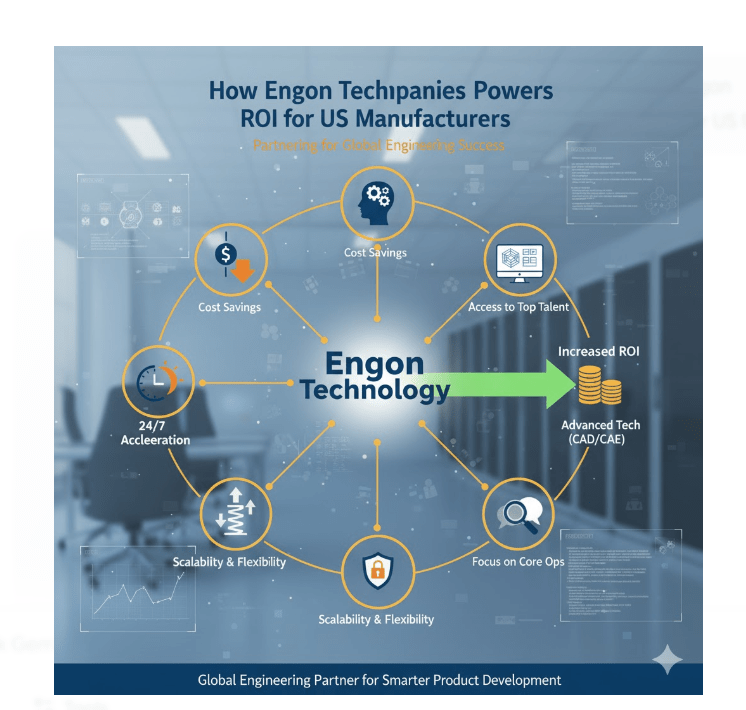
Engon Technologies powers ROI for US manufacturers through global mechanical design outsourcing, highlighting cost savings, 24/7 acceleration, scalability, access to top talent, and advanced CAD/CAE technology

How US Manufacturers Boost ROI Through Global Mechanical Design Partnerships

Why Global Mechanical Design Outsourcing Boosts ROI In today’s highly competitive manufacturing landscape, US manufacturers are under constant pressure to innovate faster, reduce production costs, and improve product quality — all while maintaining profitability and ROI. Traditional in-house design teams, though capable, often face limitations in scalability, specialized expertise, and cost efficiency. This is where global mechanical design outsourcing partnerships come in, offering a smarter, leaner, and more collaborative approach to engineering excellence. By leveraging specialized outsourced mechanical design outsourcing services, manufacturers are no longer confined to local talent pools or costly R&D setups. Instead, they gain access to a worldwide network of mechanical engineers, product designers, and simulation experts who work around the clock to bring ideas to life. For US firms, this isn’t just about cutting costs — it’s about unlocking innovation, agility, and faster time-to-market. Companies like Engon Technologies are at the forefront of enabling this transformation. With a global delivery model and a proven record in mechanical product development, Engon helps manufacturers turn complex design challenges into commercially viable solutions that directly improve ROI. Quick Stats — ROI from Global Mechanical Design Outsourcing Key Metric Impact for US Manufacturers 30% Faster Design Cycle Achieved through 24/7 design collaboration and global engineering handoff. 25% Cost Reduction Lower labor and infrastructure costs via offshore design partnerships. 20–35% Higher ROI Driven by faster time-to-market and improved design optimization. 100% Quality Assurance ISO & ASME-compliant engineering processes validated with FEA and CAD simulations. Understanding the ROI Equation in Manufacturing Design Return on Investment (ROI) in manufacturing has traditionally been measured by tangible outcomes like reduced production costs, shorter design cycles, and lower failure rates. However, the modern ROI equation includes strategic intangibles — agility, innovation capability, and global competitiveness. When manufacturers invest in mechanical design outsourcing services, they’re not merely buying engineering hours; they’re investing in efficiency and innovation multipliers. Global partnerships enable them to spread R&D costs, tap into niche domain expertise, and accelerate product iterations through parallel engineering teams. This combination directly translates to higher ROI through: Faster Time-to-Market: With global design teams working across time zones, development cycles shrink dramatically. Lower Overheads: Outsourcing eliminates fixed costs of hiring, training, and maintaining large in-house teams. Higher Quality Output: Access to multidisciplinary experts ensures better validation, fewer redesigns, and improved product performance. Engon Technologies, for example, has worked with several US-based OEMs to achieve up to 30% reduction in design cycle time and 25% cost savings per project. Their approach combines precision-driven modeling tools like SolidWorks and Creo with simulation-driven validation to ensure every product is optimized before it reaches production. Ultimately, ROI in manufacturing today isn’t just a financial metric — it’s a reflection of how efficiently and intelligently a company designs its future products. The Strategic Edge of Global Mechanical Design Partnerships Global design partnerships have evolved beyond transactional outsourcing. Today, they represent a long-term strategic collaboration that fuels innovation, scalability, and operational excellence. By forming alliances with specialized engineering partners like Engon Technologies, US manufacturers can amplify their design capabilities without inflating costs. Such partnerships are built on co-engineering models, where the external design team functions as an integrated extension of the client’s in-house R&D. This allows for flexible resource scaling during high-demand phases like product launches or redesign cycles. Additionally, global partners bring exposure to diverse manufacturing standards, materials, and simulation methodologies — offering design diversity and risk mitigation that internal teams often lack. Engon Technologies stands out in this space by aligning global resources with local client priorities. Their project management framework ensures seamless collaboration, real-time updates, and quality assurance at every stage of mechanical product development. For US manufacturers aiming to enter new markets, this global-local synergy ensures that designs are compliant with international safety norms and production constraints. In essence, global partnerships transform design from a cost center into a competitive differentiator. When managed strategically, they not only reduce expenditure but also elevate the manufacturer’s ability to innovate — driving sustainable ROI growth. Cost Efficiency Without Compromising Innovation One of the biggest myths about outsourcing design is that cost savings come at the expense of innovation or quality. In reality, outsourced mechanical design services can deliver both — when executed with the right partner. Engon Technologies has perfected this balance through its “Value Engineering First” philosophy. Instead of simply executing client blueprints, the company collaborates deeply to identify optimization opportunities — whether it’s reducing material usage, simplifying assembly, or improving manufacturability. Every design phase, from CAD modeling to prototype validation, is guided by the dual goals of cost-effectiveness and innovation excellence. Through advanced simulation software’s, Engon’s engineers validate mechanical integrity and optimize performance before production begins. This proactive design validation prevents costly post-production errors and rework — one of the most overlooked ROI killers in manufacturing. By tapping into global mechanical design engineering partnerships, US manufacturers can access top-tier design expertise at a fraction of the local cost. The savings generated can then be reinvested into innovation — funding new product lines, automation upgrades, or sustainable material exploration. In today’s competitive landscape, the smartest manufacturers are not those who spend more but those who design smarter. Engon enables precisely that — helping clients achieve cost efficiency without diluting creativity or engineering rigor. Accelerating Product Development and Time-to-Market In fast-moving industries like consumer electronics, automotive, or industrial equipment, speed defines survival. The faster a company can move from concept to prototype to production, the stronger its market advantage. This is where global mechanical design engineering partnerships deliver a massive ROI impact. Engon’s distributed engineering model enables round-the-clock development. With design teams in multiple time zones, progress continues even after US business hours — effectively cutting project turnaround times by 30–40%. This time-zone advantage allows manufacturers to iterate designs, run simulations, and receive deliverables overnight. Furthermore, Engon’s agile project management ensures that feedback loops are short and transparent. Using digital collaboration platforms, clients can review 3D models, simulation reports, and design revisions in real time. This agility not only accelerates product development but

How US Manufacturers Boost ROI Through Global Mechanical Design Partnerships Read More »

US company collaborating with Indian mechanical engineers for CAD design

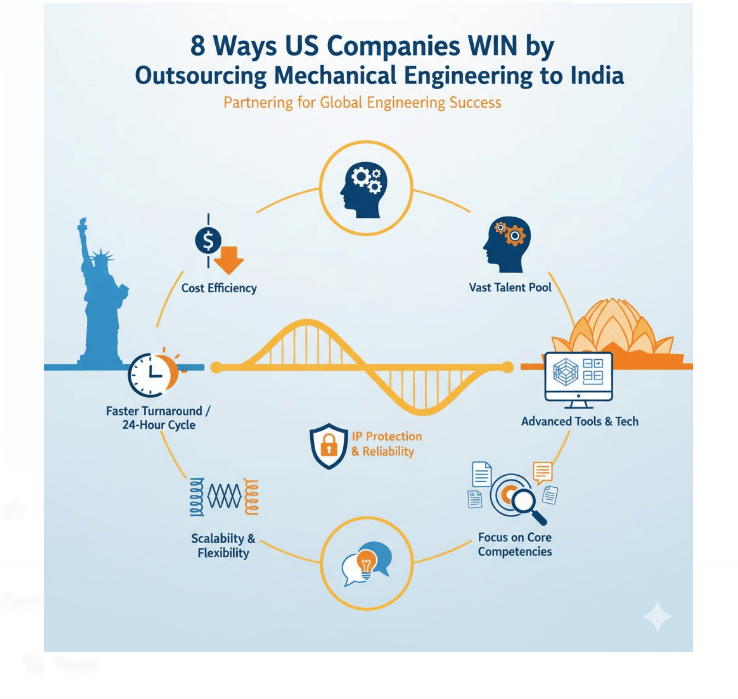
8 Ways US Companies Gain by Outsourcing Mechanical Engineering to India

In today’s fast-paced product development ecosystem, agility, precision, and cost-effectiveness determine who leads and who lags. For many US-based manufacturing and product design companies, balancing innovation with operational efficiency has become increasingly complex. This is where outsourcing mechanical engineering to India is transforming the competitive landscape. India has evolved into a powerhouse for mechanical design, prototyping, and simulation services, offering not only cost advantages but also world-class engineering expertise. With a strong pool of mechanical engineers, advanced CAD/CAE proficiency, and a growing culture of innovation, India provides more than just a workforce — it offers partnership in problem-solving. For US companies, collaboration with Indian firms like Engon Technologies enables faster project turnaround, higher design precision, and scalability without inflating operational costs. Engon’s engineering teams combine technical excellence with a deep understanding of international manufacturing standards, helping startups and OEMs alike bring complex ideas to market efficiently. Here are eight powerful ways in which US companies gain a tangible edge by outsourcing mechanical engineering design and development to India — and how Engon Technologies is helping bridge that global innovation gap. Cost Efficiency Without Compromising Quality One of the primary reasons US companies turn to India for mechanical engineering support is the significant cost advantage. Outsourcing can reduce project expenses by up to 50–60%, freeing up budgets for research, innovation, and marketing. However, cost savings are only part of the story — quality engineering delivery remains the key differentiator. Indian mechanical engineers are highly skilled in CAD platforms like SolidWorks, Creo, and AutoCAD, ensuring designs meet both aesthetic and functional goals. Firms like Engon Technologies go beyond standard outsourcing by implementing multi-level design quality checks and simulation-based validation before project delivery. This balance of affordability and precision allows US manufacturers to scale operations, experiment with multiple prototypes, and refine product features without the typical cost constraints. Moreover, Engon’s engineering processes adhere to ISO and ASME standards, ensuring every component and assembly aligns with global benchmarks. For startups and mid-sized US businesses, this means having access to premium engineering support that rivals in-house teams — but at a fraction of the cost. Outsourcing to India, when done through a specialized partner like Engon, transforms cost efficiency into strategic value. Access to a Vast Pool of Skilled Engineers India’s mechanical engineering talent pool is among the largest and most diverse in the world. Every year, thousands of engineers graduate with specialized expertise in design, thermodynamics, materials science, and production engineering. This creates a ready ecosystem of technical talent that US firms can tap into for a wide variety of design and development needs. Engon Technologies, for example, leverages this talent advantage by building dedicated engineering teams for US clients across domains like product design, simulation, reverse engineering, and prototyping. Their engineers are trained in global best practices and equipped to collaborate seamlessly across time zones using modern communication tools and project management systems. This scalability helps US businesses overcome a key challenge — shortage of skilled engineers locally. Whether it’s a startup developing a custom enclosure for IoT devices or an established OEM needing component redesigns, Engon can instantly onboard experts tailored to the project’s needs. By outsourcing to India, US companies gain not just manpower, but specialized minds who understand complex geometries, design optimization, and real-world manufacturing constraints — ensuring innovation is both practical and production-ready. Faster Turnaround and Time-Zone Advantage In product development, speed to market is everything. Outsourcing to India offers a distinct time-zone advantage that accelerates project timelines. When the US workday ends, Indian teams begin theirs — effectively creating a 24-hour engineering cycle. This means design iterations, simulations, and revisions can continue overnight, leading to faster project delivery and reduced time-to-market. Engon Technologies maximizes this benefit by operating on a “follow-the-sun” model, ensuring continuous progress. For example, a US client can share project inputs at the end of their day, and Engon’s engineers can have updates ready by the next morning. This seamless workflow drastically reduces delays in design validation, prototyping, and documentation. Moreover, Engon combines agile methodologies with engineering design principles, allowing clients to receive frequent updates, feedback loops, and quick design refinements. For industries where deadlines dictate competitiveness — such as automotive, consumer electronics, and industrial equipment — this model ensures US companies stay ahead of the curve. By outsourcing to India through Engon Technologies, US businesses not only gain speed but also ensure engineering precision under tight deadlines, a critical advantage in today’s innovation-driven economy. Access to Advanced Engineering Tools and Technologies Modern mechanical design demands cutting-edge software and tools for CAD modelling, CAE simulation, FEA analysis, and product lifecycle management. Outsourcing to India provides US companies access to the latest engineering technologies without heavy capital investment. Engon Technologies, for instance, employs a full suite of tools such as SolidWorks, Creo, CATIA, Ansys, and Autodesk Inventor, ensuring compatibility with global design ecosystems. This allows clients to receive deliverables in formats that integrate seamlessly into their internal processes. Beyond software, Engon uses virtual prototyping, 3D simulation, and digital twin approaches to validate designs before production. This reduces errors, improves design reliability, and enhances manufacturability — saving both time and money in the long run. For smaller US companies, this is a game-changer. Instead of spending thousands on licenses and high-end hardware, they can access world-class design environments through Engon’s infrastructure. Engon’s engineering ecosystem enables clients to innovate freely without infrastructure constraints, turning ideas into production-ready designs faster and more accurately. By outsourcing mechanical engineering to India, US firms gain the technological leverage they need to compete globally — powered by partners like Engon who invest heavily in tools, training, and process automation. Scalability and Flexibility for Every Project Size One of the most overlooked advantages of outsourcing mechanical engineering to India is scalability. Whether a US company needs support for a single prototype or an entire product line redesign, Indian engineering firms can quickly adapt to changing project scopes. Engon Technologies offers flexible engagement models — from project-based assignments to dedicated design teams — allowing

8 Ways US Companies Gain by Outsourcing Mechanical Engineering to India Read More »

Top 10 Reasons US Businesses Choose Offshore Mechanical Engineering Partners

In today’s competitive manufacturing landscape, U.S. businesses are under constant pressure to innovate faster, optimize costs, and maintain high-quality engineering output. One strategic solution gaining momentum is offshore mechanical engineering partnerships. From startups developing IoT hardware to large-scale OEMs designing industrial machinery, companies are increasingly turning to overseas engineering firms to meet their design, prototyping, and production needs. These collaborations not only bridge skill gaps but also provide access to advanced technologies, flexible resources, and faster development cycles—without compromising precision or quality. Partnering with experienced global firms like Engon Technologies enables U.S. manufacturers to scale their mechanical design outsourcing capabilities efficiently and cost-effectively. Let’s explore the top 10 reasons why U.S. businesses are choosing offshore mechanical engineering partners and how this approach is transforming modern product development. Cost-Effective Engineering Without Quality Compromise Outsourcing mechanical design services offshore is one of the most effective ways to control costs whilfor e maintaining global standards. Labor and operational expenses in countries like India are significantly lower than in the U.S., enabling companies to achieve more for less. However, cost-effectiveness doesn’t mean cutting corners. Reputed firms like Engon Technologies combine affordable engineering talent with certified design processes and advanced CAD/CAE tools to deliver exceptional results. Clients gain access to expert mechanical engineers capable of executing projects with high precision—from initial CAD/ CAE engineering USA modelling to complex finite element analysis (FEA). By optimizing budgets and minimizing overheads, U.S. businesses can allocate resources more strategically—focusing on R&D, innovation, and market expansion—while their offshore mechanical engineering partner manages the technical heavy lifting. Access to Specialized Global Expertise Global mechanical design firms offer a wide range of domain expertise that’s often difficult or expensive to maintain in-house. Offshore teams bring experience across industries such as automotive, consumer electronics, aerospace, and industrial machinery. Engon Technologies, for instance, provides end-to-end mechanical engineering services for US companies, including CAD modelling, simulation, reverse engineering, and prototype validation. Their engineers are proficient in leading tools like SolidWorks, Creo, and AutoCAD, ensuring precision-driven results that align with U.S. industry standards. Access to specialized skill sets enables American companies to address complex mechanical challenges quickly—whether it’s optimizing enclosure design, improving thermal management, or re-engineering legacy components. This knowledge diversity helps accelerate product design outsourcing innovation while maintaining reliability and safety. Faster Time-to-Market In highly competitive markets, the speed of innirmsovation often determines success. Offshore mechanical design partnerships significantly reduce product development cycles through 24/7 workflows. When a U.S. company collaborates with an overseas partner like Engon Technologies, time zone differences become an advantage. While the U.S. team concludes its day, the offshore team continues progress overnight—resulting in continuous project movement and faster turnaround times. Moreover, these digital collaboration tools enable real-time updates, version tracking, and faster design reviews—ensuring no time is wasted in communication gaps or redundant iterations. Engon Technologies uses structured sprint cycles and milestone tracking, allowing clients to monitor every stage of development. This approach not only accelerates delivery but also improves overall design accuracy and accountability. By aligning design speed with market demands, businesses gain the agility to adapt to changing customer needs and emerging technologies—turning mechanical design into a true competitive advantage. Scalability and Resource Flexibility One of the biggest challenges for U.S. manufacturers is managing fluctuating project demands. Offshore engineering partnerships provide instant scalability—allowing businesses to ramp design teams up or down based on workload. Instead of hiring and training new engineers for every project, U.S. firms can rely on offshore mechanical engineering teams that are ready to deploy skilled professionals as needed. This flexibility minimizes fixed costs and maximizes operational efficiency. Engon Technologies offers scalable engagement models, from dedicated teams to project-based collaborations. This adaptability ensures that clients always have the right level of support—whether for a short-term design sprint or a full product lifecycle engagement. Additionally, scalability plays a crucial role in helping businesses stay resilient during uncertain market cycles. When demand spikes—such as during a new product launch or large client order—offshore partners can immediately augment design capacity without disrupting timelines. Conversely, during slower periods, U.S. companies can scale down without the burden of maintaining idle resources or additional payroll commitments. This elasticity empowers organizations to stay clean, efficient, and competitive. With Engon Technologies, companies also benefit from structured onboarding frameworks that make scaling seamless—ensuring new engineers integrate quickly into ongoing projects, adhere to established design standards, and maintain consistent quality output. Such a partnership not only saves time and money but also enhances project agility. Whether it’s accelerating a prototype phase, conducting mechanical stress simulations, or refining CAD assemblies, Engon’s team ensures every scale-up or scale-down transition happens smoothly. Ultimately, scalable offshore models redefine how U.S. manufacturers operate—transforming mechanical design capacity into a truly on-demand service that grows and adapts alongside business goals. Access to Advanced Tools and Technologies Modern mechanical design requires advanced software, simulation tools, and rapid prototyping technologies. However, maintaining these systems in-house can be prohibitively expensive. Offshore partners often invest heavily in state-of-the-art tools to stay competitive. With firms like Engon Technologies, U.S. clients gain access to a full suite of modern platforms—ranging from mechanical CAD modelling (Creo, SolidWorks) to CAE (ANSYS, Hyper Mesh) and 3D printing. These technologies enhance design precision, optimize material usage, and enable quick virtual testing before physical prototyping. By leveraging offshore partners’ technology infrastructure, U.S. companies benefit from world-class design capabilities without the financial burden of software licenses or specialized hardware investments. Overcoming Engineering Talent Shortages The U.S. faces a persistent shortage of skilled mechanical engineers, especially in advanced manufacturing sectors. According to industry reports, demand for mechanical engineering firms in India  is outpacing supply, making it challenging for businesses to maintain in-house design teams. Offshore mechanical engineering partnerships bridge this gap. Companies like Engon Technologies employ highly trained engineers who bring strong technical foundations and global exposure. By tapping into this international talenesign t pool, U.S. firms can fill expertise gaps quickly—without the delays and costs of recruitment or relocation. This access ensures continuity, innovation, and a reliable pipeline of engineering excellence regardless of

Top 10 Reasons US Businesses Choose Offshore Mechanical Engineering Partners Read More »

Challenges Faced by Mechanical Design Consultants in Industrial Design Projects

Industrial projects today demand precision, speed, and innovation. Whether it’s developing complex machinery, optimizing production layouts, or designing next-generation enclosures, mechanical design consultants play a crucial role in transforming ideas into tangible engineering solutions. However, the journey from concept to completion isn’t without its roadblocks. Design consultants often navigate multiple challenges—from misaligned project goals and resource constraints to communication breakdowns and changing client requirements. These hurdles can directly impact cost, quality, and time-to-market. To stay competitive and deliver high-performing solutions, consultants need a mix of technical expertise, project foresight, and adaptive collaboration models. This article explores the most common challenges faced by mechanical design consultancy in industrial projects—and, more importantly, how to solve them effectively. Companies like Engon Technologies have set benchmarks in overcoming these challenges with robust design frameworks, advanced simulation tools, and a problem-solving mindset that consistently ensures project success. Challenge: Unclear Project Requirements and Scope Creep One of the biggest hurdles in industrial mechanical design projects is a vague or evolving project scope. Often, clients come with a basic idea of what they need but lack clarity on design parameters, performance metrics, or manufacturing constraints. This ambiguity leads to frequent design revisions, scope creep, and delayed approvals—eventually derailing timelines and budgets. How to Solve It: The key lies in establishing clear communication and documentation from the start. Before diving into CAD or simulation, consultants must conduct requirement workshops, gather detailed use-case data, and define technical boundaries. A structured Design Requirement Document (DRD) helps in aligning expectations and reducing back-and-forth during execution. Companies like Engon Technologies implement a phase-gated design approach, where each phase (concept, design, validation, and handover) has defined deliverables and checkpoints. This ensures that every stakeholder—from the client to the production team—remains aligned, minimizing last- minute surprises and optimizing design turnaround time. Challenge: Managing Cross-Functional Collaboration Industrial design projects are rarely solo efforts. Mechanical, electrical, automation, and production teams must work hand-in-hand. Yet, communication silos and incompatible software ecosystems often create bottlenecks. When electrical and mechanical teams design in isolation, issues like interference, assembly misfits, or conflicting tolerances surface during production, leading to costly rework. How to Solve It: Integrated collaboration is the answer. Using shared platforms like SolidWorks PDM, Creo Windchill, or Teamcenter ensures real-time access to design data, version control, and seamless handoffs between departments. Regular design reviews and concurrent engineering practices keep teams synchronized and agile. Engon Technologies bridges interdisciplinary gaps through digital design ecosystems and cloud-based design management. Their teams collaborate across continents using synchronized platforms that allow designers, fabricators, and clients to review models simultaneously. This reduces communication lags and ensures that every subsystem—from a gear assembly to a robotic arm—is designed in harmony. Effective collaboration transforms project complexity into a unified engineering effort, boosting efficiency and reliability across all mechanical design stages. Challenge: Balancing Cost, Quality, and Turnaround Time In industrial design, clients often expect high-quality designs within tight budgets and aggressive timelines. This balancing act between cost, quality, and speed is one of the most demanding aspects of consulting. Cutting corners on materials or simulation depth can compromise product reliability, while over-engineering increases costs and delays delivery. How to Solve It: The key is to apply value engineering—designing for optimal performance at minimal cost. Advanced simulation tools like ANSYS or SolidWorks Simulation allow consultants to predict product behaviour, identify design flaws early, and minimize physical prototyping expenses. Time-efficient processes like parametric modeling and modular design speed up iteration cycles. Engon Technologies employs a design optimization framework that emphasizes data-driven decisions and simulation-led engineering. Their team uses real-world testing feedback to refine virtual models, ensuring that clients receive robust, manufacturable designs within budget. By aligning early-stage concept validation with production realities, consultants can deliver faster, cost-effective, and high-quality outcomes—strengthening client trust and long-term partnerships. Challenge: Integrating New Technologies and Tools The mechanical design landscape is evolving rapidly. Emerging technologies like AI-assisted design, IoT integration, and digital twins are redefining how products are conceptualized and validated. However, not all consultants are equipped to integrate these advancements efficiently. Resistance to change, lack of training, or incompatible legacy systems often hinder innovation and slow progress. How to Solve It: Consultants must cultivate a culture of continuous learning. Regular tool upgrades, simulation automation, and exposure to global design trends help teams stay relevant. Adopting digital twin simulations, for instance, allows real-time performance prediction and remote monitoring, reducing post-deployment failures. At Engon Technologies, innovation is not optional—it’s integral. The company leverages AI-based design validation and generative modeling tools to create optimized geometries that balance strength, weight, and manufacturability. Their engineers also integrate IoT-ready design features, preparing products for smart manufacturing ecosystems. Incorporating emerging tools doesn’t just enhance design efficiency—it positions consultants as technology leaders capable of handling complex industrial demands with modern precision. Staying ahead of the curve ensures that mechanical design consultants deliver future-ready solutions to their industrial clients. Challenge: Handling Design Revisions and Change Management Industrial projects evolve over months, sometimes years. During this journey, design changes are inevitable—whether due to updated client needs, compliance revisions, or supplier constraints. Without an efficient change management process, revisions can lead to confusion, outdated drawings, and production errors. How to Solve It: The solution is a robust revision control system that tracks every modification and maintains version integrity. Design consultants should adopt standardized file-naming conventions, change request protocols, and audit trails. Tools like PLM systems or versioned CAD vaults simplify this process by automating notifications, approvals, and backups. Engon Technologies integrates advanced PLM tools into its workflow, ensuring traceable and controlled design changes. Each update is validated through impact analysis—so if one component is altered, its effects on the entire assembly are automatically reviewed. This structured approach not only reduces design errors but also builds client confidence through transparency. Clear documentation ensures that every stakeholder—from design engineers to production managers—works with the latest, approved version of the design. Challenge: Ensuring Manufacturability and Assembly Feasibility A design that looks perfect on screen may fail during production if manufacturability isn’t prioritized. Oversized tolerances, difficult-to-machine geometries, or

Challenges Faced by Mechanical Design Consultants in Industrial Design Projects Read More »

manufacturing digital transformation trends

The Future of Smart Manufacturing: Why Every Business Needs to Embrace Digital Transformation

The manufacturing industry has always been at the centre of innovation, driving progress through mechanization, assembly lines, and computerization. Today, we stand at the dawn of Industry 4.0, a new industrial revolution that blends physical production with digital technologies to create factories that think, adapt, and evolve. For global businesses, the message is undeniable: the future of smart manufacturing is not on the horizon; it is already reshaping operations across every sector. Smart manufacturing represents the fusion of IoT, automation, robotics, artificial intelligence, and data analytics into cohesive systems that enhance efficiency and unlock opportunities previously unimaginable. Machines no longer operate in isolation but instead communicate with one another, with operators, and with central platforms in real time. The result is not just faster production but also more agile and resilient supply chains. The importance of this shift cannot be overstated. As markets become increasingly competitive and customer expectations continue to rise, manufacturers must embrace digital transformation in manufacturing or risk losing relevance. From predictive maintenance to adaptive production lines, the benefits extend beyond cost savings to include improved sustainability, greater customization, and long-term competitive resilience. Businesses that adapt will thrive in this connected era; those that resist risk falling into obsolescence. What Smart Manufacturing Really Means Smart manufacturing is not simply about installing a few robots on the production floor. At its heart, it is about transforming traditional, legacy factories into connected, data-driven ecosystems where decision-making is driven by intelligence rather than intuition. Consider the role of sensors that track machine health in real time, alerting engineers when maintenance is needed long before breakdowns occur. Think of cloud-based platforms that store and analyze vast amounts of production data, enabling managers to optimize processes with remarkable precision. Visualize digital twins, virtual replicas of physical assets, which allow companies to simulate, predict, and refine operations before implementation. These advancements minimize errors, reduce downtime, and streamline production. Meanwhile, predictive maintenance powered by machine learning ensures that costly disruptions are avoided. Instead of waiting for machinery to fail, companies can anticipate problems, saving time and resources. This holistic integration of smart factory technology is what makes manufacturing automation trends so transformative. It is not just about replacing people with machines; it is about creating harmony between human expertise and technological intelligence to drive superior outcomes. For Engon Technologies, the definition of smart manufacturing also includes accessibility. Many businesses assume such innovations are reserved for large corporations with deep pockets. In reality, smart factory solutions, when supported by outsourced engineering expertise, are within reach for companies of all sizes. Engon’s mission is to make digital transformation practical, affordable, and scalable for small to medium enterprises as well as large OEMs. The Challenges Businesses Face in Going Digital Despite the compelling benefits, the path toward digital transformation in manufacturing is not without its hurdles. One of the most pressing concerns is the high upfront infrastructure cost. Building a smart factory from scratch requires significant investments in hardware, software, connectivity, and integration. For many traditional manufacturers, these costs can be prohibitive. Another critical challenge is the shortage of skilled workforce. While the demand for digital skills in manufacturing continues to grow, many industries are still staffed with workers trained primarily in conventional systems. Retraining and reskilling employees requires time, resources, and cultural adaptation, which can slow down transformation initiatives. Resistance to change also remains a major obstacle. Traditional industries often rely on processes that have been in place for decades. Convincing stakeholders to replace legacy systems with digital ones is not just a financial challenge but also a cultural one. Many leaders still see digital adoption as disruptive rather than enabling. These digital transformation challenges and manufacturing modernization issues can seem overwhelming. However, businesses do not need to go it alone. This is where strategic partnerships with specialized technology providers like Engon Technologies become invaluable. By offering engineering expertise on demand, Engon reduces the burden on in-house teams, accelerates adoption, and helps manufacturers overcome the very barriers that hold them back. Outsourcing as a Catalyst for Digital Adoption Outsourcing has long been associated with reducing costs, but in the context of smart manufacturing, it has evolved into something far more strategic. Partnering with an outsourced engineering partner like Engon Technologies enables businesses to leapfrog challenges and fast-track digital transformation without the weight of heavy capital expenditure. Instead of investing heavily in new infrastructure and recruiting specialized staff, manufacturers can tap into on-demand engineering solutions. Engon provides access to expertise in drafting, prototyping, technical illustration, and documentation that are essential for implementing and managing smart factory technologies. This accelerates adoption and ensures manufacturers benefit from modern solutions while keeping overhead manageable. The flexibility of engineering outsourcing for manufacturing also means that companies can scale their digital transformation efforts according to their unique pace and budget. Smaller businesses that once considered smart manufacturing unattainable can now experiment with automation, digital documentation, and compliance support without risking financial overextension. Outsourcing also brings a fresh perspective. Engon’s team of engineers and designers brings cross-industry knowledge and cutting-edge practices that help manufacturers reimagine their operations, discover inefficiencies, and unlock value they might not have identified internally. Case Example: Modernizing Without Heavy Infrastructure Consider the case of a mid-sized manufacturer eager to adopt smart machinery but lacking the internal resources to modernize its processes. The company’s biggest challenge was creating the digital documentation and illustrations required to operate, maintain, and comply with its new automated systems. Building an in-house team to manage this transition would have been expensive and time-consuming. This is where Engon Technologies stepped in. Acting as the company’s outsourced engineering partner, Engon delivered high-quality digital documentation, technical illustrations, and user-friendly schematics tailored for the smart machines being installed. This support significantly reduced confusion during implementation, improved communication across departments, and ensured the company met compliance requirements without delays. The outcome was profound. With Engon’s support, the manufacturer adopted automation faster, minimized downtime, and avoided the heavy investment of building internal infrastructure. This engineering outsourcing case study serves as

The Future of Smart Manufacturing: Why Every Business Needs to Embrace Digital Transformation Read More »